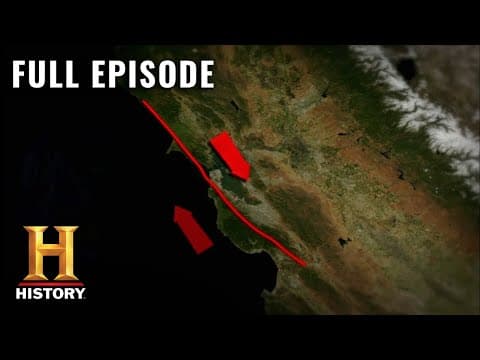
[0:02]Earth, a 4.5 billion-year-old planet, still evolving. As continents shift and clash, volcanoes erupt and glaciers grow and recede. The Earth's crust is carved in numerous and fascinating ways, leaving a trail of geological mysteries behind. In this episode, an investigation into California's San Andreas Fault, the greatest fault line on Earth. 800 miles long, this ugly scar on the landscape has spawned earthquake after earthquake. But for now, it waits quietly, deep under our cities, building up stress to strike once again. The San Andreas Fault is one of the most dangerous geological features on Earth. California's greatest cities and millions of her citizens live in constant peril.
[1:23]Since records began, there have been 13 large earthquakes along the San Andreas Fault. And now America's geologists, her rock detectives, are warning of a potential disaster.
[1:47]In the fall of 2008, more than 300 scientists calculated what a major earthquake would do to Southern California.
[1:58]We've been conducting a special study of a magnitude 7.8 earthquake on the Southern San Andreas fault, large enough to potentially damage tall buildings. Fires will be very significant. The definitive scientific report presented to politicians was code-named shake-out. It forecast thousands of deaths and billions of dollars of damage in the city of Los Angeles, which makes it crucial to investigate the most important question: When will the next big earthquake hit the San Andreas Fault?
[2:37]The latest preparations for disaster are the climax of an investigation that started more than 100 years ago. In the aftermath of the Great San Francisco Earthquake of 1906, the earthquake struck on a Wednesday, just before dawn. The ground shook violently for 45 seconds, igniting fires that raged unchecked for the next four days.
[3:13]28,000 buildings, a tenth of the entire city, were destroyed, and more than 3,000 people, one in every hundred of the population, were killed. With a magnitude of 7.8, it's in the top 20 of North America's strongest ever earthquakes. The scale of the Great San Francisco earthquake shocked the nation, but no one understood what had made the city shake.
[3:47]Native American myths explained earthquakes as shocks from a battle between warring spirits. Later-day explorers couldn't understand the shocks that destroyed their mission buildings. One Spanish missionary wrote: "The Earth shook around me from explosions under the ground." 300 years later and science has still made little progress. Refugees in the ruins of San Francisco still blamed earthquakes on mysterious underground explosions.
[4:26]So just three days after the earthquake, the state of California asked one of the world's most famous geologists, Andrew Lawson from California State University, to investigate what had destroyed the city. He and a team of 25 scientists began collecting damage evidence in the city and surrounding countryside. There were roads that had buckled, rail tracks that had twisted. The most startling evidence of all, that came near the town of Bolinas in Marin County, to the north of San Francisco. This picket fence had an eight-foot gap in the middle. Before the earthquake, it was a solid boundary fence, dividing two fields. But when he recreated what had happened, Lawson realized that the land had jolted apart and torn the fence in two.
[5:26]Plotting the evidence on a map around San Francisco revealed a surprising pattern. Because connecting the dots drew a straight line, and at every point, the Earth moved in the same way, on the coast to the north, inland to the south. This line of weakness was the culprit they were searching for. South of San Francisco, the suspect line ran underneath a lake, the Laguna de San Andreas. So now, the earthquake perpetrator at last had a name. Professor Lawson, who a decade earlier had identified cracks in the earth here as a harmless rift, now rechristened it the San Andreas Fault.
[6:18]In modern-day San Francisco, the buildings, the roads, and the railways have long since been repaired. But if you know where to look, evidence of the 1906 quake can still be found.
[6:33]Geologist Charlie Paul follows in the footsteps of Lawson's team, seeking signs of the havoc from 1906. He finds it on the cliffs at Mussel Rock, 12 miles south of San Francisco. The cliff is not here by accident. There's a very good reason why this cliff is here. A half a mile or so of the shore face apparently fell off in the 1906 earthquake. And if you look down below us, there's a big rotated block that's near the present-day shoreline. And it is just in board of the San Andreas Fault. The San Andreas Fault is a about a quarter of a mile offshore here. And of course, that's one of the major crustal junctions on this side of North America.
[7:21]Modern computers can now trace how damage waves spread out across the city, and that pinpoints where the quake originated along the San Andreas. It was offshore, about two miles out to sea from the Golden Gate Bridge. So to continue tracking the fault, the investigation must head out to sea. Marine geologists use remote operating vehicles, mini-submarines, to map the sea floor. What you'd see is subtle variations in the topography or topography that would not naturally line up. So there might be a line on the ocean floor that is higher or lower on one side. And you can use various techniques to determine that this actually is a fault instead of some other process. Running south across the seabed, the San Andreas finally runs out of ocean and hits the land. This broken line of rocks, stretching in from the sea, marks where the San Andreas hits land, 12 miles south of San Francisco. We're here at Muscle Rock, and we're essentially standing on the San Andreas Fault right now. And if there was an earthquake, I don't know what would happen right here, but I wouldn't want to be here.
[8:47]This Pacific coastline, where cliff crumbles slowly into the sea, is the boundary between two of the Earth's massive continental plates.
[8:59]Separated by the San Andreas Fault, two vast separate blocks of the Earth's crust lie directly alongside each other.
[9:10]Here the continent of North America lies slightly on top of the adjacent section of crust, which holds the Pacific Ocean.
[9:24]The joint can be seen where these lower darker rocks are overlaid by light-colored sedimentary rocks. These rock types differ by by uh more than 100 million years in age, two rock bodies that uh are not similar in any way, have been brought together. The fault line was exposed to geologists when the cliffs collapsed here in the 1906 earthquake. But back then, nobody understood how and why the two different types of rock were next to each other. Until around 40 years ago, when the answer was finally revealed by the theory of plate tectonics.
[10:10]The theory showed that the Earth's crust consists of separate moving plates on which the oceans and continents sit. Around 200 million years ago, the heavy Pacific Ocean plate collided with North America and started sinking underneath the lighter continent. Professor of Geophysics Mark Zoback studies that process called subduction in his laboratory at Stanford University. For many millions of years, prior to the existence of the San Andreas Fault, the Pacific Plate was subducting beneath North America. The oceanic plate was diving down. And uh, that process went on for well, well over 100 million years. So a tremendous amount of activity was occurring. As the unstoppable force of one plate met the immovable object of the other, they were forced to change direction. About 20 million years ago, the plate motions were such that the Pacific Plate had to start sliding north with respect to North America. And now, you know, the the principal motion is this sliding process between the two plates. And 20 million years ago, the San Andreas Fault was born. It was the moving plates that crushed different types of rock together, just as here at Mussel Rock.
[11:38]At last, the investigation knows what it is dealing with. The San Andreas Fault is 800 miles long, emerging from the sea bed north of Point Arena in Northern California, and running down to the Salton Sea in the south. The evidence is coming together. Clues from the 1906 earthquake, such as the picket fence that was torn apart, prove that the land was moving. Connecting the dots identifies the straight line of the San Andreas Fault. And Mussel Rock uncovers different plates of the Earth's crust on either side of the fault line. But investigators still need more information about how often the San Andreas has spawned earthquakes in the past. It might help them answer the all-important question: When will the San Andreas strike again?
[12:49]To discover when the San Andreas Fault will strike again, the investigation needs to know about ancient earthquakes that have struck along the fault line.
[13:02]But there's an immediate problem. So here in California, it's a particular challenge and some of the earliest written records were from the missions and from the early explorers. So only dating back into the 18th century here. Other parts of the world, we have an earthquake history going back millennia. The investigation moves 350 miles south of San Francisco to a desert where the San Andreas may have been active for thousands of years.
[13:32]There's crucial evidence here about earthquakes from ancient times. This creek used to flow straight across the San Andreas Fault here. But several earthquakes formed a natural dam where the San Andreas Fault wedges up here in front of me. That created a small pond, and now we're looking at the dry sediments of that pond that record the history of earthquakes. And that tells us quite a great deal about the past behavior of the San Andreas Fault. Some of the clues are so small that Hudnut's detective work gets him down and dusty among tiny cracks inside the fault. Sometimes we can find out about the past behavior of the San Andreas Fault by looking at the tiniest details. At the bottom of this small ancient pond, mud sediments collected above a fine line of pebbles. Then an earthquake shifted the land upwards on one side of the vertical fault line. So this layer was originally flat, and then in a subsequent earthquake, it was broken like this along this tiny fracture strand of the San Andreas Fault. But finding proof that this is the site of an ancient earthquake is only part of the story. Hudnut needs to know how long ago it happened. The bare rock layers are no help in dating his find, but just above the fracture line of the rocks, he has found the evidence he needs. Here a bush was burned by a prehistoric wildfire, and that remnant of carbon is why you see this black stain on the side of the trench wall. The key to unlocking the age of the rocks is carbon-14, known as radiocarbon. Its molecular structure means that carbon-14 is a more unstable isotope than other forms of carbon. It's absorbed by growing plants, then radioactively decays at a known rate after the plant dies. So measuring carbon-14 in vegetation burned in a wildfire reveals how long ago those plants died, and dates the rock in which the carbon is found. And through this, we can reconstruct the evidence of the past earthquakes. Radiocarbon dating has proved that earthquakes have been happening along the line of the San Andreas for thousands of years. The particular small earthquake investigated by Hudnut, for example, is around 3,500 years old. It happened at a time when the last woolly mammoths were dying out in North America. The investigation moves to an even more remote desert spot, the Carrizo Plain, 160 miles north of Los Angeles. Here lies a dried-up riverbed, which takes an unusual course. Coming down off the hills, the creek bed takes a sudden, sharp turn to its right. A few hundred feet later, it makes an equally odd 90-degree turn to the left. The creek crossed the line of the San Andreas, but early geologists were mystified. Why did it bend in this way?
[17:00]The scientific pioneers were limited to studies on the ground. Nowadays, Hudnut has an advantage. He can take to the air.
[17:15]The San Andreas Fault where it cuts through the Carrizo Plain, it almost looks like a scar and it was caused by repeated earthquakes in the past. Along the long line of hills marking the course of the San Andreas, Hudnut spots the puzzling bends that he's seeking.
[17:33]Oh, if we could swoop along the fault through here, that would be awesome. Oh, there's a great angle. See that right angle offset channel with the elbow in it right there? That's a classic one right there.
[17:47]Hudnut's aerial view of the creek bed shows that the river once flowed straight on across the fault. But little by little, a series of earthquakes along the San Andreas dragged the creek away from its original course. Recreating how the land had moved showed Hudnut that the two parts of the creek had traveled more than 300 feet apart.
[18:15]So if you imagine the North American Plate is fixed and the Pacific Plate is moving to the northwest, the Wallace Creek site records that offset.
[18:28]Because the channel was straight across the fault, but it's been offset through time. Earlier investigators had already radiocarbon dated the land on each side of the fault here, revealing that it took 3,000 years to change the creek's position.
[18:43]So knowing the distance and the time it took to do it, lets Hudnut calculate the average speed with which the two landmasses are moving past each other. 300 feet in 3,000 years, one foot per decade. Just over an inch a year. But this was never a steady, sliding one inch a year movement. The reality was a series of sudden small jumps, whenever tension built up enough between the two moving plates to overcome friction between the rocks and rip the land apart with an earthquake. It's an important moment for the investigation. Knowing how fast the land is moving, not only reveals the stress that's building up, but also the risk of an earthquake.
[19:45]The San Andreas Fault is giving up its secrets. Clues from a long dried-up pond revealed the site of ancient earthquakes. Carbon from a prehistoric fire provides the dates. And bends in a riverbed prove how fast the land is moving.
[20:06]But now the investigation has a new mystery to solve: If the land along the San Andreas is moving one inch every year, causing earthquakes, then why has one small town along the fault line never had any?
[21:25]There are plenty of clues suggesting that the land must be moving here.
[21:45]Walking through Hollister, we can see anything that man has built, that was laid out in a straight line, may have a jog in it. Every year it changes a little bit and it's a progressive thing.
[21:59]The clues add up to one clear conclusion: Even without any earthquakes, the Earth in this town, in the heart of the San Andreas system, still slides imperceptibly slowly and effortlessly along. In one sense, the damage that you see here associated with the creeping is clearly sort of under control. But as a geologist, if you start playing that out for tens of thousands or hundreds of thousands or millions of years, the consequences of that become enormous. For many years, the creeping ground that moved without earthquakes remained an unsolved mystery. But then, the investigation moved 100 miles south to another small community, where the land also creeps along.
[22:50]The village of Parkfield has a population of just 37 people and a bridge which spans right across the San Andreas Fault. The bridge separates the Pacific Plate on one side from the North American Plate on the other. And the bridge railings have started to bend. I'm uh right now I'm on the Pacific Plate, on the west side of the San Andreas Fault. And, you know, the the San Andreas comes off the flank of that hill, and right across that field, right under the bridge, and then right over by the corner of that building or that fence post, and then on off to Middle Mountain.
[23:37]The movement here around the bridge is strikingly similar to the slow creeping ground of Hollister. But there is one important difference here in Parkfield: Every couple of decades or so, this village does have earthquakes. They're just little tremors, but they're big enough to be recorded on earthquake monitoring seismographs. That's why the village proudly boasts of being "the Earthquake Capital of the World." But it's perhaps more accurately called the Earthquake Study Capital because scientists are fascinated by the fact that earthquakes here follow a predictable pattern: on average, every couple of decades or so.
[24:59]After the '66 earthquake, investigators set up a network of monitoring instruments to see if the fault gave any warning before the next earthquake arrived.
[25:13]They expected it sometime between 1988 and 1993, but it was late. And months of waiting stretched into years.
[25:26]But still, the scientists waited. Until finally, in December 2004, the long-awaited earthquake arrived, and was caught on film. From a now slightly worn and damaged camera.
[25:48]The earthquake movie may not have seemed that impressive, but the instruments collected a mass of information. The data didn't, after all, help with earthquake prediction, but it did pinpoint where the earthquake started underground, which told investigators where to look next. Deep down, under the Parkfield countryside, after three years of drilling, long cores of rock were extracted from the exact spot where the earthquake occurred.
[26:35]This was the first time that team leader geologist Mark Zoback had ever seen rocks from the center of the San Andreas.
[26:45]What we're looking at here are cores from the active San Andreas Fault from a depth of about two miles. So for the Earth science community, uh, these are like moon rocks. As we were trying to exume these cores, we had a great deal of drilling difficulty. The San Andreas Fault was literally fighting back. After nine weeks of attempting to recover the cores in the middle of a huge lightning storm, almost a scene directly out of Hollywood, with the thunder and lightning, these cores came to the surface. And so it was a tremendous feeling of satisfaction. Um, the lightning and thunder just made it that much more dramatic. And we're all wearing gloves. We didn't want any oil from our fingers to affect the core. And the rule was that you touch the core as little as possible. Obviously. I'm not going to wait for you guys. Oh, look at this beautiful rock. The reality was, we couldn't help ourselves and, uh, um, it was just such a remarkable thing to be actually looking at the San Andreas Fault, uh, for the very first time. That we all got to touch it a little bit. Buried within the rock cores, they found a vital clue about the way that land slips along the San Andreas. They found serpentinite. Serpentinite is an unusual rock type. It was originally formed at the base of the ocean crust and exhumed up onto the continent, but the reason that serpentinite is so interesting is that serpentinite is very easily altered to talc, that allows the rock to slide at very low force levels. It's talcum powder. It is very slippery. Talc's crystalline structure of soft sliding flat plates makes it one of the slipperiest rocks known to science. So talc could well be a key mineral in in deciding how the fault is actually working in in Central California. We see that the secret of the slipping San Andreas Fault is actually the rocks themselves. The talc explains the tiny earthquakes of Parkfield. Nobody's yet drilled to investigate the rocks at Hollister, but scientists suspect the talc is present there, too.
[39:50]So if you are in an old building, for example, uh you will shake one way, you will accumulate some damage, and uh very soon after that you will get very strong ground shaking because of other types of waves coming also.
[40:25]The high-speed ruptures that Rosakis calls supershear happen where faults run in a straight line. Which might help explain the 100-year-old mystery surrounding the Great San Francisco earthquake, the natural disaster which launched the entire San Andreas investigation. The overwhelming damage in San Francisco has long seemed surprisingly out of proportion to the 7.8 magnitude of the quake. And there's a particularly straight section of the San Andreas approaching San Francisco. So many scientists now believe that the damage was greater than expected because the 1906 quake had traveled at supershear speed. And of greater concern to modern emergency services is not what happened a century ago, but what could happen tomorrow. Because there is a similar straight section of faulted ground heading straight towards Los Angeles. And if a supershear earthquake develops on that line, then the consequences could be disastrous. All of the investigations warnings about the San Andreas came together in the fall of 2008 with the biggest earthquake drill ever held in California. If this earthquake would have happened in reality, there's, uh there would have been buildings coming down. We know that there would be no water in certain areas.
[42:04]That's what this exercise is all about. But what are the real chances of Los Angeles soon being hit by a massive earthquake?
[42:36]It really isn't even a question of if anymore.
[42:43]The shaking is going to be severe for two to three minutes. You're going to have fires breaking out.
[43:14]You're going to have conflagrations developing. Tens of blocks will be on fire.
[43:23]That's the kind of nightmare scenario that we're looking at.
[43:30]This spectrum of disaster to California's people and cities motivates the search to unravel the secrets of the San Andreas Fault.
[44:33]When will the sleeping San Andreas come to life once again? It could be anytime. The only certainty is that nothing is certain in the ever-evolving story of how the Earth was made.


