[0:00]Hello everyone. I'm so glad you could be here today to talk about social security disability insurance or SSDI and employment. So if you're receiving SSDI, you might have questions about what happens to your benefits if you decide to work. That's completely understandable. Today we're here to show you that working while on SSDI is not only possible, it's supported. Programs like Ticket to Work and SSDI work incentives are designed to help you explore employment with confidence. Many people worry about losing their cash benefits or Medicare coverage if they start working. But this is often a misconception. Social security offers safety nets that allow you to test your ability to work without losing your benefits prematurely. So whether you want to work part-time or are ready to take on full-time employment, there are supports in place to help you navigate that transition. All right. So what we'll discuss today? Our goal today is to help you feel confident and informed. We hope to clear up some of the confusion about going to work while on SSDI. We will begin with an overview of the SSDI program, dispel some common myths about SSDI and employment, learn about the work incentives available to help you transition to work successfully, and we'll explain how you can work and keep that health care coverage. So you may not believe this, but social security encourages you to work and treats work favorably. With that in mind, you don't have to navigate this journey alone. There are work incentive planning services available through DOR and community work incentive planning and assistance or WIPA programs that are available through the ticket to work program. And they'll guide and support you every step of the way. Finally, we'll share some other resources and tools that are available to help you manage your benefits while working. All right, so let's talk about social security's definition of disability. To qualify for disability benefits, you must meet social security's definition of disability. This means you have to have a serious medical condition that prevents you from working and earning above a certain amount, which is known as substantial gainful activity or SGA. These benefits are intended to support individuals who face significant challenges due to their medical conditions. So to get SSDI or other disability benefits, the beneficiary must meet the Social Security Administration's Disability Standard, which again, the inability to engage in any substantial gainful work activity or SGA because of a medically-determinable physical or mental impairment that is expected to either result in death or that has lasted or is expected to last for a continuous period of not less than 12 months. So once you're approved for SSDI and have received benefits for 12 months, you become eligible for the protections of the Ticket to Work program and SSDI work incentives. So, understanding SSI and SSDI, and why that matters. So it's very important to know which benefits you receive to ensure that you're using the right work incentives and following the specific rules for your program. So Social Security has two main disability benefit programs for individuals with disabilities: SSI, Supplemental Security Income, and SSDI, the Social Security Disability Insurance. SSI is a needs-based public assistance program funded by taxes, offering cash assistance to aged, blind, or disabled individuals with limited income and resources, which is $2,000 for individuals and $3,000 for couples.
[4:13]The payments can vary month to month based on other income and living arrangements, and recipients automatically qualify for Medical. On the other hand, SSDI or Title 2 is an insurance program for those who have paid social security taxes through work, which are known as FICA taxes. So the amount of SSDI a person receives is based on the worker's past earnings, with Medicare available after a 24-month qualifying period. And because SSDI is an insurance program, there is no resource limit, and it is possible that someone also receives a little bit of both. So the key point to remember is that SSI and SSDI are separate programs with very different rules for work and earnings. So it's important to know which one you receive to take advantage of right supports.
[5:09]Today, we're focusing on the SSDI program. So now that we've covered the key differences between SSI and SSDI, we're going to take a closer look at those SSDI benefits. There are three main SSDI or Title 2 programs. There's Social Security Disability Insurance, SSDI, which is for people with disabilities based on their own work history. There's Childhood Disability Insurance benefits or CDB, which support dependent adult children with disabilities who are aged 18 or older and whose disability began before the age of 22. Eligibility is based on a parent's work record, meaning that benefits may be available if a parent is receiving SSDI, retirement benefits or is deceased.
[6:02]And thirdly, Disabled Widow/ers Benefits or DWB, which helps people with disabilities aged 50 to 60 who were married to someone who qualified for SSDI or retirement benefits. So unlike SSI, Title 2 or SSDI benefits are only impacted by income from work, not by resources or other types of income.
[6:35]Additionally, work incentives are available to support your transition to employment.
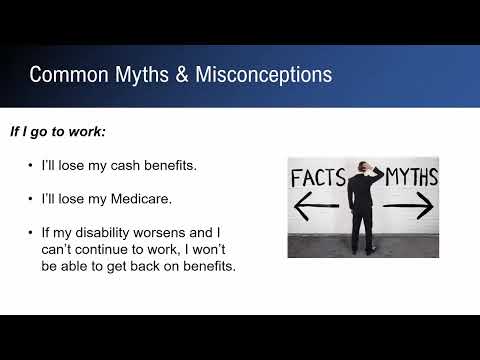
[6:42]And it's important to note that if you participate in the Ticket to Work program and make progress toward your employment goals, social security will not conduct a medical continuing disability review, called a medical CDR. So why choose to give work a try? There is a lot of confusion about SSDI and work. Giving work a try is not something everyone can do, only you can decide if work is right for you. If you're ready to give it a try, there are many free services and supports available to help you transition to work without losing your benefits right away. By choosing to work, you can earn more money and work towards financial independence. You can meet new people and build confidence while learning a new skill that can open doors to greater long-term success. And the great news is, if you're receiving SSDI, you can explore work for up to nine months risk-free. Many people with disabilities discover that the rewards of working, such as greater financial stability and personal development, far exceed the risk of losing benefits. So let's dive into the details of what you need to know. All right, now that we've gone over the key differences between the two main disability programs, let's address some of the common myths and misinformation that often hold people back from considering work and then break down the SSDI work incentives that protect your benefits. The three most common concerns we hear are, if I go to work, I'll lose my SSDI benefits. If I go to work, I'll lose my Medicare. And if I go to work and need to stop working later due to my disability, I won't be able to get back on benefits. The good news, these are all myths. Literally says it right there, common myths. Social security has built-in protections to help you explore work opportunities at your own pace without risking your benefits. So let's dive into the facts and take a closer look on how these programs work. All right, common myth number one. If I go to work, I'll lose my SSDI benefits! So maybe you have similar concerns. Social security has rules that help you stay connected to SSDI when you're working, making work risk-free. SSDI work incentives give you the freedom to try working without losing your benefits suddenly, offering stability and support while you explore working. Now, let's turn it over to Tish, who will break things down for us.
[9:31]Thanks so much, Tina. Thanks for kicking us off with a great start. So while social security encourages beneficiaries to attempt returning to work if they can, it's helpful to stay informed about the program's rules. Unlike the SSI program, SSDI work incentives uses three specific stages to determine whether a beneficiary is eligible for their cash benefit each month. And what I mean by stages is that you must complete one more incentive stage before moving on to the next. So these stages ensure that both your cash benefit and health care remain available if you need them. The primary work incentives for SSDI recipients are the trial work period or TWP, the extended period of eligibility or EPE, cessation and grace period, and lastly, the expedited reinstatement or EXR. Let's dive into the details and break things down a little further. So before we go on, I want to talk about two key earnings thresholds. They're important to understand. The trial work period and substantial gainful activity. Understanding these will help you make informed decisions moving forward. The trial work period is an important work incentive. It allows you to test your ability to work for nine months within a 60-month period. These months don't have to be consecutive, meaning they can be spread out over 60 months or five years. During the trial work period, you get to keep both your take home pay and your full SSDI cash benefit. No matter how much you earn. Even if Bill Gates were on SSDI, he would still keep his SSDI benefit during the nine trial work period months. There is absolutely no risk of losing your benefits during this period due to your earnings from work. Each month your gross earnings exceed the trial work period threshold, which is $1,160 in 2025, it will count as one of your nine trial work period months. For self-employed individuals, a trial work period month is used if your net earnings exceed the threshold, or if you work 80 hours in a month.
[11:55]So just for a quick example, let's just say that you worked for five months and you earned $2,000 per month. And things didn't work out and you had to stop working. The good news is, you're keeping that extra $2,000 a month and you still have four trial work period months remaining when you have an opportunity to return to work. After you complete the ninth trial work period month, the other threshold you should know about is substantial gainful activity or SGA. SGA is the amount of income social security considers to determine if work affects your SSDI benefits. In 2025, the SGA limit is $1,620 for people with disabilities and $2,700 per month for individuals who are blind. SGA is a monthly amount of countable earnings that someone on SSDI needs to reach to stop disability cash benefits. These amounts are adjusted every year to help keep up with the cost of living. So we have trial work period, $1,160 per month in gross earnings, and substantial gainful activity, $1,620 per month in countable income. When you start working, there are three key work incentive stages designed to support your transition. First is the trial work period, TWP. To recap, during the trial work period, you can try work risk-free. You keep your SSDI and earnings from work at the same time, no matter how much you earn. And to use a trial work period month, your earnings must be over that trial work period threshold of $1,160 per month. If earnings remain below the trial work period threshold, it will have absolutely no effect on your benefits, and you can continue working at that level indefinitely and keep your benefits.
[14:01]The decision is entirely up to you. After completing the ninth trial work period, you enter the extended period of eligibility or EPE. This is a 36-month safety net where social security evaluates your earnings against the SGA level. Remember, that's $1,620 a month, or $2,700 a month for blind individuals. So during the EPE, your SSDI payments will continue for any month that your countable earnings remain below the SGA level.
[14:38]If countable earnings are above the SGA level, the SSDI payment stops for that month. But the good thing here is that the benefits can restart quickly during the EPE if the earnings drop below SGA. The first month your earnings are above the SGA threshold, social security provides a three-month grace period. The first month over SGA is considered the cessation month, so your benefits will cease. Followed by two grace months. During this three-month grace period, you continue to receive your SSDI payment as usual. And at the end of the 36-month EPE, your SSDI benefits continue only if your earnings remain below SGA. If the earnings exceed SGA, following the 36 months of the EPE, SSDI benefits will stop. Now, it is important to understand that for SSDI to stop due to work, four conditions must be met. You must complete the trial work period, you must finish the 36 months of the EPE. You must have used your cessation and grace period, and your earnings must continue to be above SGA. Some more good news. Even after your SSDI stops, there's a third stage or provision called expedited reinstatement. Okay, this is a valuable safety net to help you return to benefits if you have to stop working because of your disability. For the first five years after you stop getting benefits, if your countable income drops below the SGA level, because of your disability, you had to stop working, you can quickly get back on SSDI benefits without having to reapply. Now, I know that this is a lot of details. So let me recap things briefly. The trial work period allows risk-free work while keeping full SSDI benefits. Followed by the EPE where your benefits continue unless your earnings exceed SGA. And if SSDI ends, you have access to EXR, which provides a quick return to benefits if you have to stop working due to your disability, within five years. These stages or this process allows a gradual transition into work with peace of mind, knowing that there is over eight years of protection. If the job works out great, right, you're going to be better off financially. And if it doesn't, and you're not able to continue working, you still have your SSDI benefits and will be right where you started. Now, beyond the trial work period and EPE, there are additional safeguards to ensure you have the support that you need. Once you've completed that nine-month trial work period, there are some other tools designed to help you succeed. These work incentives can make a big difference in how social security counts your earnings, helping to maximize your benefits, or help you stay on benefits. A work incentive planner or a WIPA can help you see which work incentives are best for you or that you can utilize. Now, first we have impairment-related work expenses. It allows social security to subtract certain disability-related expenses when they count your income. These expenses must be related to your disability, needed for you to work, and are paid for by you. Examples of IRWEs include prescription medications, service animal expenses, medical supplies, assistive technology, therapies, maybe special transportation, and more. Moving on to subsidies and special conditions. A subsidy is extra support from your employer to help you on the job. While a special condition is help from someone outside of your job, like a job coach provided by the DOR. Social security will determine the value of this support and subtract that from your gross earnings to determine countable income. Really reflecting the value of the actual work that you do based on receiving that extra help. Then we have income averaging, another tool used by social security to support you. Averaging is used to figure out countable earnings when someone's income fluctuates above and below the SGA level month to month. By averaging the earnings over the months that you've worked, it often works out in your favor, bringing that countable income to below the SGA level. And finally, we have an unsuccessful work attempt. This is a great tool if you started working and you were unable to continue working at an SGA level within six months. Due to your impairment, right, or a loss of a special condition. So social security won't count the unsuccessful work attempt months as SGA months. Now that you're familiar with SSDI terms and rules, and acronyms, let's take a look at a few examples. All right, first we have Mika. Now, Mika is 25 years old. She receives $1,000 every month in childhood disability benefits. She really wants to give work a try. She participates in a paid work experience through the Department of Rehabilitation, and she's earning $700 per month. With her SSDI, she receives Medicare and she has private insurance through her parent's insurance program. What will happen to Mika's SSDI CDB benefit? So based on what you've learned today, what do you think's going to happen to Mika's SSDI benefit if she's earning $700 a month in a paid work experience? Good news for Mika and her family. Since her gross earnings of $700 per month are below the trial work period threshold of $1,160, there's absolutely no impact on her CDB benefit. She keeps her SSDI cash benefits and her earnings from work. She can continue to work at this level indefinitely as long as she continues to have a disability. All right, moving on to scenario number two. So Sam, Sam is 40 years old. He receives $1,200 a month in SSDI. And he keeps, he has Medicare that's connected to his SSDI benefit and he's working part-time earning $1,800 a month, $1,200 a month. What will happen to Sam's SSDI benefits? All right. So, this is an SSDI tracking chart that we can use to track Sam's current and projected use of his SSDI work incentives. He started working in January 2025, earning $1,800 a month. As this is his first time working since receiving SSDI benefit, he will have access to his trial work period. His earnings of $1,800 a month is higher than the trial work period threshold, so he will begin to use his trial work periods. His first trial work period will be January 2025. Will Sam get his SSDI check this month? Yes, absolutely, it's the trial work period. Remember, during the trial work period, he receives his SSDI payment, no matter how high his earnings may be. If he continues to earn $1,800 a month moving forward, he will continue to use his trial work period months until he completes all nine months. And during this time, right, he's keeping his SSDI cash benefit of $1,200 and his $1,800 from work for a total income of $3,000 per month during the trial work period.
[23:38]That is a lot more than what he was getting on SSDI alone.
[23:46]So once Sam completes his ninth trial work period month, he will enter his 36-month extended period of eligibility or EPE. Starting immediately. If Sam's ninth trial work period month is September 2025, his EPE will begin October 2025, and run consecutively until September of 2028, regardless of whether he's working or not.
[24:16]During the EPE, Sam can stay connected to his SSDI benefit. Starting with the EPE, social security will now use SGA level to determine if Sam can receive his SSDI cash benefit. So based on Sam's earnings of $1,800, he's earning over SGA, and he will use his cessation and grace period in October, November, and December. Remember, during the grace period, he keeps his SSDI payment. Now, anytime after this, if he earns above SGA, he will not receive his SSDI cash benefit for those months. So in this example, beginning in January 2026, Sam's SSDI benefit is put on hold. And social security will look at his earnings for February to determine whether he's eligible for a payment, or if that benefit will be continue to be on hold. Sam is still on SSDI through the entire EPE, he's just not getting a SSDI check any month his earnings are over that SGA threshold. So I like to think of the EPE as a three-year safety net. All right, so moving on to myth number two, and this is probably really the biggest fear we hear from most participants. If I go to work, I'm going to lose my Medicare, right? I have, I have medical expenses that I need to keep up with and it's really important that I keep my health care. So this is really a bigger concern than losing cash benefit. It's important to know that there's a work incentive for that too. And there are options for continued health care coverage long-term for people with disabilities who work. The extended period of Medicare coverage, EPMC, protects Medicare for at least 93 months after the trial work period ends.
[26:28]Even if your SSDI benefit stops due to work, that's also for seven and a half years of protection. Beyond the 93 months, social security offers continued Medicare coverage for a monthly premium. Through the Medicare for people with disabilities who work program. More good news, SSDI beneficiaries can actually take advantage of the Medical working disabled program. This is one of the best kept secrets out there and we're here to make sure you know about it. Under this program, Medical pays your monthly Medicare premiums and some out of pocket expenses. This special program offers free Medical for people with disabilities who work. You can work and earn up to $76,320 in California and still qualify for Medical. And even more good news, there is no resource limit. So this may be a very good option to help you cover those Medicare premiums and you can apply through your county department of social services. That's called the Medical working disabled program. If you sign up, you'll be receiving both Medicare and Medical. Medicare will continue to be your primary insurance and Medical will be your secondary insurance. So, as you can see, there are several work incentives that help you maintain long-term health care coverage. And work incentive planners can help guide you through those available options and help you get started on the right path. All right, now let's discuss myth number three. And we've, we've touched on this one. Um, what if I go to work and have to stop work working because of my disability, I won't be able to get back on benefits. This is a common misconception. We hear it a lot. And many people fear that they'll lose their benefits permanently if they go to work. But here's the reality, social security has a built-in safety net called expedited reinstatement. Expedited reinstatement allows you to quickly restart your benefits if your disability prevents you from working again after your benefits have ended due to earnings and work. With expedited reinstatement, you won't have to submit a new application or go through a long approval process. Instead, you can request expedited reinstatement within five years of your benefits ending, and social security will give you provisional benefits while they review your case. So rather than worrying about losing benefits permanently, EXR, or expedited reinstatement, gives you the flexibility to try working, knowing that if your disability makes it too difficult to continue, there is a quick way back onto benefits if necessary. Thank you for sticking with us. I know we've covered a lot of detailed, complex information, including some new social security acronyms for you to learn. But before we share some helpful resources, I just want to quickly recap a few key points. First, it is possible to work while receiving SSDI benefits, especially when you understand the rules. The trial work period allows you to explore employment for nine months without risking your SSDI benefits. After that, the extended period of eligibility provides ongoing support, ensuring that if your earnings are over SGA, your benefits pause rather than permanently terminate. And then, if your benefits have ended, expedited reinstatement, or EXR, lets you quickly restart benefits within five years if your disability prevents you from continuing to work.
[30:08]Additionally, you can keep your Medicare coverage for a minimum of 93 months, over seven and a half years, while working. Giving you stability and peace of mind to focus on those career goals. These work incentives are designed to reduce barriers, offering flexibility and support to help you transition to employment at your own pace. They are meant to empower you to explore new opportunities if you are able, knowing that support is available every step of the way. All right, now let me turn things back over to Tina, and she's going to share some information about wage reporting and helpful resources. Okay, I'm back, folks. Let's talk about wage reporting. So now that Tish has told us all about how these work incentives can support your employment goals, an important rule to keep in mind is to regularly report your wage and work earnings to social security. So this allows them to accurately track your earnings so that they can determine the use of the trial work period and the extended period of eligibility and will help you to avoid any potential issues with your benefits. So it is essential to report when you start or stop work, changes to your work hours or income, and you are required to report your wages every month. A couple of questions had come through the Q&A about this. So perfect timing because these are the answers that you were wanting, folks. So there are a lot of options to report your earnings, and you can pick a way that works best for you. You can take your pay stubs and report in person to your local social security office. You can call, you can fax, you can mail in your wages. We recommend that you actually set up an online my social security account, which is a great way to manage your benefits and report your wages online. So it's a good idea to go ahead and check with social security with your local office to see, you know, what option is going to work best for you. To avoid overpayments, or any issues with your benefits, wages should be reported between the 1st and the 10th of every month. So for example, all those big bucks that you're going to earn in January, those need to be reported by February. All right, so it's important to know that you don't have to figure all this out alone. So if you are a DOR participant, we have work incentive planners or WIPS that are available in all California DOR offices to help guide you. If you are not receiving DOR services, the Ticket to Work program also provides access to work incentive planning and assistance programs or WIPA. So both provide free and accurate benefits planning to help bridge that gap between the social security benefits and that successful employment.
[33:34]I know I did get a question there in the Q&A earlier about how do I know how many trial work periods I've used. Um, and I went ahead and answered that by saying you could go ahead and, uh, obtain that benefits planning query that BPQY and that will, uh, break down your benefit situation so you know exactly where you're at. So you can go ahead and, uh, call your local social security office or the SSA call center at 1-800-772-1213 to request a free copy of that BPQY. Um, and just let them know that you're going to be receiving benefits planning through the ticket to work program. So, before we take your questions, uh, we'd like to share a few resources. Uh, there are some great resources to help you learn more about managing your SSDI benefits while you work. And we're going to start with social security, right, the website ssa.gov. I've, I've sent a few of you the link for the red book there is a section on Urwis. We had some question coming in about those impairment related work expenses, you can check out that red book, um, www.ssa.gov/redbook. The phone number, the 1-800 number, uh, 772-1213. You've got the Ticket to Work, you can go on choosework.ssa.gov. You can give them a call 1-866-968-7842. Um, there you can access the uh, work incentive planning and assistance program, the WIPA. Um, there's fact sheets, webinars, job boards and so much more, so go ahead and check that out if you'd like. Um, and then you can always contact the helpline as well. Um, the website is there or the, uh, yes, website that TTWinfo@dor.ca.gov and the phone number 1-866-449-2730. And you can check out our social security programs and disability benefit planning service web page.
[35:52]But that's not it, let's keep going. The World Institute on Disability has a fantastic website to help you learn more. And you can find that online at ca.db101.org. On their SSDI and work page, you can learn more about work incentives, explore Medicare and Medicare savings programs. And this website offers an easy to use estimator that lets you explore different scenarios to forecast how your income might impact your SSDI benefits. It's very user friendly, easy to navigate and a really great tool to help you plan ahead. And then lastly, I just want to mention Cal Able Accounts, which is California's Achieving a Better Life Experience program. Uh, these accounts are designed for individuals diagnosed with a disability before the age of 26, helping them to save and invest for their future. It's definitely something worth exploring if it aligns with your goals. Thank you so much, uh, for joining us today, and for your time and attention. Uh, so this concludes our program, and we hope you found the information helpful. So let's open it up for your questions. discuss a question that came in through the ticket to work helpline, okay, And that question is, please explain how SSDI recipients monthly check is affected if the individual wins a lump sum, like a lawsuit, or receives an inheritance from a living will or trust. All right, so the good news is for SSDI recipients that unearned income from lump sum winnings or inheritance do not impact the monthly SSDI payment, okay, So keep in mind, SSDI is based on work history, and it is not a needs-based program. All right, so for SSDI only social security looks at earned income from work activity when determining that continued eligibility. What are SSA's three tests for self-employed SSDI beneficiaries? All right, that's a really good question. So, generally, these tests are used when you initially apply for SSDI, right, before you receive date SSDI, or within the first two years of receiving SSDI, okay, So they really kind of help social security decide if your self-employment work counts towards substantial gainful activity. There are three rules. If you meet one of the three rules, social security will determine that your earnings are at or above SGA. Okay, but keep in mind, once you've been on SSDI benefits for 24 months, that three test rule doesn't necessarily apply. Okay, then they're going to be looking at your net earnings. So the first one is significant services and substantial income. That's really going to look at if you're actively working a lot in the business, and you're earning more than the SGA level. So they're going to be looking at the hours you're putting forth in that business. Comparability. They're going to compare your work to the others without disabilities in a similar business to see if you're working at that same level. And the third test is the value of the work. They're going to check the value of the work even if it's unpaid and to see if that is worth the SGA amount. Okay, so I hope that that answers your question. I'm going to close out the Q&A right now because we have our amazing work incentive planner, Trisha Johnson Brisco with us. And she's going to share some insightful information about DOR's work incentive planning program. All right, she is a work incentive planner in the LA South Bay District and works with your participants in the Long Beach area. Hey Trisha, good morning. Thanks for joining us. Good morning. Glad to be here. Can you tell us a little bit about your role as a whip? Uh, thank you, Tish. I sure will. Um, I'm glad to have the opportunity to share some wonderful and hopefully inspiring information about DOR Wip services. As you stated, Wip stands for work incentive planner. As a whip, our main goal is to assist our consumers in maximizing their ability to maintain their benefits throughout their employment journey. Whips are available at all the California DOR offices. Uh, if you're already a DOR consumer, you can contact your local DOR counselor and ask them for a whip referral. So if you could give one piece of advice to everyone today, what might that be? That piece of advice would be to protect your benefits by keeping accurate and good records, such as your SSDI letters from social security, information that you received from your whip planner, and to stay on top of wage reporting. We advise you to track your employment earnings and report them to social security every month. Just get into a routine of following your records and all communications. This can make things so much easier if you have a system, a filing system, a file folder, a file box, something that you can put all your communications in, this will make it so much easier when you need that information quickly to maybe respond to a letter from social security, or if you have questions regarding reporting or just anything to do with work and social security. You want to make sure that you are organized. Now, here's a tip for everyone. Let social security know when you start a new job. Or when your hours are cut, or when you stop working. And if you need more guidance in reporting, just contact your whip. We'll be more than happy to help you to get those wages reported. Yeah, no, that's excellent guidance. Um, definitely helps to avoid any potential issues with your benefits. So, thank you, thank you so much, Trisha. Now, you know, to kind of close things out, can you share an example of a situation when your services really made a difference. Okay, so first of all, I'm sure everybody knows that transitioning from SSI or SSDI benefits to working is sometimes overwhelming, the thought of it, but taking things one step at a time can make, can make a huge difference in the transition. Christine is an SSDI recipient that I work with and I'm still working with. She was able to completely increase her earnings over time. Christine began working 15 hours a week as a cashier. She made about, I think, $17, or $17.50 an hour, and she actually enjoyed working. She enjoyed being out, she enjoyed meeting people. But she was so nervous about losing her SSDI benefits, till it kept her from working more hours, which she wanted to because she enjoyed being at work. Christine and I got together and we approached her situation with a clear plan. The first thing was to understand her starting point, then we took a step-by-step process and focusing on her initial comfort zone, which was the 15-hour part-time work. After which, Christine was able to ease into employment without immediate changes to her SSDI working 15 hours. So, she was clear about her Medicare and her SSDI at this point, while working together, she understood that even with increased earnings, she could still maintain her Medicare coverage, which really gave her peace of mind.
[45:00]So when she felt ready, she began to build on her success by increasing her work hours gradually from 15 hours to 32 hours a week. I'm happy to say that Christine is working 40 hours a week. And she's clearing $2,800 a month. And using the step-by-step approach, allowed Christine to see how her work impacted her benefits, while building her confidence. I want to say that Christine's transitioning off of benefits doesn't have to happen all at once, as with any other SSDI. With careful planning, SSDI recipients can gradually increase their earnings while keeping important safety nets, like Medicare in place. That is a great success story that really shows how useful these stages of work incentives can be to help someone gradually reach that, that independent stage. So, excellent work, Trisha. In closing, if you are considering giving work a try, we highly encourage you to work with a work incentive planner or a WIPA for some accurate guidance. Everyone's situation is unique, and personalized guidance allows you to make informed decisions with understanding of what's going to happen to your benefits. With that said, I really want to thank Tina and our interpreters and our captioner for their assistance in making this webinar accessible to everyone today. And we look forward to your participation in future events. Have a fantastic day, everyone.