[0:00]Welcome to the War Archive, where wars become stories. In less than a decade, France will do what no great European power has ever dared to do before. It will seize its king, strip him of his sacred authority, and execute him in public. Before a crowd that once believed he ruled by the will of God. But the French Revolution does not begin with a guillotine. It begins with something far more ordinary and far more dangerous. Bread that people can no longer afford, and a state so deeply in debt that it can no longer govern as it once did. What follows is not a sudden explosion of violence, but a slow, unstoppable collapse. A system built on privilege, tradition, and fear will crack piece by piece until power slips from the crown, spills into the streets, and reshapes Europe forever. This is the story of how France tried to reform itself and instead tore its entire world apart. France in the late 18th century looked, at first glance, like the glittering heart of Europe. The palaces were radiant, the court refined, and the prestige of the Bourbon monarchy still echoed across the continent. Yet beneath the gilded chandeliers and polished marble floors, the kingdom resembled a living relic, an old structure sagging under its own weight. The ancien regime had endured for centuries, but time had exposed every crack in its foundation. At the top stood the king, followed by the clergy and nobility, together barely 2% of the population, who enjoyed exemptions from most taxes and controlled vast estates. Below them, crushed beneath centuries of privilege, labored the Third Estate, a staggering 98% of the nation, ranging from wealthy merchants to starving peasants. They paid nearly all direct taxation, the tie, the Gabel, feudal dues, tithes, and countless local levies. It was a system where those with the least contributed the most, and those with the most gave almost nothing in return. The imbalance might have held if France had remained stagnant, but the country was changing quickly. A booming population from 22 million in 1715 to nearly 28 million by 1789, added pressure to already strained land and resources. Peasant families grew larger, bread became more scarce, and every poor harvest sparked waves of fear. Even in cities, where artisans and merchants thrived, the exclusion of the rising bourgeoisie from political power fostered quiet resentment. They were wealthy, educated, and ambitious, but trapped in a system built for another century. Meanwhile, the countryside simmered under its own tensions. Many peasants lived one bad harvest away from ruin, their futures pinned to unpredictable weather and rising grain prices. Bread, the backbone of survival, became a symbol of despair. In some regions, rural poverty bordered on famine, and whispers spread that the king's ministers manipulated the grain market. Whether true or not, the belief revealed a dangerous truth. The monarchy had lost the trust of its people. And still, the upper classes clung to privilege. The clergy collected tithes from the poorest households, noble estates demanded feudal dues long after their purpose had vanished. In this rigid world, where birth dictated everything, and opportunity was rationed by lineage, it was increasingly difficult to imagine reform coming willingly from above. France was a kingdom pretending it could stand still while history marched forward. Yet no one, not even the most radical pamphleteers, could foresee how quickly the system would unravel. In 1788, the harvest failed once more. Bread prices soared, and riots flickered across the country like sparks in dry grass. France was still technically at peace, but tensions pressed from every direction. Something had to give. Looking back, it is tempting to see the old kingdom as doomed from the start. But in the winter before the Revolution, France was not yet a battlefield. It was a fragile structure held together by tradition and fear, waiting for the moment when a single shock would cause the entire edifice to collapse. That shock was already approaching. France did not collapse in a single moment. Its financial ruin unfolded slowly, like a grand ship taking on water beneath a brilliant sky. Its passengers confident in its size and splendor, unaware of how deep the cracks ran. Despite being the wealthiest nation in Europe, France was drowning in debt. Wars fought for glory and prestige had drained the treasury long before revolutionaries ever raised their voices. The War of the Austrian Succession, the disastrous Seven Years War, and the costly intervention in the American Revolution left France with staggering obligations. By 1788, the numbers told a story no amount of ceremony could disguise. The monarchy earned roughly 475 million levers a year, yet almost 325 million vanished instantly into debt payments. The state was functioning on borrowed time and borrowed money. But even taxes could not save the monarchy because the method of collecting them was almost medieval. A system of tax farming meant private financiers collected levies on behalf of the crown, keeping enormous portions for themselves. It is estimated that only half of all taxes actually reached the state's coffers. Corruption was not a blemish on the system; it was the system. A parade of reform ministers attempted to stop the bleeding. Turgot proposed sweeping economic changes, Necker pushed for transparency, and Calonne envisioned tax equality. But each met the same fate. Their proposals crashed against the political walls of France's ancient institutions, especially the Parlement. Elite judicial bodies determined to protect privilege at all costs. Every attempt to modernize the tax structure was strangled before it could take root. As the monarchy floundered, the public grew restless. Pamphlets mocked the court's excess, and coffee houses buzzed with speculation that the king's authority was weakening. Bread shortages fueled anger, but the deeper cause, the sense that the monarchy could no longer govern, was far more dangerous. People no longer feared the state's power, they doubted it. By 1788, France's credit collapsed. Lenders refused to supply more funds. The government, desperate and cornered, had only one option left, summon the Estates General, a medieval body that had not met in 175 years. It was meant to be a temporary fix, a ritual to legitimize new taxes. Instead, it became the spark that ignited the largest political transformation in modern European history. On the eve of 1789, France stood financially bankrupt, but far worse, it was morally bankrupt too. A state that could not pay its debts, reform its system, or feed its people, was about to face the consequences. The crisis that brought the Estates General into being would soon unravel the monarchy itself. On May 5th, 1789, representatives from across France gathered at Versailles for an event unseen since 1614. The Estates General, a medieval institution long buried by absolute monarchy, was summoned back to life. What was intended as a technical solution to a financial problem, immediately became something far more dangerous. France had reopened a political door it no longer knew how to close. The assembly was divided into three estates. The First Estate of clergy, the Second Estate of nobility, and the Third Estate representing everyone else. Though the Third Estate accounted for nearly 98% of the population, it was granted the same number of votes as the privileged minorities. Under traditional rules, voting was done by estate, guaranteeing that the clergy and nobility could always outvote the common people two to one. From the beginning, the system felt like an insult. Tension rose as weeks passed with no resolution. The Third Estate demanded voting by head, which would reflect population rather than privilege. Pamphlets flooded Paris, arguing that sovereignty did not belong to the king, nor to birth right, but to the nation itself. What had begun as a dispute over procedure was quietly transforming into a challenge to the foundations of authority. On June 17th, the Third Estate made a decisive break. Declaring that it represented the will of the nation, it renamed itself the National Assembly, claiming the exclusive right to legislate for France. This was not merely symbolic. It was an assertion that political power flowed upward from the people, not downward from the crown. Three days later, locked out of their meeting hall, the deputies gathered in a nearby indoor tennis court. There, on June 20th, they swore an oath never to disband until France had a constitution. The Tennis Court Oath was a moment of quiet defiance, not shouted rebellion, yet it carried revolutionary weight. For the first time, loyalty to the nation openly surpassed loyalty to the king. Louis XVI hesitated. Troops gathered near Paris, but decisive action never came. On June 27th, under pressure and fear of unrest, the king ordered the clergy and nobility to join the Assembly. What appeared to be a compromise was in reality a surrender. Absolute monarchy had not fallen yet, but it had cracked in full view of the nation. The Estates General had been summoned to save the monarchy. Instead, it exposed its weakness. A body resurrected from the past had awakened a future France could no longer contain. The question was no longer whether reform would happen, but whether the old order could survive it.
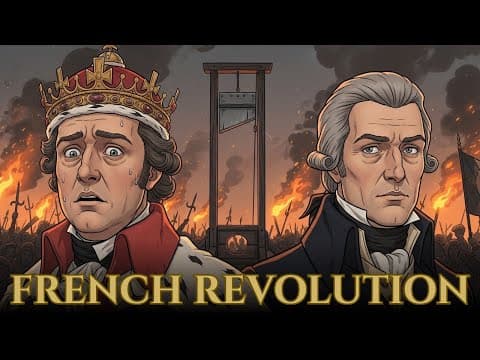
French Revolution: How Terror and the Guillotine Took Control of France?
The War Archive
10m 4s1,536 words~8 min read
YouTube auto captions
Transcript source
YouTube auto captions
This transcript was extracted from YouTube's auto-generated caption track. The transcript below is server-rendered so it can be read, searched, cited, and shared without opening the original YouTube player.
Pull quotes
[0:00]In less than a decade, France will do what no great European power has ever dared to do before.
[0:00]It will seize its king, strip him of his sacred authority, and execute him in public.
[0:00]Bread that people can no longer afford, and a state so deeply in debt that it can no longer govern as it once did.
[0:00]What follows is not a sudden explosion of violence, but a slow, unstoppable collapse.
Use this transcript
Related transcript hubs
Watch on YouTube
Share
MORE TRANSCRIPTS


