[0:00]The subject of this short lecture is about Michel Foucault and discourse as knowledge and power. I'm D Elizabeth Glasgow and I'm your lecturer for this series. Michel Foucault looked at discourse as a precursor to understanding systems of representation. Here discourse would simply mean textual passages that are connected by writing or speech. What Foucault argued was that there are rules and practices that produce meaningful statements and regulate discourse within given historical conditions. Foucault argued that discourse means you have a range of statements that provide a language with the way of talking about something. It provides a language with a way of representing knowledge about a particular subject matter at a particular given historical juncture. As Stuart Hall said, all social practices entail meaning and meaning shapes and influences what we do, all the practices that we have possess a discursive aspect to them. For Foucault, discourse was about both language and practice, making a distinction between what one says, talks about ideas and what one does, how one puts those ideas into practice. It is about the production of knowledge through language, that there are rules and practices that produce meaningful statements and that regulate discourse in particular historical periods. These statements are not singular. They range across a number of statements which provide language with the way of talking about something, a way of representing knowledge about a particular topic at a particular historical moment. Discourse constructs the topic. It defines and produces the objects of our knowledge. That is to say, discourse governs the way we talk about knowledge, how we rationalize about it. It influences the way ideas are put into practice and how these ideas regulate our conduct and the conduct of others. Now, just as a discourse rules in a certain way of talking about something, in defining an idea, in an acceptable and intelligent way, how we speak and write about it, so too does a discourse rule out other ways of talking about something and how we conduct ourselves accordingly, in relation to particular subject matters and constructing knowledge about those subjects. What Foucault said was that discourse never consists of just one statement or just one action or one source of information. The same discourse that characterizes a way of talking or thinking in a state of knowledge at any one time can cross a range of texts that may lead to different forms of conduct within different institutional sites within a society. But whenever these discourses come together and they refer to the same topic, they possess the same style. They support the same strategy. They then become what Foucault thought of as discursive formations. With discursive formations, institutionalization of a particular way of thinking and acting about a particular topic comes about. Now, this will often be in support of particular political ideologies or institutional ways of thinking about things. So meaning and meaningful practice is constructed through discourse. Like Saussure and Barthes, Foucault was a constructionist, but unlike them, he was more concerned with the production of knowledge and meaning and language but also through discourse. The idea that discourse produces objects of knowledge and that nothing exists outside discourse was really central to Foucault's thinking process. This is not to say that there is no real particular existence to an object, like a tree or a book or a ball. They do exist physically in the world, you can see them and you can touch them, but what Foucault argued and what Stewart Hall and others came to see as well, was that these objects have no real meaning outside of discourse, outside the way one talks about them and acts upon these ideas. The cultural theorists, Ernesto Laclau and Chantel Mouffe, wrote in 1979, quote, turning to the term discourse itself, we use it to emphasize the fact that every social configuration is meaningful. If I kick a spherical object in the street or if I kick a ball in a football match, the physical fact is the same, but its meaning is different. The object is a football only to the extent that it establishes a system of relations with other objects and these relations are not given by the mere referential materiality of the objects, but are rather socially constructed. This systematic set of relations is what we call discourse. distinguishing themselves from their opposite, the project of behaviorism or empiricism. Laclau and Mouffe objected to the notion that the science of behaviorism looks to examine the existence of objects independent of their discursive articulation, that analyzing objects devoid of the socially constructed rules of their engagement deprives the objects of real meaning (Laclau and Mouffe, 1979, Pg. 80). We'll talk about this more in another video on empiricism. So the concept of discourse is not about whether something exists. Again, it does exist. You can see it and you can touch it. What it's about is what meaning and action is attached to that object. That is to say, physical objects, though they exist, have no fixed meaning. They only take on meaning and become institutionalized objects through the language attached to them and the social practices that accompany those ideas with discourse, both language and practice, how we talk about something and what we do about that talk. Now, let's look at a couple of examples. The first is, if we talk about building, for instance, a wall to keep immigrants out, you have the distinction made between the linguistic parts, the actual rhetoric surrounding building the wall, what it represents and campaigning for funds for materials and manpower. And you have the actual physical act of building the wall, of manning it and regulating passage through it. The first is linguistic, you're asking and talking about it. The second is actually bringing the wall into creation. Separately, they mean nothing. Together, they mean a whole way of thinking about, depending on your orientation, immigration, human rights, citizenship, racism, xenophobia, fear, constitutionalism, security, law and order, etc. Both are discursive and meaningful within discourse. Or as a second example, we can look at former President Obama, when he became president. We see Obama as an individual. We acknowledged him as president. We saw him as a Democrat. We saw him as a black man, as the first black politician to ascend to the presidency. But these and other attributes only become meaningful within the socially constructed terrain of the rules of political engagement, of historical context of race in the United States of America, of black political agency, of white's privilege and domination, of presidential precedent, secession, power, agency and power, party politics, partisanship, political polarization, etc. It is impossible to determine what the meaning of an object is outside of how it is used. Going back to the case of Barack Obama, it is impossible to determine how Obama came to be thought of without putting him within the context of the environment within which he exists, both historically and contemporarily. It is the idea that physical things and actions exist, but they only take on meaning and become objects of knowledge within discourse, how they are talked about and how they are put into practice and become institutionalized. This then is the heart of constructivist theory of meaning and representation. What Foucault argued was that we only have a knowledge of things if they have meaning, if they have discourse. We cannot have knowledge of the things in and of themselves. That is to say, meaning only comes through discourse (objects + practice) produces knowledge, a way of thinking about and acting on things that then become institutionalized. In the end, Foucault argued that objects and practices are provided meaning through discourse. The power accorded to discourse is similar to that given to language by other cultural theorists, the power to define how the world is categorized and perceived. Rather than possessing innate meaning, Foucault believed individuals give meaning to objects and events. Looking at a final example, we can look at the mass media. With the mass media, Foucault rejected the notion that the media is a transparent conduit of reality. In fact, discourse for Foucault was a rejection altogether of absolute truth and meaning. His analysis of what he called truth regimes led him to understand that much like practitioners of the scientific method purport to impartiality, to neutrality and objectivity, so do journalistic codes of ethics, values and balanced reporting. In reality, Foucault argued that portraying an object or an event will reflect journalistic interpretation and ways of thinking and seeing. Also, with ideology. Here Foucault rejected the reduction of the relationship between knowledge and power to one solely confined to class interests, preferring to believe that other social forces are in operation as well, like race, gender and sexuality. So, in summary, just as the constructionist conception of language and representation displaced the subject from the privileged position in relation to knowledge and meaning, so too did Foucault's discursive approach. On this subject, the cultural theorist Stuart Hall wrote, it is discourse, not the subjects who speak it, which produces knowledge. Subjects may produce particular texts, but they are operating within the limits of the episteme, the discursive formation, the regime of truth, of a particular period and culture. Indeed, this is one of Foucault's most radical propositions: the subject is produced within discourse. This subject of discourse cannot be outside discourse, because it must be subjected to discourse. It must submit to its rules and conventions, to its dispositions of power and knowledge. The subject can become the bearer of the kind of knowledge which discourse produces. It can become the object through which power is relayed, but it cannot stand outside power and knowledge as its source and author. I'm D. Elizabeth Glasgow. Thanks for watching. Please like and subscribe.
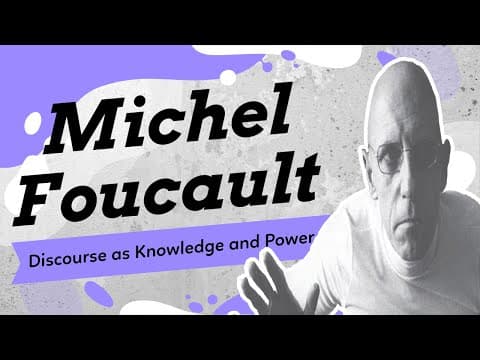
Michel Foucault's Conception of Discourse as Knowledge and Power
University Quick Course
11m 39s1,649 words~9 min read
YouTube auto captions
Transcript source
YouTube auto captions
This transcript was extracted from YouTube's auto-generated caption track. The transcript below is server-rendered so it can be read, searched, cited, and shared without opening the original YouTube player.
Pull quotes
[0:00]The subject of this short lecture is about Michel Foucault and discourse as knowledge and power.
[0:00]Michel Foucault looked at discourse as a precursor to understanding systems of representation.
[0:00]Here discourse would simply mean textual passages that are connected by writing or speech.
[0:00]What Foucault argued was that there are rules and practices that produce meaningful statements and regulate discourse within given historical conditions.
Use this transcript
Related transcript hubs
Watch on YouTube
Share
MORE TRANSCRIPTS


