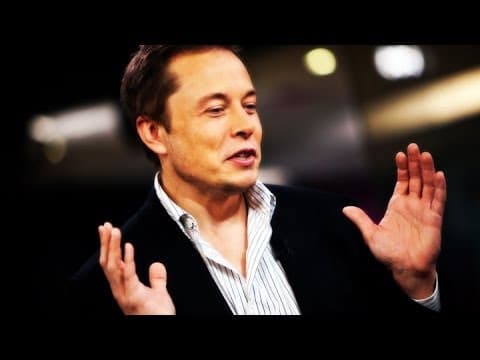
[0:02]Billionaire entrepreneur Elon Musk puts his money where his mouth is. I am personally guaranteeing that value and standing behind that guarantee with all of my assets. His greatest asset is his ability to take this big, big dream and make other people believe that it's true. The determined engineer's big dreams transformed three industries. I'm just wishing to any entities that are listening, please bless this launch. You know, here's an immigrant from South Africa coming to America to say, you know, NASA, that whole rocket thing you're doing with the Space Shuttle, I got a better way. His better way meant risking everything. We had maybe about a week's worth of cash in the bank, or less. I had to make a choice then that either I took all of the capital that I had left from the sale of PayPal to eBay, and invest that in Tesla, or Tesla would die. Others weren't so willing to take a chance on him or his companies. You put $90 billion, like 50 years worth of breaks into solar and wind, to to to Solyndra and Fisker and Tesla and N.R. 1. I mean, I had a friend who said you don't just pick the winners and losers, you pick the losers. It's very unlikely that the Tesla investment is ever repaid to the taxpayers. Electric vehicles are really not possible in ways that would be effective for most consumers still. But his bets have paid off. We didn't just repay the principle, we actually repaid it with interest, and and a bonus payment, so ultimately the the U.S. taxpayer actually made a profit of over $20 million on this loan. Elon Musk has even bigger dreams that might just take him farther than anyone else. Elon Musk goes a step further. Earth not big enough. With SpaceX, he literally wants to go to Mars. And long term I'd really love to go to Mars, and that's the overarching goal of SpaceX.
[2:11]When I was a little kid, I was really scared of the dark. But then I I sort of came to understand, okay, well, dark just means really the absence of of photons in the visible wavelength, 400 to 700 nanometers. It's hard to believe that entrepreneur Elon Musk was ever afraid of anything. And Elon said, darkness is merely the absence of light. Then I thought, well, that's really silly to be uh afraid of a lack of photons. Then I wasn't afraid of the dark anymore, after that. Once one of the kids said to him, Look at the moon, it's a billion miles away. And he said, Well, no, it's actually under 250,000 miles away. And they said, Oh, Elon! Entrepreneur Elon Musk has spent his life proving people wrong. Growing up in South Africa, Musk was the oldest of three children and started school a year early. His father was an engineer, his mother May was a model and nutritionist. He was the youngest, he made it by two days and the shortest, and then he was this brilliant boy, and so people didn't really like him. So I was this little bookwormy kid and probably a bit of a smart Alec, so this is a recipe for disaster. Not that he told me much about it, but he was picked on quite a bit. So I just like read read a lot of books and uh and tried to stay out of people's way during school. And so his social life was much less than my other two kids, and that's a typical nerd. I read all the comics I could buy, or that they'd let me read the bookstore before chasing me away. I read everything I could get my hands on from when I woke up to when I went to sleep. At one point, I got I I really ran out of books and started reading the encyclopedia. And he has a photographic memory, so he could remember everything. Anytime I had a question, my daughter Tosca would say, Call genius boy.
[4:03]When Elon was 10 years old, he got tested by IBM, and he was found to have one of the highest aptitudes they'd ever seen for computer programming. I tried to take some computer classes, but I was way ahead of the teacher, so it didn't really help. So I started programming a space game called Blastar. Musk, already thinking like an entrepreneur, figured out how to sell his game. And I don't think he realized I was 12. We decided we were going to open an arcade out near near our high school. We were into video games, so we figured that uh it was going to be a a huge hit. We got a lease on a building, we got the arcade provider to deliver the equipment. And the only thing we needed to do by the end of it was get the city to approve what we were doing. But an adult had to apply for a city permit, and they hadn't told their parents what they were up to. And of course, they told us we were not going to be opening an arcade. Max Chafkin is a technology and business journalist who has profiled Elon Musk several times. Really, the most amazing thing about his childhood is his escape from from South Africa. I remember thinking and saying that America is where great things are possible, more than any other country in the world. It's a little cliché, but it's true, America is the land of opportunity. By moving, Musk would also avoid mandatory service in South Africa's army. Growing up in a in a part of South Africa was pretty surreal. I mean, we didn't support that government, we didn't believe in it. And so the idea of of actually going to the military service was really out of the question. I told my parents I was going to to Canada, and they tried to convince me not to leave. And off he flew and I thought, wow, he's so independent. Of course, as soon as he lands, he calls me and he says, what do I do now? So I bought a bus ticket from Montreal to Vancouver, and that allowed me kind of to see Canada at least from from the highway. He worked at odd jobs across the country before settling at Queen's College in Toronto. In fact, when I went to college, I rarely went to class, I just read the textbook and then show up for exams. The big appeal to university was being able to date girls my own age. I actually met my first wife there. Musk got an engineering and business degree from the University of Pennsylvania, and a scholarship to go to Stanford. Silicon Valley was the promised land. I really wanted to to just kind of go where where the really exciting breakthroughs were occurring. Elon had this ability to to look at the world, go, this is a real problem that's going to happen in 20 years. He looked around and he saw that the world changing stuff was not happening at Stanford. I didn't even go to class. I called the chairman of the department and said, I'd like to try starting this Internet company. If it probably won't succeed, and so when it fails, I want to make sure that I can still come back. My kids do funny things, and I've never too concerned about them, because, you know, if Elon wanted to drop out of college, he could always go back. My brother was in Canada at the time, and I said, look, I think we should try to create an Internet company. So he came down and joined me. He had, you know, $2,000, no friends, uh barely enough money for an apartment. I think he told me he was showering at the gym because they didn't have a shower where he was living. We just got some a few tons that they were couches during the day and then turn into beds at night. Steve Jurvetson is a venture capitalist in Silicon Valley. I first met Elon and Kimbal Musk, his brother, back in the mid-90s when they, uh, first set foot in California. I think they'd been here for about a week, and they were pitching a new company called Zip2. Silicon Valley in the mid-90s in the late 90s was a gold rush. People were flocking to the region to find riches, to make it in the Internet business. Musk came up with an idea to bring newspapers into the digital age. He took a CD-ROM yellow pages, some mapping software, wrote a little code, and put it all together to create the first online city listings. Elon was more the the the business mastermind, I was more the sales guy. I still had my my core programming skills, so I was able to write the the software needed for for the first company. Now, when Elon was starting Zip2, keep in mind, you know, the Internet was just a couple of years old. Most local businesses were not on the Internet, and the way you found a local business was you opened up the Yellow Pages. And we thought was the media companies, the newspapers are going to need help coming online and building lots of functionality into their websites. We had someone literally throw a Yellow Pages book at us and tell us, Do you think you'll ever replace this? And we thought the guy was crazy, because not only were we going to replace this, but that's not where it ended, it would keep going from there. It wasn't long before media companies across the country were signing up. And so we were able to uh get as investors and customers, the New York Times Company, Hearst, uh Knight Ridder, and a number of other companies. In 1999, the AltaVista division of Compaq bought Zip2 for $307 million in cash and $34 million in stock options. Musk was just 28 years old.
[9:03]I thought that's crazy. Why would somebody pay such a huge amount of money for a little company that we have? It actually often turned out very well for them financially, so it's that they knew a lot more about it than I did. When the kids sold the two, it was the most exciting day. We couldn't believe it because you don't know in the Internet world if you're going to, you know, make a million or die tomorrow.
[9:31]In February 1999, Elon Musk sold his first company. At 28, he joined the ranks of Silicon Valley millionaires. Zip2 was acquired by Compaq for a little over $300 million and I I made about I think about 21 or $22 million as a result of that, which was a a phenomenal amount of money for me. It was obviously a financial windfall. It was super fun to go out and buy some cool toys. There he is, John, in the fastest car in the world. One of his first things to do is go out and get a big sports car. He comes from a family that really enjoys racing in vehicles, and he got one of the highest performance cars money could buy at the time. It was a McLaren F1. And uh proceeded to uh enjoy that around the Bay Area, let's say. A number of adventures, and risk-taking moves with with his driving. Well, I'm sure it felt, you know, wonderful to have all this money and and to have people recognizing success. I think he was also frustrated that this company hadn't become as great as he wanted it to be. It hadn't, it hadn't changed the world, it had just slightly altered the course of newspaper history, which I think from his point of view was, you know, kind of a peddling accomplishment. So I I suddenly had the choice at that point of retiring and, you know, buying an island somewhere and sitting my ties, but that was not not of interest to me at all. There really wasn't a choice of we weren't going to do anything, it was just really what we were going to do next. In Elon's case, in particular, it was really just a stepping stone. The goal with in doing my second Internet company was to to create something that would have a profound effect. And it seems to me that the financial sector had not seen um a lot of innovation on the Internet. And and money is really just an entry in a database. And and it's so it's low bandwidth, it's it seems like something should lend itself to innovation. He was very rich, I mean, just more money than most people could dream. And he took almost no time in between that sale and starting uh the company that became PayPal. Musk's new company created something we take for granted today. It changed the way the world buys things, the way money is transferred from one person to another. At the time, transactions were very slow, people would have to mail checks to each other, so it could take weeks just to complete a single transaction. With his windfall from the sale of Zip2, Musk quickly turned around and founded X.com to make electronic cash transfers possible. But his new company collided with a rival mobile payment company called Confinity. And they were really competing against each other, and the the real enemy at the end of the day was eBay. We combined our efforts in order to compete effectively against eBay's built-in system. They called the new company PayPal. When he looked at PayPal, his goal was not to create a place you could do person-to-person payments. His goal was to transform the financial industry. We're able to become the the leading payment system in the world, and then eBay finally threw in the towel and acquired PayPal in uh early 2002. Musk and his partners sold PayPal for $1.5 billion. Musk was the largest shareholder and walked away with $180 million. He was 30 years old. I could have bought probably a a chain of islands. But but that that again, that was also just not of it's just not of not of interest to me. Islands weren't of interest, but outer space was. It's just a much more exciting inspiring future if we're out there exploring the stars, as opposed to a future where we are forever confined to Earth. I was thinking, well, I wonder when when we're going to Mars. You know, when when is when is NASA going to go to Mars? And I went to the NASA website and there was no plan to go to Mars, and no plan to really even take the next step in space exploration. This is Elon saying he wants to go and enable the the human civilization to leave the planet Earth. It's about a big as big a vision as you could possibly imagine. And that's going to require funds, and he has enough funds to go do it, so he's going to go do it.
[13:32]Musk had the outrageous idea that private enterprise could actually re-energize space travel. And in June 2002, he founded Space Exploration Technologies, or SpaceX. Elon was the only founder of the company for those early years. Another incredibly risky move to say, nobody on the planet thinks this idea is financible, I'm going to fund all of it myself to the tune of almost $100 million. Which was the majority of his net worth at the time, into a dream to take on the military industrial complex.
[14:12]I actually traveled to Russia three times to look at buying our refurbished uh ICBM without the nuke. And I came to the conclusion that the real the thing that was really holding us back from making much more progress in space, it was really that rockets had not evolved since the '60s. So the trick isn't figuring out how to get to orbit, it's figuring out how to get to orbit cheaply. So I had to come up with lower cost ways to produce engines, the primary structure of the electronics to launch operation, as well as run the company at with with very little overhead. And the sum of inventions in all those areas is what has led us to um roughly three to four-fold improvement over the cost of of other rockets in the United States. What SpaceX has been very successful at is taking basically off-the-shelf technology, stuff that was developed by NASA 50 years ago, and streamlining it. So in that way, he's kind of the Henry Ford of of space, because Henry Ford didn't invent the automobile, he just figured out how to make the automobile, you know, commercially viable. Musk was more than just an entrepreneur. If you ask Elon how he managed to teach himself rocket science, he'll just look at you very seriously and just say very quietly, he read a lot of books.


