[0:00]On July 16th, 1913, in a remote mountainous peninsula in northeastern Greece, 462 Russian Orthodox monks were violently rounded up by Russian military and arrested. Four died during the event and 46 were injured. The monks, who passively resisted by linking arms, were drenched point blank with cold mountain water for one hour from water cannons, then beaten and stabbed with bayonets, hurled downstairs and dragged onto a military vessel. Their crime? They were accused of heresy for their belief that the name of God is God himself. The soldiers were acting at the behest of the Russian Orthodox Church and were half drunk. Thanks to the involvement of the church authority, who coordinated the abuse, Archimandrite Misail. We can only imagine the horrors that might go on today if religious authorities had military forces at their command, which they could use to settle doctrinal disputes. What you are about to hear is the story of the name controversy which took place in Russia prior to and during the Soviet Revolution. Some thinkers have drawn a mythical or karmic connection between the abuses wrought upon these holy monks and the downfall of Russia into a communist dictatorship. The idea that God's names are special is not a new idea, and it is not unique to this subset of Christianity. Indeed, Islam, Judaism, Buddhism, Christianity, and Hinduism, all have teachings about the potency of God's names, as well as God's identity with his name. The willingness of the Holy name devotees to stand up for what they believe in the face of difficulty, having faith in their profound mystical experiences, make their lives worthy of our admiration and interest. You may be wondering what Buddhism is doing on the list. Buddhists will deny being theistic, but have a listen to what some Buddhists believe and make up your own mind whether it sounds like theism. Pure Land Buddhism's sole salvific practice in the current Dharma ending age is Nembutsu, reciting and trusting in the name of Amida Buddha, the Buddha of infinite light and life, who is his very name. This mirrors teachings of Vaishnava traditions in India. The most prominent form of Vaishnavism today are followers of Sri Chaitanya, who taught that in this age of quarrel and hypocrisy, the only means of deliverance is the chanting of the Holy names of the Lord, and that furthermore, in this age, God has descended as an avatar in the form of his name for our benefit. In Islam, the chanting of Allah's names is a core devotional practice. The fourth Khalif, Ali ibn Abu Talib, taught that the beautiful names of God are the pillars which hold up all things. The Prophet Muhammad states, Allah Most High has 99 names. The one who enumerate them will enter paradise. The Sufi book, Physicians of the Heart explains that Allah is the name of the essence. All the names of Allah are nothing but Allah. Within Judaism, the Orthodox teaching is that God and his names are one. Outside of religious services, it is custom for Jews to call God Hashem, which means the name.
[3:38]Now, back to the story. The controversy centered around two Russian Orthodox monasteries on Mount Athos, St. Panteleimon Monastery, and St. Andrew's Skeet. Since the third or fourth century AD, Mount Athos has been a haven for Eastern Orthodox monks. The peninsula is technically part of Greece, but civily Mount Athos is an autonomous Republic with its own government council. To this day, Athos is an oasis for Eastern Orthodox monastic life.
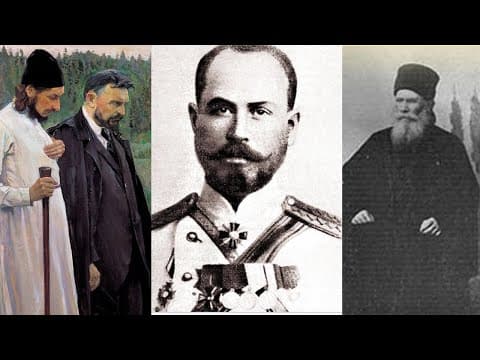
[4:18]Our story begins with a simple Russian monk named Elder Hilarion. His contribution is a book titled, On the Mountains of the Caucasus, a conversation between two elders-hermits on the Inner Union of Our Hearts with the Lord through the Jesus-Prayer, or Spiritual Work of Contemporary Hermits. This book sparked a movement centered on the chanting of the Jesus prayer and popularized the idea that God's name is God himself. Hilarion lived a renounced life, even leaving a well-established Athonite monastery to find the peace he felt would help his internal meditation with the Jesus prayer. This led him to living for many years in an austere mountainous condition. Prior to this life of austerity and seclusion, he spent 20 years on Mount Athos living in St. Panteleimon Monastery. He was there during what is considered to have been the golden age for Russians on Mount Athos, 1875 through 1888. This period was made great by the stable finances of St. Panteleimon Monastery, and the growth of the monastery's library. Hilarion took advantage of this to study theology avidly. It must have been here that he learned the importance of chanting God's Holy name and of the names divinity. Hilarion was largely self-taught, and he rose up the monastic ranks with ease despite his lack of formal training. Perhaps this contributed to his work being opposed, as some monks may have been envious of his swift rise up the ranks and his revered reputation as a source of spiritual guidance. In 1907, Hilarion submitted his book to many authoritative and theologically educated people asking for feedback. Of the few that replied, most stated that they didn't feel competent to comment. Some of the leaders who were asked for feedback at this time would go on to oppose the book once its influence grew. Perhaps their opposition to the book was political in nature, given their earlier approval, or at least lack of opposition. If it was heretical in 1913, then it was just as heretical in 1907. The book was first published in 1907 and was reprinted twice more. Upon publication, the book received a glowing review from Father John of Valaamo, who would later be canonized as a saint. The second printing of the book was financed by a member of the Imperial Family of Russia, the Grand Duchess Elizaveta Fyodorovna, who would later become a new martyr and saint of the Russian Orthodox Church. This is further evidence of important people approving of the book prior to its becoming politicized. On the third printing in 1912, an unprecedented 10,000 copies were printed. The book was a hit. Part of the growth of this movement is attributed to the death in 1908 of the beloved Father John of Kronstadt, who is known to have said that God is identical with his name. John of Kronstadt, while not having been an official saint of the church at this time, was nevertheless revered as one. In 1990, the church officially glorified him as a wonderworking saint, due to the many miracles related to his holy life. In 1909, several Athonite monks began to raise theological concerns over the new name glorification movement. They felt it was a theological deviation and that Hilarion had brought new ideas into the church. Hilarion used new phrases, which was seen as evidence that he had used new ideas, but arguably his use of new phrases simply refreshed the same essential spiritual truths found in the writings of the church fathers and in the Bible. The opposition considered Elder Hilarion's views to be pantheistic, meaning they read him as teaching that the universe is God. One objection stated that if the name of Jesus is divine, then you can make a man God simply by naming him Jesus. Many of these objections are severe misrepresentations of what Hilarion taught. Hilarion would join his opposition in arguing against many of the ideas he was accused of teaching. What Elder Hilarion and others before him taught is very much in line with the Hare Krishna Vaishnava understanding. Bhaktisiddhanta Saraswati taught that God's name is not an arrangement of syllables. God chooses whether or not to appear on the tongue of a devotee who chants his name by his own volition. Hilarion taught that there is a lifestyle which is pleasing to God, and which is necessary to get the full benefit from practicing the Jesus prayer. For example, he taught that if you offend a brother, then you must resolve things with your brother, as holding grudges and offending others inhibits the benefits of the prayer. The parallels between this and the teachings of Sri Chaitanya are striking. We could go into depth on the debates surrounding Hilarion's views, but that will have to be a topic for another video. 1909 is also the year that our main protagonist reads the book and becomes a supporter of name glorification. The name glorifiers were mostly made up of uneducated monks with peasant backgrounds. Hieroschemamonk Anthony of St. Andrew's Skeet, on the other hand, was university educated and came from an aristocratic background. He would go on to become the main theological defender of the divinity of God's name in the years that followed, as well as being the leader of the movement. Father Anthony, born Alexander Bulatovich, into a family of Oriel nobility, was an extraordinary personality. He was a priest and a senior ranking monk on Mount Athos. After graduating in 1891 near the top of his class from a prestigious university, he entered the army. Thanks to family connections, he entered into one of the most aristocratic regiments of the Russian army. He earned several medals and wrote two books about Ethiopia, following the time he spent there offering humanitarian aid. These books are now used by historians for the value they offer in understanding Ethiopian history and society. In 1902, he left all that behind and entered monastic life, taking on the name Father Anthony. Seven years later, in the spring of 1909, he received a copy of the book and was asked for an opinion on it. At first, he objected to the book's message, but after some contemplation, and after serendipitously reading a passage which echoed Hilarion's message from a book written by St. John of Kronstadt, he changed his mind. Father John of Kronstadt had been a big influence in Father Anthony's life and had personally given him that book in one of their last meetings. Father Anthony commented that he too was about to renounce the name of the Lord, as had others. If the prayers of my unforgotten spiritual Father John of Kronstadt hadn't saved me. Father Anthony didn't get involved in the controversy for another four years. In 1910, the name glorifiers began to report mistreatment at Novaya Fiviziada retreat. The Abbot, Elder Avraamiy, denied the name glorifiers the sacrament of confession. Sacraments in Christianity are integral expressions of the faith, so being denied them is equivalent to being excommunicated. At St. Panteleimon, tensions were brewing. Father Alexey, a senior monk, was spreading rhetoric in opposition to the divinity of God's names, which disturbed many monks to the degree that some of them began to refuse to accept sacraments from him. Alexey would say things like, Well, what is the name of Jesus that Father Hilarion ascribes such importance to it in the Jesus prayer? A simple human personal name, just like other human names. For the name glorifiers, this felt like a rejection of Jesus Christ himself. In a peacekeeping effort, Abbot Misail of St. Panteleimon Monastery took the drastic action of banning any discussion of the name of Jesus outside of church services. His efforts did not have the intended effect because he didn't silence Father Alexey. Some think Abbot Misail was taking a neutral position on the issue, but such silencing must have been a great disturbance for the supporters, who considered the chanting and glorification of God's names to be an essential part of their faith. In 1912, enthusiasm for name glorification continues to grow. The monks are motivated by their personal experiences of the power of the Jesus prayer, combined with an appreciation of the theological contents of Elder Hilarion's book. Church authorities and intellectuals begin to publish criticisms of this book. One such condemnation is published in a widely circulated monastic journal, taking the controversy beyond the borders of Athos and circulating it throughout Russia. Archbishop Anthony of Kiev publishes these criticisms without ever actually reading the book whose teachings are under attack. The published criticisms give ammunition to the monks opposing the name glorification movement. The pro name glorifiers are at a loss for how to respond to these new attacks. Most of them had peasant backgrounds and many were illiterate. When these monks heard about a university educated monk living nearby who shares their views, they request his help. He soon became their leader, and in the years that follow, he virtually single-handedly carried on the theological defense of the divinity of God's name, publishing an acclaimed theological defense and petitioning influential people to intervene on behalf of the persecuted name glorifiers. In September of 1912, the book is condemned by the Patriarch of Constantinople, Yahim III, who happened to be a 33rd degree Freemason. Yes, by the beginning of the 20th century, the Masons had gained control of the Episcopal Sea of Constantinople, and the Ecumenical Patriarch at this time was a 33rd degree Mason. The monasteries of Mount Athos are self-governing to a limited degree, having autonomous status, but report directly to the Ecumenical Patriarch, who is the highest authority for this church jurisdiction. The Patriarch had authority only to resolve issues which could not be resolved by the governance structure of Mount Athos. There are several factors which may have contributed to the controversy beyond the apparent ones. There was a class element. The advocates consisted largely of uneducated monks from peasant backgrounds, while the opposing side was largely educated monks from aristocratic backgrounds. There had always been class tensions on Athos, so in a way, existing tensions were simply taking a new form. There are also a few personal grudges which may have contributed to the disputes. We'll avoid explaining them here for the sake of brevity. A desire to Hellenize Athos, meaning to reduce the Russian population, may have seized on the happenings to further its interests. Russian-Greek tensions were at an all time high at the time of this controversy. Russian members on Athos had ballooned beyond that of the Greeks, and there was a push to revive the archaic political structure of the mountain. With the Russians gaining dominance, the revised political structure would likely have severely limited Greek rule over the region. One outcome of the events which follow is that Russian numbers on Athos were slashed and did not recover, resulting in Greek rule over the region being preserved. Another factor which fueled theological opposition to name glorification is affection for philosophical rationalism. An out-growth of the Enlightenment era's scientific materialism, rationalism favors human reason as the basis and source of knowledge, rather than divine revelation. Names of God are thus regarded as human creations, not as God's self-naming revelation to humans. The philosophy of nominalism, in particular, according to which particulars do not embody universals, was employed by some, such as Archbishop Nikon, to oppose the view that God's name is divinity. Nominalism is inconsistent with the claim that a sound vibration can be an instantiation of a universal, in this case, of God. A bigger factor may have been the problem posed by mysticism for the power structure of the church. The church is empowered by being an intermediary between believers and God. If the Jesus prayer is a direct line to God, then this power structure is threatened. Perhaps the church was trying to preserve its power, which it saw threatened by a rapidly spreading virus among monks, who believed that they had direct access to God. Perhaps they feared the motherland would become infected and took drastic action in an effort to nip it in the bud, or to amputate the infected limb. Of note is the fact that the very same church authorities which violently persecuted hundreds of monks in an effort to protect the purity of the church doctrine were also willing to sacrifice the purity of the doctrine in order to spare themselves persecution. Only a few years after these events, the Stalinist government took power and demanded church leaders pledge complete oneness of mind with the atheistic regime. This is not a criticism of their cooperation with the Stalinist government. Who knows what any of us would do in the same situation, given that those who refused to collaborate were imprisoned and executed by the thousands. This is simply to point out a contrast between the importance these authorities placed on doctrinal purity, when they were the ones doing the persecuting, versus when they were faced with persecution. Arguably, the reasons professed by the instigators, namely the heretical nature of the views, cannot be the real reason, because heresy does not justify such abuses, and further, there were many inconsistencies displayed by the church authorities.