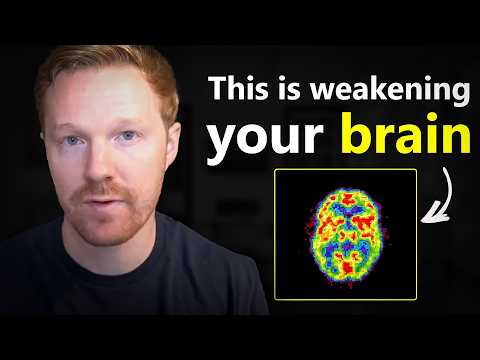
[0:00]So there's a habit that almost all of us do every single day, and it's quietly weakening your brain. I'm talking about the parts that determine whether you feel sharp or foggy, decisive or scattered, motivated or completely stuck. I'm talking about your cognitive capacity. Today I'm going to show you exactly what that habit is, what it's doing to your brain, and how to start reversing it. And as always, I'm going to try to be as efficient and concise as possible with this, but I also want to be very thorough. So, I really respect your time, I might be moving quickly. I say that because I really think you need to hear all this, and you really should stay for the whole video, but also I'm not going to run this out into a 25-minute video when it could be done in 10 minutes. So, if you have felt more distracted lately, more mentally tired, more overwhelmed by simple tasks, you're not just imagining it. This likely isn't just aging, like some people will think. It's not a character flaw. It's not that you're just bad at focusing. New research is showing that common patterns of digital behavior, aka doom scrolling, app hopping, endless short form content, mindless morning phone use, these are all linked to measurable hits to your attention, your executive function, your working memory, and your self-control. We all had our parents yell at us to get off of our phones, and they said it was going to rot our brains. Well, they might have been right. We are seeing significant deficits across multiple studies. And I want to be very clear, this doesn't mean that you're getting dumber. It means that your brain is being trained in the wrong direction. The problem isn't just screens to a degree. It's how you're using these screens. It's the micro switching, you hear me talk a lot about the negative impacts of multitasking and that's what you're constantly doing on your phone. It's the constant novelty, it's that dopamine drip of tiny, unintentional scrolls again and again and again with drastic emotional swings in almost every single one. One recent study on short form video found that scroll immersion, which is that feeling of like falling into your feed, like you just really fall into it, strongly predicted attention problems, working memory disruptions, and cognitive fatigue. Another study using EEG found that people with high short form video addiction tendencies had weaker frontal theta power during tasks that required executive control and lower self-control scores overall. In simple terms, the more your brain gets trained on rapid novelty, the less capacity it has for deep thinking. The best way I can summarize this is you're teaching your brain to crave stimulation instead of focus. And if you've been feeling that in your own life, that constant mental buzzing or just detachment from reality or that inability to stay on one thing, this might be why. To really drive home the point about the impact of this, and something that really isn't even talked about enough in the studies, but when you're constantly just feeding your brain that stimulation, you are distancing yourself from the present, distances yourself from purpose. And I want to make something really clear that you hear me say in a lot of videos. You are going to die eventually.
[3:16]Do not waste this wonderful life and opportunity that you have scrolling it away because you are addicted to that dopamine buzz. It may be hard, but I'm going to give you steps very soon in this video on how to fix this. I'm telling you, chase after a beautiful purpose, not scrolls. And you'll hear me mentioning different studies in this video, I'm going to link them in the description for you. So, I want to talk about the science to this, and in my usual fashion, let's break this down in simple human terms. Number one, attention. Some of the biggest deficits across the research are in attention, which is what I talk about so much on this channel. Where your attention goes makes a drastic difference in your life. I cannot exaggerate that enough. People with disordered screen time use patterns perform significantly worse on focus-based tasks. You might resonate with this with the feeling of like, I just can't get into things anymore, or I just can't stay on tasks these days. Like that type of person who's like, oh, I can't focus anymore, that could be where this is coming from. Number two, your executive function also takes a hit. This is your ability to plan, inhibit impulses, which is equally as important, switch tasks intentionally, and stay on track with things. This is why you may sit down to reply to one email and suddenly you're on TikTok, Instagram or shopping on Amazon without even realizing it. Number three, cognitive flexibility and decision making. Big cohort studies show that heavy smartphone use with media multitasking, so the things we've been talking about, are linked with increased impulsivity, cognitive inflexibility, and worse decision making. You become more reactive, simply put, you become more jumpy, and you get overwhelmed by simple choices. You're not less intelligent, per se, at least there haven't been many studies that have really measured IQ in this setting, but you're just running on a brain that is overstimulated and undertrained. And if you don't think this is important, think about how many decisions you make in your life and how one single decision can drastically alter your day, your week, your year, your life. You want to be good at that. Don't weaken it for some shallow reason. And I know this might sound real and intense, but it's really important. I'm telling you, I just I see so many people literally on their death bed, I'm in a very unique opportunity as a physician. And so many of these people will tell you that they just never really lived or really realized why they were here, and I don't want that to be you. And I think this is a big part that is in the way of that. So, let's keep going, and again, I'm going to move fast because I really do respect your time, but you do need to hear the rest of this. These impacts weren't just showing on performance tests. Brain imaging studies showed consistent gray matter reductions in the dorsolateral prefrontal cortex. That's a tough one to say, and anterior singulate cortex. These are the regions responsible for top-down control, focus, and emotional regulation. These are also responsible for decision-making, and these were all seen in people with problematic internet patterns. A large longitudinal study showed that high internet use predicted smaller gains in verbal intelligence and smaller increases in gray and white matter in the areas responsible for attention, language, and executive function over several years. Again, this is not a fearmongering for views type channel, this is the exact opposite of that. And I want to be really clear, this isn't like brain damage, like you would think about it in common terms, like that's not what I'm going to make the title of this video for clickbait reasons like a lot of people might. And I'm saying this because I want you to know that it's reversible. This difference, though, is meaningful enough to change how you feel, and that matters to a profound degree. You know, so much of why I started this channel is because I feel like for so many years, the focus was just simply on keeping people alive, but we let go of how people actually lived. So, we've got people living a decent amount of time, but many people are just skeletons of what they could be, and I don't want that for you. I've seen this in so many people, I've seen this in myself at times. Before medical school, and also partly in medical school, as well as during the early stages of building multiple businesses, my attention was shredded. I wasn't depressed, I wasn't lazy by any means. My cognitive capacity had just shrunk to a point where I struggled to function at a high level. Admittedly, that might have made me a little bit depressed in hindsight. Once I fixed this underlying behavior, though, everything changed. So, how do we know if this is already happening to you? Let's do a quick test. Let's call it the put a finger down version, you know. If three or more of these hit, you're probably dealing with this issue. And this is just a fun little game, so if any of these really resonate, you should probably focus on it. You can't read more than one to two pages without reaching for your phone. You lose your train of thought mid-sentence. You open your phone for one thing and do five other things instead. You feel mentally tired after tasks that should be easy. You bounce between tabs with no plan. You feel mentally cluttered most of the day. If that's you, it's not too late. Your brain is insanely adaptive. Let's talk about how to rebuild it now. If you stayed for this part, drop a comment right now, to know that your attention span is better than the vast majority of the population because we are a few minutes into this, and I'm very proud of you. But you really do need to hear this part. Let's dive into it. This is the practical steps that you need to do. These are the same tools that I've used on myself, my patients and clients have used, and honestly, this is the foundation of what I teach inside my new community that is loaded with resources to start living your best life. You should really check it out, I'll link at the top of the description. The best thing is, these things work, incredibly well. So, you need to do reps like you're in the gym of deep work. Forget the idea, though, that you should sit down and study or do something for three hours, like this monk mode type focus that is not where you start. You start with 10 to 30 minute deep work reps. One task, no switching, no notifications. Consider this like interval training. At first, you may feel incredibly dependent on these structured blocks. Like, you're really not going to get a lot done if you're not using them. That's normal. That doesn't mean that your brain is broken. It means that your brain hasn't been trained for depth in a long time. But here's the part that I feel like a lot of people don't talk about and slash or realize. The more of these reps that you do, aka, the more times you dive into these deep work sessions, whether that's 10 minutes or 30 minutes or 40 minutes, and then by the way, you're going to take a 10-minute break and then if you need to do more work, then you do another block like that, and then you take another break. And you have to combine that with the less stress that your brain is also taking from social media and these triggers that we've been talking about, the less you'll rely on the structure at all. So, to really simplify this, you need to do the good things and you need to take out the bad things, okay? So, more of the reps, less of the stressors. Your brain gets stronger, focus becomes much easier, and eventually, this becomes your baseline. That's the goal. What I'm saying is, the more you do this, the less you will depend on it in the future, and that's huge. I started a timer every time I worked when I first started out on this journey. When I was in medical school, I would get my timer and just set it for a 30 or 40 minute block and then 10 minute break and I was back doing it again, or I'd be time blocking or something like that. Now, I don't ever do that. I had a hard a physical timer, I don't even know where it is. I trained my focus, you learn to be able to focus for very long periods of time when you practice this. Like I said, you can stretch this to 30 minute blocks or 45, you can keep pushing it, but after about that time frame, I wouldn't avoid breaks. Like 45 to 60 minutes is probably your max, then you should take a short break. This is also called the Pomodoro Technique, by the way. Lots of free timers in app stores and the internet, like you can literally just pull up a web page and you can do a Pomodoro timer, it's super easy. Next, dual in back, okay? This is like working memory strength training. This is your mental weights. Dual N-Back is one of the only cognitive training methods shown in research to reliably improve working memory. This underlies your focus, your problem solving, your decision making, and your emotional regulation. 15 to 20 minutes daily or almost every day, you'll hate it at first. It sucks, I'm sorry. It's about the only thing that I consistently talk about across this channel that just isn't fun to do, but you will feel the results everywhere. Your mind gets quieter, your thoughts get much sharper, and most importantly, you feel more mentally capable. The feelings are subtle at first, but stay with it, and you will build yourself into an absolute powerhouse. Now, no scroll mornings and no scrolling before deep work. This one is huge. Your morning sets your tone for the entire day. If the first thing that you do is to give your attention away, your brain spins the rest of the day, trying to get it back. So, here's the rule, and before a deep work block, no scrolling or no short form content before then either. No phone, no feed, no digital novelty like we talked about earlier. Let your mind settle, get your baseline back, then start. This alone can change your cognitive capacity, almost anything else. And no, I know these things aren't flashy, this isn't like the super hype study channels that people love to listen to, which I think are really good by the way, these are just different techniques, but this is building your core foundation. None of that stuff will make a big difference if you don't have your foundation down. Trust me on these things, just do them. Now, when it comes to limiting your impulses to be able to do this kind of doom scrolling. I recommend friction causing devices like Brick or there's some other brands out there to interrupt that reflex to scroll. Now, you hear me say the words, we want to reduce friction so often on this channel. Well, let's build up some friction to the stuff that we don't want to do here. So this is the opposite, but this is we're building friction to a negative trade. Look, we all override the app blockers. We all cheat on our screen time limits, we are human. They don't work for most people, I'm sorry. That's why devices like Brick exist. These are physical NFC tags that you tap, it locks down the apps and they can't be overwritten. I mean, how much more simple and effective could that be? You tap your phone on the tag, stick it on the fridge in a different room, and it locks the apps that you've chosen to lock. There are plenty of brands for this, Brick is the one that I like. I will put my affiliate link in the description, I will also put a non-affiliate link in the description. It's your choice. I'm not sponsored, I don't know them. I just like their product a lot. I wouldn't mention it if it didn't work. It's helped a ton of people break the unconscious reflex that kills cognition. If you don't think that you have this unconscious reflex, look at your screen time. Now, attention recovery windows. At least one or two 30 to 60 minute blocks a day, you don't scroll, you don't multitask, you don't stimulate your brain, you let your nervous system settle. This resets this cognitive fatigue that we're in constantly. It restores stability and it literally resensitizes your attention. This is where you start to feel like your old self again is what people will tell me. Go for a walk, read a book, sit there, call a friend and have a joyful conversation, not drama. You get the point. So, wrapping it up, here's the truth. You don't have a motivation problem, you have an overstimulation problem, and an overstimulation problem is reversible. Your cognitive capacity is not gone, it just hasn't been trained in the right direction. If this video hits, if it feels like the missing piece for you, my community is where we're going deeper into this work. It is a space for people who want clarity, strength, and mental performance without the chaos. It's full of life-changing content that I update all the time, like almost daily, direct access to chatting with me and asking me questions, protocols for many areas of life and performance, and accountability with a community if you want that. I think it can change your life, and I would love to see you inside. And if you want the deeper blueprint for this without the community aspect, everything I used to rebuild my own mind, that is exactly what I wrote in my book, From Dull to Doctor. It is in all forms, I'll link in the description, check it out. I wrote this because it is the guide step-by-step that I wish I had when I was going through this like you may be now. It is science-backed, but it is also written like a knowledgeable friend is talking to you, and I think you might enjoy that. For now, here is your seven-day challenge. Every morning, no scrolling for the first hour. Every day, one 10 to 30 minute deep work session. Every other day, 10 to 15 minutes of dual N-Back. Do that for a week, your brain will feel different, I promise. If this resonated with you, please like this video and subscribe. Also, turn on your notifications so you don't miss another amazing video like this. I drop one to two of these a week. Also, hype the video. It's a new feature, and it seems pretty amazing, and it helps the channel grow, so I can keep doing this for you. Share this video with someone that you think it could help. It's completely free, and it is the least that you can do to help a loved one. Now, great job getting this far. As always, I'm Dr. Matt Jones. Thanks for watching, and I'll see you in the next one.


