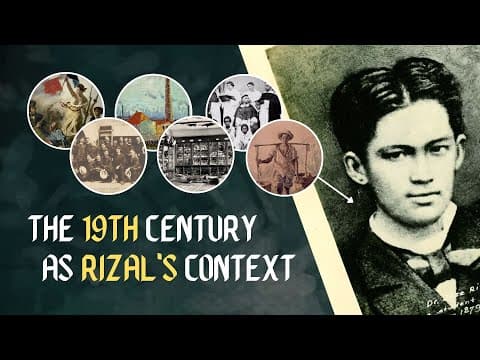
[0:00]Kamusta? Ako si Yumi. Sa video na 'to, pag-uusapan natin kung ano ang mga pagbabagong naranasan ng Pilipinas at ng mundo noong 19th century. Na direktang nakaapekto sa paghubog ng pagkatao ni Rizal.
[0:18]Natanong mo na ba sa sarili mo kung paano ka naging ikaw? Ang pagkatao natin ay hindi lang dine-define ng genetics, but by a multitude of experiences and events that are interwoven throughout our lives. Hindi lang iisa kung hindi maraming factors ang humubog at patuloy na humuhubog sa pagkatao mo. Kung medyo naguguluhan ka, ihalintulad natin siya sa isang jigsaw puzzle. Dito, ang mga pieces ay 'yung experiences at events na nangyayari sa buhay mo. At kapag pinagsama-sama natin sila, makakabuo ito ng isang larawan. At ang larawang 'yon ay ikaw. May mga factors na kaya mong kontrolin, tulad ng pag-decide kung mag-iipon ka ba, kung trine ba mag-exercise o kung trine ba mag-aral kaysa mag-best sa social media. Yung ibang factors naman ay beyond our control, tulad ng mundong kinagisnan natin. Kung pinanganak ka bang mayaman, kung mapagmahal ba ang pamilya mo, kung sino ang nasa paligid mo, kung anong mga events ang nangyayari sa mundo, kung saan ka nakatira, kung anong generation ka, kung maganda ba lahi niyo at marami pang iba. Lahat ng factors na 'yan may kinalaman kung paano ka naging ikaw. Punta tayo kay Rizal. Si Rizal, pinanganak at lumaki siya noong 19th century. And he grew up amidst the Philippines' struggle for independence and the shifting social, economic, and political landscape of the time. At ang mga pagbabagong iyon ay nag-contribute para ma-develop ang perspective niya sa buhay. Para mas maintindihan natin kung paano naging Rizal si Rizal, balikan natin kung ano ang nangyayari noong 19th century. Ano-ano ba 'tong mga pagbabagong 'to in terms of economics, social, cultural at political landscape? Na humubog sa kanya, sa kanyang pamilya, sa Pilipinas at sa mundo noon.
[2:04]So, 19th century. Ang 19th century ay tinatawag ng ilan na birth of modernity. Bakit? Kaya siya tinawag na birth of modernity ay dahil in-emphasize ng era na 'to ang pag-break natin sa mga traditional ways of life para sa emergence ng mas modern o new ideas, attitudes at institutions. Kung dati monarchy, ngayong 19th century democracy. Kung dati feudalism, ngayon capitalism. Kung dati passively accepting, ngayon reform-minded. Tinawag din ang period na 'to na parte ng Age of Revolution. Bakit? During this time, nangyayari ang Industrial Revolution. Nagkaroon ng mga bagong modes of production, transportation and communication were introduced, bringing about a shift from manual labor to machine-based production. Na nagresulta para mag-transform ang ekonomiya dahil nag-shift ang mundo mula sa manual labor papuntang machine-based production. This transformation of the economy and society resulted in new forms of work and leisure, as well as urbanization and the growth of cities. Nagkaroon din ng mga political revolutions noong late 18th at early 19th century. Nandiyan ang American Revolution at itong nasa screen mo na French Revolution, which were both heavily influenced by the Enlightenment, a philosophical movement that valued reason, rationality, and individualism. The wave of political change challenged the power of the monarchy and paved the way for new forms of governance based on individual rights, nationalism, and freedom. Linawin ko lang na nangyari itong dalawang political revolution na 'to noong late 18th century. Pero malaki ang influence sila na achievable pala ang ganitong systema na nagbukas ng pintuan para sa marami pang revolution na nangyari noong 19th century. The 19th Century encompasses a new way of thinking about the world and one's place in it, characterized by an increased focus on individualism, rationality, and the belief in progress and the ability to shape the world through scientific, technological, and social advancement. Noong 19th century rin, habang lumalakas ang iba't ibang lugar sa Europa, tulad ng Britain, salamat sa Industrial Revolution, at France, salamat sa French Revolution, humihina naman ang estado ng Spain. Bakit humihina? Tignan natin ang economical condition nila during this period. At I think mas lalo natin 'yang maiintindihan kung babalik pa tayo ng ilang centuries noong panahon na hindi pa tayo sinasakop ng mga Kastila.
[4:39]Bago pa man tayo sakupin ng mga Kastila, nakikipag-trade na tayo sa iba't ibang mga karatig nating bansa. Tulad ng China, Japan, Thailand, Cambodia, India, Borneo, Spice Islands. Nung sinakop na nila tayo, nakita ng Spanish Crown ang opportunity para kontrolin at pagkakitaan ang kalakalan na 'to. At hindi lang 'yon, ginawa nila itong isang government monopoly and eventually closed the ports of Manila to all countries except Mexico. Bakit bukas pa rin sa Mexico? Dahil at that time ang Mexico ay parte ng Spanish Empire. At gino-govern ng Spain ang Pilipinas from Mexico. Dahil colony ng Spain ang dalawang bansa, ang Spain ay may exclusive control over the trade route and the goods that were traded. From that point nabuo ang Manila-Acapulco Trade, o baka mas familiar ka sa isa nitong pangalan, ang Galleon Trade. Ang Galleon ay 'yung tawag sa ship na ginamit sa pakikipagkalakalan. Throughout centuries, ang Manila ang naging center of commerce sa East. Papadala sila ng kung ano-anong bagay papuntang Acapulco may Chinese silk, may tuba, may fireworks, may carabao, iba't ibang textile, perfume, precious stones. Tapos pabalik naman, may dala silang iba't ibang flora at fauna tulad ng guava, avocado, papaya, pinya, kabayo, baka. In short, naging mercantilist superpower ang Spain. But not forever. Why? By the late 18th century, the Galleon system faced tough competition as other nations became self-sufficient and preferred direct trade. Spain's trading system and the demand for Asian goods eventually declined. Isa pa, ang Spain ay heavily dependent on the silver mines of its colonies in South America, which slowly dwindled. Kung wala silang makukunan ng yaman, wala silang pagkakakitaan. Also, tumaas ang production ng silver sa Americas, the value of silver also declined due to the increased production of silver in the Americas, reducing the profit margins of Galleon Trade merchants. At higit sa lahat, nagkaroon ng War of Independence ang Mexico. Nagkaroon ng revolt ang Mexico sa Spain, thus shifting the focus and priority of consumers away from trade. Kaya nung unang dekada ng 19th century, dahil hindi na sustainable ang kalakalan, the Galleon Trade was ended by decree during the first decade of the 19th century. Dahil natunuan ang kalakalan, the Philippines need a commercial purpose. Salamat na lang at maraming economic opportunities dahil sa Industrial Revolution. Kaya naman ang Pilipinas ay binuksan sa World Commerce. Nag-transition tayo bilang isang supplier ng mga raw materials for the industries of the West by utilizing its underutilized land resources to venture into cash crop agriculture. Ang cash crop agriculture is a type of farming where crops are grown primarily for sale rather than for personal or local consumption. Kung dati nagtatanim tayo para sa ating mga sarili, pagdating ng 19th century, nagtatanim tayo para supply-an ang ibang mga bansa. Nag-invest dito ng capital ang British, Dutch at mga American trading companies para sa large scale production ng iba't ibang products, tulad ng tobacco at sugar. Para mas mapadali ang mga transactions, ang mga foreign investor ay kailangan ng tulong mula sa mga tao na nasa Pilipinas. Dito pumasok ang mga Chinese, mestizo at mga mayayamang natives. They help them with the acquisition of lands, mobilization of labor, transportation of crops, and retail trade. Ang mga Chinese immigrant ay nag-serve as the middleman between sa provinces, kung saan tinatanim ang mga products, at sa mga merchant houses na mga mestizo sa Manila. Ang mga mayayamang natives naman ay naging mga tenant o inquilino sa Spanish. Ganito ang ginagawa ng mga inquilino. Inuupahan nila ang mga malalaking haciendas sa mga prayle. Ang inupahan nilang 'yon, ipapa-partition nila at ipapa-upahan ng mas mura sa mga indigenous farmers. Nung in-open ang Suez Canal, isang artificial sea level waterway, the distance of travel between Europe and the Philippines was considerably shortened. Kung dati, inaabot pa ng tatlong buwan, ngayon, 40 days na lang. The opening of the Suez Canal, construction of steel bridges, and safer and faster transportation, salamat sa railways at steamships, gave way to more intensive production of crops, which provided a huge advantage in commercial enterprises.
[9:05]Hindi makakaila na malaki ang epekto sa atin ng Industrial Revolution. Binuksan tayo sa World Commerce. Foreigners were engaged in manufacturing and agriculture. Ang economy natin ay dynamic and balanced. There was a rise of new influential and wealthy Filipino middle class. People were encouraged to participate in the trade. Migration and increase in population were encouraged. Nung 1825 ang total trade lang ng Pilipinas ay 2.8 million pesos. Pero pagdating ng 1875, 31.1 million na ito. At nagdoble pa 'yan pagdating ng 1895. What does all of this have to do with Rizal?
[9:52]Well, the fast tempo of economic progress in the Philippines during the 19th century facilitated by Industrial Revolution resulted to the rise to a new breed of rich and influential Filipino middle class. Dahil maganda ang ekonomiya, nagsiyaman ang mga inquilino. At kasama sa mga yumaman na 'to ay ang pamilyang Mercado sa father side ni Rizal. Tignan natin kung gaano sila nakinabang sa economic progress na 'to. During mid-18th century, noong panahon ni Domingo Lam-co, ang Chinese ancestor ni Rizal, the average holding of an Inquilino was 2.9 hectares. Pero pagdating ng 1890s, after Rizal's father had moved to the Calamba Hacienda, the Rizal family in the 1890s rented from the hacienda over 390 hectares. The family Mercado became one of the most affluent family in Calamba. At hindi lang sa father side, mayaman din ang mother side ni Rizal. Eh ano ngayon kung mayaman sila? Well, dahil mayaman sila, kaya nilang mamuhay ng komportable at higit sa lahat, kaya nilang pag-aralin ang kanilang mga anak.
[11:05]Ang edukasyon, aminin man natin o hindi ay isang status symbol. During this time, halos mga mayayaman at may dugong Kastila lang ang nakakatamasa na mag-aral sa isang college o university. Yung bang mga nasa tuktok ng hierarchy.
[11:23]Para mas maintindihan natin kung bakit education is such a luxury during this period, magandang i-check natin ang racial hierarchy noong 19th century. So, in the Mariana Islands, for administrative purposes, the Spanish racial hierarchy was as follows: Peninsulares, Creoles or Insulares, Mestizos, Native Filipinos at Indios. Sa pinakatuktok nandiyan ang mga Peninsulares o ang mga pure-blooded Spaniards na pinanganak sa Iberian Peninsula, tulad ng Spain. Sila 'yung mga officials at mga prayle at sila lang ang may kapangyarihan at authority na mamuno sa Pilipinas. Sa baba ng mga Peninsulares, nandiyan ang mga Insulares o ang mga Creoles. Ang Insulares ay parang Peninsulares lang din, 100% na may dugong Kastila. Ang pinagkaiba lang ang mga Insulares ay hindi pinanganak sa Spain kung hindi sa Pilipinas. So, kung ang tatay at nanay mo ay 100% pure-blooded Spaniard pero pinanganak ka naman dito, hindi ka pwedeng tawaging isang Peninsulares.
[12:35]Sa pinakababa ng hierarchy, nandiyan ang Native Filipinos at ang mga Indio. Dahil nasa baba tayo, mababa ang pagtingin sa atin ng mga Kastila. Indios is a term used to refer to the poor people of the country who were viewed as inferior and treated as second-class citizens. The Spanish colonial government's discrimination against Indios limited their opportunities and social mobility. This oppression resulted in the term "Indio" becoming associated with social and economic oppression. Kung mapapansin mo, malaki ang kahalagahan ng Spanish blood noong Spanish era. Highly valued. Para sa mga mata ng mga officials na Kastila, kapag ikaw ay pure-blooded, mas superior ka sa kahit sinong Filipino. And as Spanish blood disappeared, so did all the privilege that came with it. Kung titingnan natin, ang mga Insulares ay 100% Kastila pa rin naman. Pero, dahil ang pinanganak sila sa Pilipinas, mas mababa sila sa racial gas system. Ayon sa mga Peninsulares, ang Pilipinas ay isa lamang "dumping ground" for "societal misfits," and to be born in such a place lowered their racial status. Those with any trace of Indio blood were never considered the social equals of pure-blooded Spaniards. Kahit ang pinakabobong Kastila, as long na Kastila, titingalain pa rin siya. Dahil kahit may katingting na patak lang ng Indio blood, sa mata ng mga Kastila, hindi ka nila magiging kapantay. Since the Spaniards viewed Filipinos as inferior, they denied them access to education, associating them with backwardness, primitiveness, and inferiority. Dahil maliit lang ang pagtingin ng mga Kastila sa mga Filipino, hindi nila ito binibigyan ng kahit kaunting respeto sa pagkatao. At kabilang dito ang access sa edukasyon. They associated us with ideas of backwardness, primitiveness and inferiority. Dahil hindi binibigyan ng oportunidad, hindi madaling makapag-aral ang mga nasa baba ng hierarchy sa kolehiyo. Pero kung kasing yaman mo naman ang pamilya ni Rizal, hindi 'to magiging problema sa'yo. Wealthy families during this period were able to send their children to study in prestigious schools. Ang mga babaeng anak ng pamilya Rizal, nag-aral sila La Concordia. Ang anak nilang si Paciano, sa Colegio San de Jose. The relative prosperity of the period has enabled them to send their other sons to Spain and Europe for higher studies. Hindi lang ang pamilya ni Rizal ang nakatamasa ng ganitong edukasyon. Kung hindi marami pang yumamang Filipino ang napag-aral ang kanilang mga anak sa Madrid at Barcelona. Sa kolehiyo, na-expose sila sa mga secular at liberal ideas, thanks to the French Revolution, which showed that a democratic world was possible. Na salamat sa mga revolution, tulad ng French Revolution, achievable pala ang isang mundo na hindi tayo aapi-apihin nitong mga kumag na 'to. The exposure of these young Filipinos in Spain and Europe inspired them to form the Ilustrados, a group of educated natives who sought freedom and independence from Spanish rule. Ang ibig sabihin ng Ilustrado ay erudite, learned or enlightened one. Bilang Ilustrado, sabihin na natin na naiinggit sila sa democracy na natatamasan ng ibang mga bansa. At sana ay ganun din daw ang natatamasan ng Pilipinas. Na sana hindi tayo inaapi-api. Na sana tinatrato tayo bilang isang tao. At isa sa mga goal nila, i-treat tayo ng mga Spaniards bilang equivalent. To be fair, madaling sabihin na kaya nag-emerge ang nationalist movement sa Pilipinas ay dahil sa mga Ilustrado. Pero mas may malaking factor pa na naging dahilan para ma-stimulate ang nationalism para sa mga natives na nasa Pilipinas. A key factor in the emergence of nationalism in the late nineteenth century was the cultural development consequent on the rapid spread of education from about 1860. In many respects, the spread of higher education among middle and lower-middle-class Filipinos, who could not afford to go abroad, was more important for propagating the liberal and progressive ideas written about from Europe by Rizal or Del Pilar. I-examine natin itong mga educational reforms na nangyari noong 19th century. Una, dahil sa Industrial Revolution, napilitang baguhin ang education system ng Pilipinas. Hindi na pwedeng puro dasal pa rin ang ituro dahil kailangan ng ekonomiya ng skilled labor. Ang mga schools, bago tayo maapektuhan ng Industrial Revolution, ay control talaga ng mga prayle. At ang environment noon can be summed up in three words: inadequate, suppressive, and controlled. Mas pinaiiral ang fear of God kaysa basic literacy. Obedience to the friar, imbes na matuto 'yung bata na magbilang. Children in the schools were taught to instill in their minds that they were inferior to others and were only capable of doing manual work. Clearly, ang ganitong educational system ay hindi na mag-wo-work to keep up with the modernizing world. Pangalawa, the Educational Decree of 1863. Isa ito attempt ng Spanish Colonial Government to address the lack of formal education among Filipinos. Sa decree na 'to, mi-mandato na ang bawat town sa Pilipinas ay kailangan magtayo ng at least one primary schools for boys and girls, which was to be supported by municipal funds and supervised by the local government. This decree marked the beginning of formal education in the Philippines and opened up educational opportunities to a wider segment of society, including the middle and lower classes. Ang primary education ay naging libre at bukas sa mga Filipinos. This is significant kasi ang pag-aaral kung paano magbasa, magsulat at magbilang ay hindi na lang para sa wealthy at elite. Although, hindi 'to perfect. It lack resources and qualified teachers. May mga discriminations din na nangyayari na nararanasan ng mga natives. At dahil nga Spaniards ang may hawak ng edukasyon, heavily influenced pa rin ito ng Catholicism at Spanish culture, limiting the scope of education and hindering the development of a national identity among Filipinos. Pero isa pa rin itong important step dahil dito, natuto tayo maintindihan ang wikang Kastila at naging foundation para sa development of formal education at sa mga susunod na educational reform. Pangatlo, the return of the Jesuits was a significant event that influenced the educational system in the Philippines. Nung bumalik sa Pilipinas ang mga Jesuits o Hesuita, may dala sila mga ideas and methods new to the educational system. Nung 1865, ang Ateneo na hinahandle noon na mga Hesuita, transformed into a secondary school that offered a level of instruction beyond the official requirements, more closely resembling today's college than high school. At ang tinuturo nila ay beyond the official requirements. Pang-college na kahit high school pa lang 'yung estudyante. Alongside Latin and Spanish, subjects such as Greek, French, and English were also taught. Literature, Science, Philosophy, and Natural Science were also given an emphasis. At dahil sa mga secondary schools na 'to, kagaya ng Ateneo, naging awake ang mga ideas of nationalism, even among those who had never traveled to Europe. While the Ateneo did not directly teach nationalism or liberal principles of progress, its emphasis on humanistic education in literature, science, and philosophy, as well as the principles of human dignity, justice, and equality of all men, undermined the foundations of the Spanish colonial regime. Although the Spanish Jesuits may not have intended to do so, their teachings broadened the perspectives of their Filipino students, and many of them drew their own conclusions from these principles. Ayon nga sa isa letter ni Rizal kay Blumentritt, "The Jesuits have surely not intended to teach us love of country, but they have shown us all that is beautiful and all that is best."
[27:03]"I was therefore forced to attack their false and superstitious religion in order to combat the enemy who hid behind this religion. God must not serve as shield and protection of abuses, nor must religion." Kanina, pinag-uusapan natin 'yung mga revolutions na nangyari. Those who shared Rizal's views wondered if other countries could achieve independence, could the Philippines also do so? The British colonial masters were overthrown to gain independence and achieve the status of becoming a sovereign nation, a feat that spread across European countries and other parts of the world. This motivated people to follow suit. Filipino reformists like Rizal were inspired by the revolution to pursue freedom and independence for the country. Panahon na para itigil ang mga abuso. The thirst for reform and nationalism flourished in the liberal atmosphere, and, to make a long story short, this led to the Philippine Independence movement and the death of Rizal. The cries for democracy during Rizal's time were a result of the long-standing injustices and corruption of the Spanish colonial authorities, who used religion to justify their actions. The call for democracy was a call for equality, justice, and fairness for all Filipinos, regardless of their skin color or social status. At 'yan ang mga nangyari noong 19th century Philippines as Rizal's context in terms of economical, social, cultural at political landscape. Kung ngayon kaya pinanganak si Rizal, siya pa rin kaya 'yung Rizal na kilala natin? Mahirap sabihin. Kung pinanganak siya o na different period, edi different din ang experiences at ideas na makukuha niya that would lead him down to a different path. Pero pwede mo ring i-argue na may nagbago ba? Hindi ba nagpapatuloy pa rin naman ang oppression at inequality? At hindi ba't passionate si Rizal na i-advocate ang karapatan ng mga Filipino? So, kung pinanganak siya ngayon, eh, baka siya pa rin 'yung Rizal na tinuturing nating bayani. Nonetheless, it is worth pondering how different circumstances, such as being born into a less privileged family or not having access to like-minded individuals, would have influenced his life's trajectory. Ngayon, only one thing is clear. Ang pagkatao natin ay hindi lang dine-define ng genetics, but by a multitude of experiences and events that are interwoven throughout our lives.
![Thumbnail for ✅ Best Smart Door Lock 2026 [Find Which Smart Lock is Right for YOU?] by Foremost Picks](/_next/image?url=https%3A%2F%2Fimg.youtube.com%2Fvi%2FoRozIS6IsnY%2Fhqdefault.jpg&w=3840&q=75)