[0:00]Welcome to the Auto Moto Freak channel. Greetings to all viewers, subscribers, supporters. So to the point. The Honda 2.2 IDTC N22B engine is the successor to the highly acclaimed 2.2 ICTD N22A engine, building on its reputation for refinement and reliability. Introduced around 2008, the N22B incorporated improvements to meet stricter emissions regulations, Euro 5 and later Euro 6, and enhanced efficiency, while still offering robust performance for a wide range of Honda vehicles, particularly in the European market. Review and opinions. The 2.2 IDTC N22B is generally considered a smooth, powerful and efficient diesel engine. It maintained Honda's reputation for refined diesel power, often being described as one of the best four-cylinder diesels of its era. Character. Like its predecessor, the N22B is known for its impressive refinement for a diesel engine. It's notably quiet and smooth, especially at cruising speeds, contributing significantly to a comfortable cabin environment. Some reports mention a slight clatter at lower revs, but it smooths out as RPMs rise. Performance, typically producing around 150 PS, 148 horsepower, and 350 Newton meters, 258 LBFT, of torque, the N22B provides strong, tractable performance. Its ample low-end torque makes for effortless acceleration and confident overtakes, even in larger vehicles like the CRV and Accord. A more powerful 180 PS version was also available in some applications, EG, a core type S. Driving experience. The linear power delivery and smooth nature of the N22B make it an enjoyable engine for daily driving and long-distance journeys. It pairs well with both manual and automatic transmissions. Refinement. Honda put a lot of effort into sound insulation and vibration dampening, making the N22B one of the more refined diesels available, especially in its class. Advantages, excellent refinement, very smooth and quiet for a diesel engine, reducing typical diesel harshness. Strong torque and power, provides good pulling power from low RPMs, making driving effortless. Good fuel economy, offers competitive fuel efficiency, especially for its displacement, contributing to lower running costs. Robust and reliable, generally inherits the strong reliability reputation of the earlier ICTD. With proper maintenance, these engines are known to cover high mileages. Timing chain, a significant advantage over engines with timing belts, as the N22B uses a timing chain, which is designed to be maintenance-free for the life of the engine, saving on costly belt replacement services. Responsive turbocharger. The variable geometry turbocharger helps provide good response across the rev range. Disadvantages. DPF diesel particulate filter issues. As with virtually all modern diesel engines, the N22B is susceptible to DPF clogging, particularly if the vehicle is frequently used for short journeys where the exhaust gases don't reach the temperature required for passive regeneration. This can lead to reduced performance and costly DPF cleaning or replacement. EGR valve and cooler clogging. The exhaust gas recirculation, EGR valve and its associated cooler can become clogged with carbon deposits over time, leading to performance issues, rough idling, and potentially a check engine light. Some reports mention the EGR pipe cracking. Piezolelectric injector failures. While generally reliable, some instances of piezolelectric injector failure have been reported, which can be an expensive component to replace. Crankshaft pulley/damper issues. Less common, but some owners have experienced premature failure of the crankshaft damper pulley. Turbocharger issues. While not widespread, some cases of turbocharger failure have been reported, particularly in earlier versions or those with neglected maintenance. Cold start issues. Some owners report difficult starting in very cold weather, though this can often be related to glow plugs or battery condition. Faults and breakdowns. The most common issues for the 2.2 ITEC N22B revolve around its emission control systems and high mileage wear. DPF clogging. Symptoms included a DPF warning light on the dashboard, reduced power, increased fuel consumption, and sometimes white smoke from the exhaust during regeneration attempts. Regular longer, higher speed drives are key to mitigating this. EGR valve/cooler problems, manifest as hesitation, rough idle, reduced power, or a check engine light. Cleaning the EGR valve can sometimes resolve this, but replacement may be necessary. A cracked EGR pipe is also a known issue. Injector problems, can cause misfires, rough running, excessive smoke, and poor fuel economy. Diagnosis usually involves leak-off tests or injector removal and testing. Timing chain stretch. Rare, but possible, while a timing chain is generally durable, very high mileage or poor oil maintenance can theoretically lead to chain stretch, which would manifest as a rattling noise, especially on startup. This is less common than with some other manufacturers' chains, but something to be aware of. Fuel consumption. The 2.2 ITEC N22B is highly regarded for its fuel efficiency, especially for an engine of its size. Real-world figures. Many owners report consistently achieving 5.5 to 6.5 L per 100 km, 43 to 51 MPG Imperial/36 to 43 MPG US, in mixed driving. Timing. The Honda 2.2 IDTC N22B engine uses a timing chain to synchronize the camshafts and crankshaft. Maintenance. Timing chains are designed to be maintenance-free for the life of the engine under normal operating conditions and proper oil change intervals. This eliminates the costly periodic replacement required for timing belts. Oil. Oil type. Honda recommends a low ash, ACC2 or C3 compliant. Full synthetic engine oil, typically 0W30 or 5W30, for the 2.2 ITEC N22B. Using the correct low ash oil is absolutely critical for the longevity of the diesel particulate filter, DPF, and the engine's emission control system. Capacity. The oil capacity is typically around 5.5 to 5.8 L, approximately 5.8 to 6.1 US quartz, with a filter change, though it can vary slightly by vehicle model. Always consult your specific vehicles owner's manual. Maintenance. Regular oil and filter changes are paramount. Adhering to Honda's maintenance minder system or traditional intervals, E. G. 10,000 to 15,000 km or 6,000 to 9,000 miles, using the specified low ash oil is crucial for DPF health and overall engine longevity. Versions and history. The Honda 2.2 L diesel engine family has a notable history, starting with the innovative ICTD and evolving into the IDTC. N22A 2.2 ICTD, the original groundbreaking 2.2 L diesel, launched in 2003. This was Honda's first in-house developed diesel engine and quickly gained a reputation for its smooth, quiet, and powerful nature, standing out against many of its competitors. It met Euro 3 quarter standards and did not have a DPF as standard. Applications. Honda Accord 7th Gen, Honda CRV, 2nd/3rd Gen, Honda Civic, 8th Gen FN2 and FK3, Honda FRV. N22B 2.2 IDTC introduced around 2008. The N22B was an evolution of the N22A, primarily designed to meet Euro 5 emission standards. Key changes included. Revised cylinder head. New piezolelectric fuel injectors, replacing solenoids. More efficient variable geometry turbocharger. Incorporation of a diesel particulate filter, DPF as standard. Later versions also met Euro 6 standards. N22B1. The most common variant, typically producing 150 PS, 148 horsepower and 350 Newton meters, 280 LBFT, of torque. Applications. Honda Accord, 8th Gen CU/CW, Honda CRV 4th Gen, Honda Civic 9th Gen. N22B2. Accord Type S, a more powerful version producing 180 PS, 178 horsepower and 380 Newton meters, 280 LBFT, of torque achieved through further turbo and ECU tuning. Applications. Honda Accord Type S, 8th Gen. The 2.2 IDTC N22B was a highly respected engine in its segment, offering a compelling blend of power, refinement and fuel economy. While modern diesel technology brings with it the complexities of DPF and EGR systems, diligent maintenance and appropriate driving habits can ensure a long and reliable service life from this robust Honda power plant. Thank you for watching the video, and I invite you to subscribe to the Auto Moto Freak channel. Greetings to everyone and see you in the next episode.
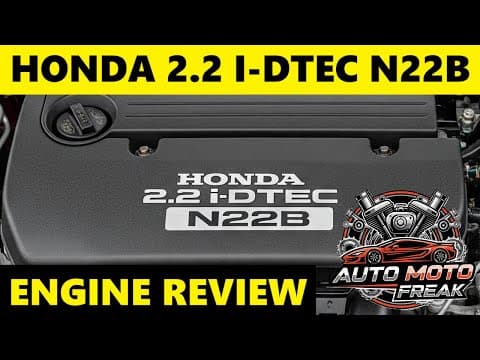
2.2 I-DTEC N22B REVIEW, PROBLEMS, RELIABILITY, FAILURES, FUEL CONSUM, TIMING, OIL?
AUTO MOTO FREAK
10m 32s1,280 words~7 min read
Auto-Generated
Watch on YouTube
Share
MORE TRANSCRIPTS