[0:00]This past month, I have realized a common theme in my life and the life of many others that I am connected with.
[0:09]And that common theme is obsession. As a kid, I was obsessed with finding a better way of living.
[0:18]That that's what I noticed. I I've I've always been a silent observer.
[0:23]I and not like observing people in a judgmental way, but in a discerning way.
[0:28]And I would be lying if it wasn't a bit judgmental at first, but thankfully, I at least try to come to my senses and not be a very judgmental person.
[0:39]I try not to, but you guys know how that is. It's it's hard to escape. But it it would always blow my mind to see how other people lived, right?
[0:48]You can go to the grocery store and you can just see like you can observe silently and discern whether their actions are good or bad.
[0:59]What are they putting into their grocery cart? How do they look? Do you want to look that way? You're trying to notice the reflection in yourself here.
[1:08]What kind of reaction does that cause and what can you learn from that reaction?
[1:12]So one thing that I was very big on observing was the conventional career path, right?
[1:20]You you're told your entire life to go to school, get a job, retire.
[1:25]And the entire thing sparked a lot of questions for me. It's like, why am I going to do this stuff to possibly get a job in this market?
[1:34]Possibly enjoy the the 70% of my life that I have that I don't have to myself, right?
[1:44]You only have like 30% of your life to live on your own terms when you're working eight hours out of the day.
[1:50]And then also, you are possibly going to be set up for success after 65 years.
[1:58]So, thinking back and reflecting on this, I think this was a major reason why I decided to not pursue that path.
[2:06]I I went to school, I ended up dropping out after five years because I switched majors too many times.
[2:11]I didn't know what I wanted to do, right? I I don't think anyone knows what they want to do at 18. They they don't.
[2:18]It's it's impossible to know what you want to do at 18. I I was also the naive young teenager that was like, oh, I know what to do.
[2:22]Oh, I'm smarter than this 30-year-old. It's like, no, you're not. It's temporal leverage. It's time.
[2:28]They're I'm only 25 and I have been enlightened to this fact very quickly that your your brain just isn't developed enough.
[2:37]You can notice it. Like once you turn 22, 23, 24, whatever.
[2:42]Either way, at 18, you're going to be that kid that is like, no, I'm smarter than everyone. It's inescapable, but I'm just letting you know now that when you get older, you will realize some things.
[2:53]And I have like, I'm I'm still in that space where it's like, no, I'm smarter than this guy.
[2:59]And at 40 years old, I'm probably going to be enlightened to many other things that I'm not aware of right now.
[3:05]So, pursuing an unconventional career path is one, something that hasn't been available for a long time, right?
[3:12]I'm very fortunate that I grew up in the time with the internet boom.
[3:16]And I'm very glad that it is continuing to boom because that's what that's that's who I went to to kind of find solace in people that I could connect with.
[3:25]Right? I would follow the YouTubers, the fitness YouTubers and I learned a lot from them. It got me in the gym for 10 years.
[3:31]It uh opened my mind and kind of expanded my awareness to understand that like, oh, there's an economy and then there's a digital economy.
[3:41]And they both work similarly. I need to learn how to get in on this and create something that I can monetize and make money from.
[3:50]And so, that led to me trying, failing seven different business models.
[3:55]If you've watched my channel before, you understand this. I tried everything, right?
[4:00]And then after like four or five years of just trying all of these things and failing, everything clicked because that's that's how it is.
[4:07]You gain awareness from your failures. You find the things that would have led to success earlier that you you just didn't know existed because you didn't dive into it a bit.
[4:18]It's like when you start your first business, it's almost inevitably going to fail because there are just some things that books can't teach you.
[4:24]There are things that you are going to glance over because you just have no idea what they mean, right?
[4:30]When someone's telling you, oh, you need to do this, that and that, a lot of that will not make sense because you haven't gotten to the place where it will make sense to you.
[4:39]Now, after all this time, this has led me to what I am theorizing.
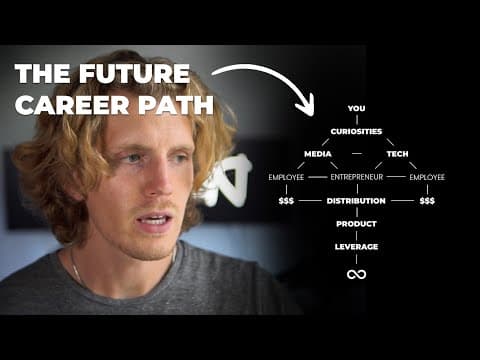
[4:46]This is a theory as the future career path, where what I think a almost everyone will have to do in order to make some form of an income.
[4:56]The human psyche is wired for entrepreneurship. It is wired for survival.
[5:02]That is. In modern day, entrepreneurship is survival. Modern day survival is entrepreneurship.
[5:09]We used to hunt, gather, trade and now we hunt for, let's say, ideas.
[5:17]We gather information, we make connections, and then we trade value through the internet, right?
[5:23]And so, in my eyes, the people and I experienced this at my 9 to 5, is that it's the difference between pursuing an intrinsic hierarchy of goals and an extrinsic hierarchy of goals.
[5:39]And there is a big different big difference there in terms of how your neurobiology is affected.
[5:45]It's kind it's not good dopamine versus bad, but it is pursuing someone else's goals as opposed to pursuing your own goals, right?
[5:53]In the past, there were no corporations or corporate culture. There were communities, but communities are comprised of individuals, right?
[6:03]They are individuals that have their own intrinsic hierarchy of goals within the community's intrinsic hierarchy of goals.
[6:09]They can do their own thing. They can hunt, gather, do whatever they want by themselves.
[6:13]I may be wrong there, but I'm speaking from experience here when I say that building something that you want to build will you will notice the dopamine and other neurochemicals flooding your brain.
[6:30]It feels good. It's progress. But when you do that for someone else, let's say like you're a freelancer and you're doing client work for someone else, you're doing what you enjoy doing, which may be like design.
[6:41]But when you're doing it for someone else, that working on that project does not have the same effect as working on a project that you love.
[6:47]It's like it's skill for someone else compared to art for you.
[6:54]Now, how do we start this? It's it's curiosity. We keep talking about curiosity, but I want to read uh two quotes from Naval's thread called How to Get Rich Without Getting Lucky.
[7:06]The first one is, "Specific knowledge is knowledge that you cannot be trained for. If society can train you, it can train someone else and replace you."
[7:15]Then the next one is, "Specific knowledge is found by pursuing your genuine curiosity and passion rather than whatever is hot right now."
[7:26]So what that means is that figuring things out for yourself, as opposed to doing what other people tell you to do, is how you gain specific knowledge, right?
[7:34]There is and that is immensely valuable.
[7:37]This is kind of a subtle flex, but this past week, I gained 120,000 followers on Instagram.
[7:44]I know exactly how I did that. Other people don't know how.
[7:48]It's not buying followers, it's not any of these like weird hacks. I understand it enough.
[7:54]I've been in the game long enough and dissected the social media platform for long enough to understand, oh, it finally clicked. This is exactly what I need to do in order to grow and it worked.
[8:05]And that's specific knowledge. You will never find that in a course. You will never find that online.
[8:09]You will never find that really anywhere unless I tell you how to do it, but even then, there is so much involved there, like my branding, my minimalist style, and all of this other things, where if I told you what it was, you're not going to get the same results.
[8:24]So you need to figure things out on your own if you want you need to stick stay in the game long enough and figure out that and make discoveries that other people have not made, right?
[8:37]If you dive into an iceberg of whatever you want to master, that is how you get this extremely valuable specific knowledge.
[8:44]So on the topic of curiosity, you have to understand uh conditioning in general, because for the 13 the first 18 years of your life before adulthood, you were kind of told what to be curious in.
[8:58]Things were given to you. There's a common theme here. You may be able to notice, but for the first 18 years of your life, it's like you you have to im imitate people in order to survive.
[9:11]That's what you do. By your parents, you're told, here's what you eat. Here is how you walk. Here is how you use the bathroom. And then you go to school and it's like, here's what you learn.
[9:20]That's it. Here's what you learn. Do your homework. And then your friends, they're doing the same thing with their parents and they start projecting their opinions on you, and you start forming these beliefs that you eventually that those eventually create your identity.
[9:34]We're going to talk about this more in the next video, but you're getting the point here, where as a child, before you were like started learning things, you were very curious.
[9:44]You'd go outside, you'd find the beauty in the flowers and you'd laugh at everything. Sure, you'd cry and you'd poop your pants or whatever you fucking do.
[9:53]But that it wasn't because you were attached to your identity. It was because you're a fucking baby.
[10:00]So, now that we're in adulthood, or you were at least being made aware of this, it things need to switch from cope to curiosity, from, oh, no, there's no other way of doing this to, maybe I could do that.
[10:15]Maybe I it's questioning, right?
[10:18]It's like, oh, that guy got lucky. And it's like, instead, no, stop.
[10:24]What skill did he learn in order to do that? What is he actually doing here?
[10:30]Uh, what goes on behind the scenes? What is he posting about? How did he learn about that?
[10:34]You just ask questions horizontally and vertically until you gain the bigger picture, and then you can make whatever opinion you want to.
[10:41]But aside from that, it's just assumption. It's a blurred lens that you're looking through, and you're not seeing the full picture.
[10:45]You're just telling yourself you're feeding yourself a story that you want to hear based on your prior conditioning.
[10:51]So after questioning, it's let's let's take the example of a skill. Like, oh, what if I did learn that skill that would lead to me doing X, Y and Z.
[10:59]That the next step after curiosity is education. You buy books on it. You look on YouTube. You Google search it. You find the answers.
[11:07]The answers are out there, especially for beginner-level stuff.
[11:12]The specific knowledge that you find by actually doing these things, that comes later, but the beginner level, the principles of all of this stuff.
[11:20]Let's say the skill. If I I could watch a YouTube. You guys are fucking lucky. We're all lucky.
[11:26]You because if I want to learn graphic design, I can go and watch an hour-long video on YouTube that will teach me everything I need to know about graphic design.
[11:36]And then once I do that, and I make a few of my own projects, I can go and apply for a graphic design job, and if I'm smart enough, and the job isn't silly enough to write off talent that doesn't have a degree, which a lot of them are opening up that option, I could get a fucking job.
[11:53]After for watching a few hours of YouTube videos, or I could go and freelance and do whatever I want.
[11:59]So I have a theory which we will dive into more in later videos.
[12:03]But I have a theory that humans are documenting the collective consciousness online.
[12:09]The the internet, social media is a giant mind as is the universe.
[12:16]Again, we can dive into all of my weird theories, but human's make sense of things from stories, labels, concepts, all of that fun stuff.
[12:22]What do we post online? We post the things that we can make sense of. That's what our mind does. It makes sense of things.
[12:28]We're telling stories. We are posting our opinions. We are posting advice. We are posting everything that our mind can make sense of and that we think will make sense to other people.
[12:40]So it is becoming a giant mind. But this means that creators, personal brands, uh, thought leaders, as cringe as that word is, because it's not well known.
[12:53]And I also have a theory that that is going to be one of the greatest uh evolvers of humanity because ideas beget ideas.
[13:06]In order for us to have these innovative ideas, we need more ideas. Like something can't be built unless the idea was birth first.
[13:13]So we need the thinkers that are expanding their mind. But what these creators and personal brands and thought leaders and online educators, they're doing is they're condensing information.
[13:23]I want you to think about this because humans can process around 126 bits of information per second, the things that we are conscious of.
[13:33]Now, what used to take, let's say, four years in an outdated formal college curriculum.
[13:39]Let's say those four that four years of information was uh 60 million bits of information that we had to process, right?
[13:48]Now, from that and from education and all this other stuff, humans and these creators have gotten results.
[13:57]Simplified it into a process that helps people get results faster.
[14:02]They've condensed information. They're putting it in courses. They're putting it online as content.
[14:06]And what used to take that 60 million bits of information to get results, now takes maybe 10 million bits of information.
[14:14]And this process goes on. That's what that's what creation is, right?
[14:20]You are creating better solutions for people and that way, we are able to expand our mind and develop ourselves intellectually a lot faster. Way faster than we used to be.
[14:29]So, now's the time where I kind of transition into the practicality of all of this, where, uh, yeah, pursuing your curiosity sounds great, but like, how how what do you do with that?
[14:36]How do you like actually do that full-time, potentially full-time, or uh, something else like that?
[14:47]So you need to understand two things. You need to understand media and code.
[14:50]So media is the message. Media is communication. That's how we communicate as people, especially online, right?
[15:00]Like we're we're like TVs used to have commercials, that's media, but now, and the shows themselves were media.
[15:08]But now it's online. Everything is media. Literally the front end, the entirety of what we see on the internet is media, right?
[15:15]You don't see the backend, which is the code, which we'll get into. But media is how we distribute the valuable, condensed information.
[15:24]Like the zip file-like knowledge, the 10 million bits of information that you expand in your mind and it or, like I guess, plug into your mind and it gives you what used to be that 60 million bits of information, that's what media is.
[15:39]It's information. So in order to display your value online because we already have the first two steps, right?
[15:45]It's curiosity and then it's self-education. So learning by yourself online, right?
[15:54]And then what do you do? You are a perspective vessel. Nothing is original, but there are original perspectives.
[16:00]And that's where you come in. So the best way to do this, in my opinion, is like, you don't need experience to post a video online.
[16:07]You don't need experience to post an article online. You don't need experience for any of this stuff, especially if you understand perspective and positioning, which is a marketing term.
[16:18]So along with all of this curiosity, if you want to make it work and impactful and effective, you need to understand marketing, psychology, persuasion, possibly epistemology, philosophy, you need to understand the mind.
[16:32]You need to understand how we make sense of things. So stories, metaphors, concepts, what catches attention, what holds attention, what is deemed valuable.
[16:43]That's what you need to do, but you can learn it in public. You can post your perspective on something that you are learning, and you can give credit to people.
[16:51]It's like there are ways around not having experience and building experience, while using this opportunity to post videos, articles, tweets, posts, whatever it may be, as a way to learn more.
[17:05]You learn the most, let's say you're studying design. You will learn the most when you actually create something.
[17:11]And then you have somewhere to post it. You have accountability. You have direct feedback.
[17:17]So, rather than sitting in your room and making fancy little designs or even just learning and not doing anything with it, post it online.
[17:25]It's not like you have to turn this into a business because even then, Twitter, LinkedIn, Instagram, they're all public resumes.
[17:33]You don't even have to grow. You just have to post your stuff and then let's say you apply for a design job, and it's like, oh, let me see your work. Oh, here's my Instagram.
[17:39]They look at it, they're like, oh, this is fucking beautiful. You're hired, right?
[17:44]That's optimal situation, but you get the point.
[17:47]So just by doing this, at a minimum, you are not only learning faster, but you are potentially getting a job, so you can make more money, and then if you want to take the entrepreneurship route, you have a good paying job that you can help fuel that with.
[18:03]Not that it costs anything to begin with, but then at a maximum, you're building leverage for the future.
[18:09]Let's say you're just doing this to get a job, right? Let's say you build 10,000 followers based on design.
[18:16]And then you go and create your own design course because at this point, you have specific knowledge. You've you've done things on your own enough to know, okay, these are the road blocks.
[18:22]I want people to avoid. This is what this is how I would learn it. And all of this other stuff.
[18:29]You package it up and you can give it away for free if you have a bad relationship with like selling courses and other things.
[18:35]Or you package it up into a course or consulting or online mentoring. Imagine this, right?
[18:40]I I've been toying with this for a bit, but why why isn't online mentoring a bigger thing, right?
[18:47]Because in school, it's like, oh yeah, you need mentoring. And so you go after school and uh someone helps you for an hour and you get like one-on-one help.
[18:56]But what about like online, right?
[19:00]What if you know design really well and people that are following you want to learn how to design things so they can increase their own value.
[19:05]And so they hire you for mentoring and you get on a Zoom call with them, and you walk them through. Here's how you design stuff. Here's the design fundamentals, all of this other things.
[19:15]And boom, you make an income and you may have freelance work coming to you and all this other stuff.
[19:21]And this is oh, man, one thing I have to mention, I keep forgetting to mention this, like in blogs and on podcasts, so you this is exclusive for you guys, because one, limiting belief that I had and so many other people have is there is there they don't have the creator mindset.
[19:35]And they don't they think that there is like too many creators when it's only like less than 1% of people are creators.
[19:48]But even then, think about this, how many interests do you have? How many people do you follow on social media?
[19:54]Maybe like two to 500 people, right? Maybe more. Everyone follows that many people, right?
[20:03]Did you ever make that connection? Like even creators, I follow maybe like three, 500 people, and it's because I'm interested in those things.
[20:12]It's not like it's not like someone is going to choose you over someone else because of like, oh, they can't follow enough people.
[20:19]Everyone in the world is going to follow 5 to 700 people, right? There is more than enough work. That's what the creator economy is.
[20:28]It's a self-sufficient utopia. You don't have to sell these digital products only either.
[20:34]You can sell more than that. If you want to open up a farm and uh be like your followers go to grocery store, then you can do that.
[20:44]You can sell anything that's already selling. If you want to learn how to create fucking refrigerators and sell refrigerators to someone, be my guest.
[20:51]So, we understand media, the front end of the internet. That's how you communicate. That's how you capture attention. That's how you potentially sell something of value to someone else and make an income for yourself.
[21:02]Now, there's code, which is the back end of the internet and what houses all of this stuff and uh is what like the advancements of tech and code allow for more creativity.
[21:14]We are kind of replacing some jobs here and there, but we're creating new jobs.
[21:19]Creators or uh whatever this is or even sometimes freelancing, it it wasn't a thing before.
[21:26]Like we're creating an entirely new digital economy. That's why I started digital economics, my own school for this stuff, is because there's a fit there. I want to train people to be able to fuel this economy.
[21:39]So, the thing about code is it's very similar in the fact that you can self-educate online.
[21:46]You can learn how to code. You can increase your value very, very quickly, and you can get a get a job.
[21:52]You can get a job without a degree in 6 to 12 months.
[21:57]That's what I did. I got a job in a year by learning to code. I used my income from that job to fuel my side business and now it is it has been my full-time business for three years.
[22:09]Now, the brutal combo with this is that the coders have kind of made their own jobs in a sense where it it's not only about web design now.
[22:21]It's not only about building fancy websites. It's not even about building SAS or software as a service.
[22:27]It's not they've created no code tools for these things. So there's drag and drop website builders, right?
[22:34]The my point here is is that you anyone can take what they're curious about, build their own website, build their own email list.
[22:42]Sign up for a free social media account. It's all free. And then you start attracting an audience by learning psychology, all of this other stuff.
[22:50]How like how to catch attention and you dissect the social media platform. So you understand how do I get eyeballs on my profile?
[22:58]Because that's how you gain followers, right? That's it. That's what a lot of people start up as. It's not just posting content.
[23:05]You have to get eyes on your profile in in order to get followers.
[23:09]So now, I want to read this quote to you from Jack Butcher, who's a designer.
[23:14]So it's kind of fitting, but he said, "Build distribution, then build whatever you want."
[23:21]So, as we've learned, uh, this is important.
[23:26]Distribution is just potential traffic. It's it's an audience, it's an email list, it's communities.
[23:31]It's your network's audience. It's everyone that can send traffic to something, right?
[23:38]So let's say I build uh 100,000 follower audience. Let's say I want to sell a physical planner, which I actually used to.
[23:45]I want to sell a journal easier.
[23:49]I want to sell a journal, and I have my friends on the internet. Let's say I have like five friends, I connected with them in the DMs. They have 100,000 followers too.
[23:59]So now that's 600,000 followers, five 600 something.
[24:04]And now I reach out to them. I write a post, promoting my new product. I have them send traffic to it, and I get that many eyes on my product.
[24:14]If I make a lot of sales, that's a lot of money. So that's the point. Build distribution and then build whatever you want, because at some point, when you have enough traffic, you really can build whatever you want, especially like you see Mr., not Mr. Beast, he's not a very good example.
[24:30]But you see people online where it's like they have their merch, they have other things that are exclusive to them, and they have distribution, and so they're going to sell it to them.
[24:37]Now, with all of this, the world is going personal. We're losing trust in formal education.
[24:43]We're losing we're losing trust in corporations. We want that human connection more.
[24:49]And the thing with that is is that as I've illustrated in this video, everything's kind of going decentralized, right?
[24:56]YouTube can is educating people on modern skills much faster than colleges are.
[25:01]People are flocking there and learning and making as much money as they want because that's just how that's what happens, right?
[25:09]And it's going to continue to move more individual as it would.
[25:12]It used to be individual, like individuals within communities, and then corporations were like, oh no, I'm going to come and take this all for myself. And now it's going back to individuals and communities.
[25:22]So keep an eye out for that, because a lot of people are talking about this, and it's inevitable.
[25:29]I mean, I'm a part of it, many other people are a part of it. And with that, I I also want to read this quote from Naval.
[25:35]Naval was a huge inspiration for this video and everything else that went along with it.
[25:39]"There are almost 7 billion people on this planet. Someday, I hope, there will be 7 billion companies." Naval.
[25:48]And the thing with this is, like, I didn't understand it at first. It's like, 7 billion companies? Like, no way.
[25:53]Not everyone can have a business. And then maybe a year or two after being exposed to this quote, it's like, yeah, this is actually can happen and probably will happen sometime soon.
[26:07]So, might as well just try to take advantage now. So, let's make this even more practical, right?
[26:13]I'm a fan of practicality. I'm also a fan of theory as you can tell at the beginning of my video. So people that stay later in my videos, they get a bit of like a treat.
[26:20]Now, but this may be beginner level advice. This is beginner level advice. But for the people that just like want to learn more about this, I'll I'll give some to you.
[26:28]So, when it comes to products and services, there's three different types you can sell, right?
[26:32]There's done for you, done with you, and do it yourself.
[26:36]Done for you is like freelancing, where you literally create, let's say, a website for someone, right?
[26:43]And then there's done with you, which is like consulting or the online mentoring thing I was talking about, where you get on a call with someone or you're in the DMs with someone and you help them with whatever problem you can solve because of your expertise.
[26:58]And then there's do it yourself, which is something like a course, where you package up that information that you have and you sell it and distribute it to other people.
[27:06]So, another Naval quote. What do you know?
[27:09]The first one is a quote from Archimedes, but it leads into the next one very well.
[27:13]So that quote is, "Give me a lever long enough and a place to stand and I will move the Earth."
[27:21]And then after that follows from Naval, "Fortunes require leverage. Business leverage comes from capital, people, and products with no marginal cost of replication (code and media)."
[27:33]So, this is like, I've been dissecting Naval's philosophy on this and have kind of it's become my own philosophy without even realizing that it was from Naval.
[27:44]But this is how you make a fortune for yourself, and we're talking about like wealth here, not just riches, right?
[27:50]We're talking about having more than enough money to meet your basic needs and do what you want.
[27:57]It's what humans are meant to do.
[28:00]So, with all of that, start building leverage. Start posting online.
[28:06]You don't have to be in the entrepreneurial mindset yet. Eventually, you will be, because it's part of your psyche.
[28:13]But start posting. Why not? You learn faster, you possibly get job opportunities. It's personal growth.
[28:20]It really is. It it sheds light on your blind spots very quickly, and it helps you it gives you a project to apply everything to, right?
[28:30]You you might not be remembering or experiencing certain things because it's like I don't have a place to actually uh utilize this thought or idea.
[28:38]That's the difference between a thought and idea is utility, right?
[28:43]So you're out and about, you're having this thought, and then it's like, oh, I could write about this online. And so you start to organize it, and you're like, how can this actually help people?
[28:50]And so it's it's great, because you start turning everyday experiences into life lessons that not only you benefit from, because they get solidified in your mind that way, but you're helping other people, and you're attracting an audience, and you're actually doing some good in the world, and you're impacting people where it truly matters, and that is their direct human experience.
[29:12]So, that is it for this video. I have more coming to you next week.
[29:17]Next week, we'll be talking about intelligent imitation, but for now, uh check out the links in the description.
[29:24]There's the private community. There's the 10x your creative output free challenge, there's the power planner, which is also free.
[29:30]Uh the podcast, all of that fun stuff. Uh be sure to like, subscribe, and enter the rest of the generic end of YouTube call to action here, and I will see you in the next video.


