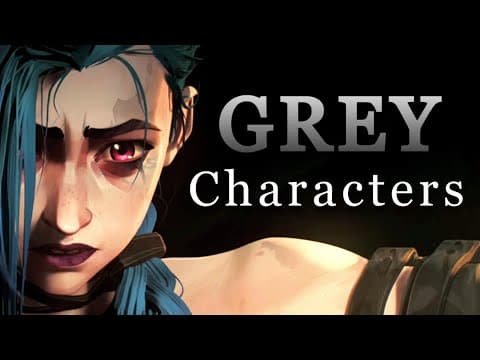
[0:03]What was going through your head when you watched this moment? How many separate feelings, like mutually exclusive feelings were you experiencing all at once? Were you happy for Jinx? Because I was, even though she was sad, even though she was devastated, even though her life was falling apart, I was happy for her for finally embracing who she is. And I also felt guilty for being happy because it came at the expense of all these other characters I've grown so attached to. I knew exactly what had to happen here, why it had to happen. Everything felt right, but I also felt lost. I felt catharsis, but I also felt hopelessness. And I really think that sums up the power of a morally ambiguous story. Pendleton Ward, creator of Adventure Time, was asked what his favorite feeling was, and he said, "Being happy and scared at the same time. It's my favorite way to feel. When I'm on the edge of my seat, but I'm happy -- that sense of conflicting emotions." And that really nails how I felt and how I think a lot of people felt with this story. So, what went into that? How do they get the scene? How do they make it? And I think you have to say it's from the characters. Every single one of these characters, we ended up with this complex relationship with before we even get to Jinx. Silco. You're perfect. That scene, how did they do that? That moment was crazy. Vi, we want her to get Powder back, but we really understand when Jinx turns her back on Powder and on her sister. That is a complex relationship. That took a lot of work to get there. Jayce, we're frustrated with, he finally is making a good decision, but man did he make some terrible ones leading up to this. Mel has this moment of redemption that we respect, but we see it's way too late. We got seven episodes of corruption and greed, and we have a hard time saying she doesn't deserve this. Viktor, we're disappointed by him, we're sad that we have to be disappointed. And that's not even everyone, it's all the characters in this show. How does all of it work?
[1:39]Can we trace all of this good complex writing into some step-by-step kind of guide? So, yeah, let's try to do that. I count nine methods of creating moral ambiguity in characters and four rules that have to do with plotting and world building. There's probably more, but let's start the discussion here. See if we can spell out all of this clearly, specifically, step-by-step. And then I'll let you tell me what else you found in the comments, and we can build on this. Okay, so let's talk about Silco, method number one, 4d characterization. And, that name sucks. I hate that term. I came up with it. I know, but it just sounds so cheesy. I do think it fits, and I think it's good to name things so that they're easier to talk about. But yeah, the name could use some work. So 4d characterization, what do I mean by that? So let's talk about the terms people use. One-dimensional and two-dimensional characters are similar, any characteristics they have are surface level, there's no depth, limited range to how this character acts. We call these characters one note and flat. Three-dimensional characters we call round. We see different sides of them, we see an arc, we see that change, that before and after, that tells us a lot about the whole character overall. By seeing how they change and what they changed into, it gives us a picture of a full person. 4d is a term I'm giving to characters who have two arcs that give us two pictures of two full, entirely separate people. These are two arcs layered on top of each other, they consist of the same set of events, but tell two full versions of two fully different characters, even though there's only one actual character. And the reason I'm stressing the difference, the separateness, is that these aren't two interpretations imposed on the character from the audience. These are two arcs that are quite different, mutually exclusive even, and this is intentional by the writer(s). It's not a door they left open for audience input and speculation, this is the intended takeaway of this character. So anyway, I talked about this before in a couple videos about specific characters. But here I really want to go into the methodology, a real step-by-step look at how to do this. So here are the characters they do this with. And there's a really precise way of sequencing this, and they do it with each of these characters. The surprising thing, perhaps, is that we must start with no ambiguity at all. We are firmly on one side of the eventual contradiction this character presents, but nope, not yet, no contradiction at this point. At this point, the character is 2d. These characters may come off as interesting, but right now they're flat, they're almost caricatures. Silco is the shadowy villain, he's scheming, he's all about the corruption, the under the table deals, and eventually he's about breaking those deals, cruelty, bloodshed, monsters. We get the surprise appearance accompanied by the "You just walked into my trap" slow clap and monologue. But Ambessa, we get the ruthless warlord, very Robert Baratheon, indulging herself, palling around with characters who are trying to be serious, pushing them to do things for her benefit and their detriment. And of course, Heimerdinger, the wise old mentor, level-headed with centuries of life experience. So that's step one. Step two, is the ill-fitting moment, which is exactly what it sounds like. This is a very in-your-face moment, a reaction, a decision that just does not fit the character as we know them. But it's a very particular type of ill-fitting. It has to be three things. One, intentional, two, it has to provide us with a paradox, and three, it has to provide us with two ways of explaining it. The idea basically is that this isn't a character flaw, it's not a moment of weakness, this is something we didn't understand about the character. With Silco, it's this moment.
[4:39]It's okay.
[4:45]Silco, the cartoonish criminal mastermind, no qualms about killing at all, stabbed Vander in the back, ready to kill his whole family, ready to kill Powder. Then she hugs him. He does this.
[4:56]And then this. And we can see how ill-fitting this hug is by the way basically everyone around him reacts. They don't get it, and we don't get it either. But, it's this that makes us go, "Huh, okay, okay, I guess this is what I didn't understand about him." His trauma of Vander, his brother's betrayal, wasn't just something that changed his life, it was something that isolated him. And when he sees this child in the same position with her Vander, her sister, he sees himself in her, and he empathizes. He wants revenge on the world for how it treated her, just like he wants revenge on the world for how it treated him. Or, we see this moment and go, "I guess I can fit this into my old understanding of Silco." Silco, the super villain, he sees this kid, this monster, and Silco's like, "I love monsters." She takes everyone out in one shot, she's a force of nature, perfect. And she's basically already loyal to me for some reason, I'm going to use this child. It's a completely unempathetic reaction, cold, calculating, villainous. So now Ambessa, her ill-fitting moment is obviously the "You weakened me" moment. Because you weakened me. I couldn't endure the look in your eyes whenever I made the decisions, the necessary decisions, to keep us safe. And we're like, "Huh, I thought she was ruthless, I thought she didn't care." And again, even Mel is shocked. And either this is a revelation, explains all the posturing and pompousness, it's Ambessa projecting strength to cover up these insecurities, these vulnerabilities. Or she's manipulating the heck out of Mel in the cruelest way possible, playing on her desire for acceptance, it's this "I love you all along" moment. And also it's playing on her tendency to be soft and to give in to things that appear poor and helpless. With Heimerdinger, it's the "Decades" scene. But give it a decade of careful research, and it will be ready. And this one isn't totally out of the blue like the others, but it's still this, "Wait, what?" moment. And again, we get confusion from the characters and a clear moment of re-evaluation. Like I said, my Heimerdinger video. Is this guy old and wise? Or is he just old? So what happens after the ill-fitting moment? Well, we see after this is the story confirming the complexity. We need to see this character acting unlike how they acted before all this, showing that yes, this really did happen, it wasn't a moment of weakness. This needs to be incorporated into your understanding of this character one way or another. With Silco, we get all the dad scenes. There's clearly a bond here, even though part of us and also Vi think he might just be manipulating her. Heimerdinger is the most radical, everybody just turns on him. But still, this question about whether he was really wrong about all this. He was definitely wrong about something, maybe it was the risk assessment, or maybe it was just not being empathetic enough, his communication skills, but he was really right about everything else. And Ambessa, she's a minor character, we don't get much, just this one scene where she doesn't even speak. But the function of this scene is clear when we consider the contrast from what we've gotten until now. Every scene we see her in, she's throwing her weight around, she's bombastic, she's indulgent, she's domineering, just raw warlord energy. And here we have a very muted response to when Mel did to the painting. Maybe she's upset, maybe she feels guilty, maybe she's calculating, figuring out her next manipulation tactic. She's thinking about her relationship with her daughter, and it's complicated, that's about all we can say for sure. So confirming the complexity, that's the next step, and just to flesh this out a bit more with Silco, who I think gives us the most thorough picture of how this double characterization is done. After his ill-fitting moment, we can look at each scene and ask, is he the super villain brainwashing manipulator? Is this scene brainwashing? Is this scene manipulation? Is he going to betray Jinx for Jayce's deal? Does he actually think she's perfect, or is he telling her what she needs to hear in order to do this? Or is he a loving dad? Does he discover his capacity for love here? Is he bonding with his daughter here? Does he not want to go to war during the time skip because he now has something to live for, something to lose? For this character who's all about breaking down barriers that keep us from power, is expressing selfish genuine love the final barrier he breaks, rewarding him with the war he's always wanted? And we get scenes that are pulling us stronger in either direction. Some scenes are there to make us remember how ruthless and power hungry he is. And other scenes are there to make us question that version of the character, see the good in him. But the most important thing, none of these scenes are conclusive. They can each be worked into both narratives, both arcs. So that's 4d characterization, we start with a 2d super villain, the 2d warlord, the 2d mentor. And with the ill-fitting moment, we create depth through two mutually exclusive arcs. And that's where we get the moral ambiguity, one version of this character is morally favorable, the other version is morally condemnable, and the story keeps us guessing. Okay, method number two, defining moments of weakness. And this is what we get with these characters, Vi, Viktor, Mel, Vander. And this is actually one of the more common methods in fiction in general. The 4d thing, pretty complex, especially if you're doing with multiple characters. It has to encompass the whole character arc. The "moments of weakness" method is similar, but it's about moments in the character arc. Moments that make us question our judgment of the character. We see something much different in the sequencing here. The character is already well developed, they have goals, conflicts, nuance, and then something unfortunate happens. We see the character have an uncharacteristic moral failure, and the rest of the show, they're dealing with the consequences of that moral failure, trying to redeem themselves, both in story and in terms of their relationship to us, in terms of our judgment of them. So the moral failure, it is very similar in function to the ill-fitting moment. But let's look at Vi to see how this plays out differently. So Vi, very developed by episode three, lots that she's struggling with, interesting relationships, interesting challenges, etc. And up until this point, we judge her favorably, we are on her side. And then, of course, I told you to stay away! It's heartbreaking for us. She was never anything but protective and loving until that one brief moment of weakness, and that changed everything, and she's dealing with the consequences from that point on. Okay, now the difference comes after that. With the 4d thing, after that, it's confirming that this complexity exists, that it happened, that it's part of the character. Here we get the opposite, after Vi's moral failure, she's the perfect sister. She never gives up, she's trying her hardest to demonstrate that she's not that person, but the world around her is treating her like that person. And it's not even necessarily because of that moment of weakness. Silco sees her as this destructive corrupting force in Jinx's life, because she, like Vander, is not all about this monster stuff, but he is. Jinx is questioning her own judgment of Vi, because of the past, but also because of Cait, because how she believes Vi has changed, whatever it is. So that's the general pattern, we have a developed character, we have a moral failure, and that colors our judgment of the character. And then after that, the split between how the character acts and how the world treats them demonstrates that dichotomy. By Vi's actions, she's this almost idealized perfect sister, but the world around her treats her as the absolute worst sister. And the audience, we're left trying to figure out how we should treat her with our judgment. So with Viktor, we see a very similar pattern here, very developed, interesting, et cetera. He's altruistic, courageous, humble, intelligent, we're rooting for him. We even get why he has to go to Singed, and when he uses shimmer it works. And then in a moment of real stupidity, the only time we ever see this character being dumb, he realizes he's out of shimmer, but uses the Hexcore anyway, and he kills Sky. Again, a heartbreaking moral failure, and by the end, it is hard for us to judge this character after what he did. He has this sense of doom about him for the rest of the series, even though he tries to act morally. And the show's reinforcement of our mixed feelings about him is the punishment he receives along with everyone else around him. We'd feel a lot different about this scene if Viktor never did anything wrong, but this is a scene of Zaun punishing irresponsible, blind, cruel Piltover, and we can't fully exclude Viktor from that category. With Vander, this works a little bit differently. The moral failure happened before the story begins. He's all about loyalty, especially with family, but he betrayed his own brother-in-arms, and this haunts him. It causes all of his problems and his eventual downfall, and possibly his death. For Mel, we have the inverse. Mel spent seven full episodes being the greedy corrupt politician, risking the fate of her city on this dangerous technology. And then she has a change of heart at the end. We don't get an uncharacteristic moral failure, we get an uncharacteristic moral triumph. But it's the same dilemma. Do we define the character in our judgment of her based on just this moment or based on everything we've seen leading up to it? And surely the strange compulsion we have that this technique plays on. We feel the need to resolve our feelings about characters into this overall binary judgment. This character is good or this character is bad, with little room for complexity. As opposed to the 4d thing where we're unsure of what we're seeing, it's qualitative doubt. With moments of weakness, the facts are clear, we just don't know how to feel. And no moment do we doubt if Vi really hurt Powder in a moment of rage or Viktor really made his stupid mistake and killed Sky. It's quantitative. How much bad is too much for a character we respect? How much good is enough to change our mind about a character we condemn? I think Lady Eboshi in Princess Mononoke is a perfect example of this. She's built up as this villain, but we see that despite killing gods, she's helped all these people. The same with her lepers, we see that there's a lot of good, along with a lot of the bad this character has done. And the story leaves us in this uncomfortable place where third words hard to judge, hard to define. Game of Thrones also uses this heavily. Cersei is almost entirely morally reprehensible except when it comes to protecting her children, she's a good mother. Jamie lives this whole life of being an amoral bully, and then we see him change and grow and become a different person. Catelyn is a great person except when it comes to Jon. So that's method two, defining moments of weakness, do we define you by your moments of weakness or by the full picture of the rest of what we see? Method number three, the well-intentioned idiot. And here we're talking about Jayce. This is common enough, I think people know what it is. I just want to point out a few things Arcane did to supercharge this archetype. First of all, they made sure there was no question that Jayce is morally pure to his core. He's altruistic to the point of dumb idealism. They gave us a defining moment in his past that sticks with him to this day. And then they made sure that his entire arc is only about morality. It's never a question of ability, Jayce is almost unrealistically good at whatever he chooses to do. This distills the focus of his arc to just these decisions, him trying to do good. And of course he can't, each of his decisions go drastically wrong, and that's step three, nothing works out morally for Jayce. Stuff blows up, people die, there's corruption. He decapitates the council of its one voice of wisdom. And even though he tries really hard in the end it's his own altruistic science that ultimately dooms his own city. Nothing worked out despite Jayce's pure intentions. Now, you can do this archetype and not go this hard, but Arcane's version is just so potent. I think this really is the way to do it. So once again, step one, make us certain the character is moral, step two, make the morality the center of every decision, step three, make everything ultimately fail morally. Method four is the chronologically immoral character. And our three examples of this are Heimerdinger, Singed, and Ekko. This is a character that may appear immoral from the time frame we're in when we first encounter them, but then we realize that they're working in a different time frame. They're thinking about time differently from us, they have a whole moral argument for viewing time that way, and in that framework, these characters are absolutely moral. And there's two versions of this, the character who's stuck in the future, and the character who's grounded in the present. For our future characters, Heimerdinger and Singed, we see certain parameters they follow. This character is usually old, they have grand concerns, and their entire life is consumed by that grand framework. The grandness is what disconnects them from the present, and very specifically, it also disconnects them from people. Heimerdinger's chief concern is the city, it's Piltover as a whole. His role as a council member, as the head of the academy is so consuming in his mindset that we see him unable to interact with individuals on a human level. He can't find it within him to care even for the life of someone close to him. For Singed, that grand framework is science on the whole, and the way they disconnected him from people is that they disconnected him from people. Pretty straightforward, he's a hermit. The arc with these characters, if they have one, is usually reconnecting with the present, reconnecting with people. This super long-term framework the characters are in, we're supposed to see as defensible but ultimately incorrect. For present-oriented characters, we often get the opposite, the character is young, the character is disconnected from grand concerns, only connected with people. These characters are actively engaged in humanitarian efforts, that's their life. It's consuming of their life in the same way the grander framework is for the future characters. With Ekko, we see this with his community. He doesn't care about Zaun, doesn't care about Piltover, he doesn't care about science or politics or any of that. It's just helping these people now that dominates his whole life and his whole mindset. And they don't play up the ambiguity here as much. So we do see it in brief ways. Ekko tries to turn Vi against Jinx because that's the reality now. She's a danger to people now, that trumps whatever she was, whatever she could be. Heimerdinger is disturbed by how unsafe Ekko's hoverboard is, and Ekko explains his present-focused mindset here and in his community as a whole. The arc of this character is usually convincing others to adopt his framework, and this framework is usually the one confirmed as moral by the story. But this time frame question is an effective way of making us unsure how to judge characters and their decisions. It makes their choices understandable, but often not quite right with us.
[18:59]Okay, so at this point, it's necessary to take a break and talk about world building for a bit. Because moral ambiguity isn't just about characters, it's why you have to shape your whole story. It's why you have to craft your setting, it's why you have to shape the plot. So rule number one is about setting, but really it's even a little broader than that. Things are not what they seem, very simple rule, very common, easy way to make depth. But usually just to make things more interesting, here it's necessary. And this is a larger fundamental in storytelling. You need to signal to your audience how deeply you want them to think into your story. If I see an ill-fitting moment in like Sesame Street, I'm just going to be confused. I'm going to think I'm misunderstanding something. So these morally ambiguous stories, they take a whole lot of elements early on and demonstrate clearly that we should withhold judgment until we know more. Princess Mononoke, we start out with a demon that isn't really a demon but a dying god. And what killed it seems too small to kill something like this. The monk is the most corrupt character. Don't be afraid of the kodama. This is before we even get to the characters and their moral ambiguity, which they also set up very carefully. The first Iron Town people we get are helpless victims. San is, well, San when we first see her. And then in Game of Thrones, monsters and magic don't exist, but they do, the wolves are our friends. The bastard is the most noble one, the White Knight is the most treacherous one. The king is a drunk, the other king is a total weirdo. And this is why I'm saying it's the setting, but it's also more than that, it's the big picture we're seeing. And in Arcane, we get this similar complex big picture. Piltover has this pristine facade like it's a Utopia, but then we learn the people here are two-faced, corrupt, bigoted. The Undercity looks like this dangerous "Poroh-eat-poroh" world, but no, everyone has each other's backs. The families are close, closer than in Piltover, we see tiny beautiful stones that can kill you. The characters who boast and mock are really insecure. The characters who appear to be on one side might be talking to the other side when no one's looking. These little subversions may have little to do with the actual morality of the story, but without a world like this, a big picture like this, we won't feel as compelled to question what we're seeing. Without this, the moral ambiguity may not fit as well, the audience may not even know it when they see it. Rule number two has to do with plot, but again it's also broader than just plot. Rule number two, the story, its themes, its world, must present unanswerable questions. And these are mostly the kind of moral dilemmas that humanity as a whole has never and probably will never agree on. These broad questions, do the ends justify the means? Poor stealing from the rich, is that morally okay or is stealing wrong period? Law enforcement, what do we think of it? How much is too much? Is scientific progress good for the world? Should we engage in corruption if that's part of how society works? And at what point is revolution necessary? And this also includes undefinable situations where the show presents a specific scenario and withholds information from us. Should Viktor develop the Hexcore? You cannot have an opinion on this question, the Hexcore isn't real. We only know what the show has told us, and the show hasn't told us enough. We don't know how dangerous it is. We have to wait for the show to tell us more. Should Piltover go to war with Zaun? Do we know the capabilities of Piltover, the capabilities of Zaun, enforcers' numbers, chem-baron resources? No. These scenarios are meant to be unanswerable, and the great thing is that it doesn't stop the audience at all from having opinions on this. Heimerdinger was stupid for trying to stop Hextech. Caitlyn is evil because she's a cop. Vander is good because he wants peace. Zaun is evil, Piltover is evil. From my point of view, the Jedi are evil. And some of these opinions will be founded in some greater thought-out philosophy of the person, but even those opinions will seem into these not enough info situations as well. And without these unanswerable questions, then a lot of these archetypes just don't really function. Because even if the character set up itself makes us ask these questions, the actual moral path is just too clear for us to be compelled by these questions. So rule number two, piggyback your story's moral ambiguity off topics, questions, situations that already have that ambiguity. And you can also manufacture these situations, these questions by withholding info. Rule number three, I call backwards fate. Characters should be punished for doing good and rewarded for doing bad. This has to do with plotting in a sense, but also how the world works, how fate works in the world. Piltover oppresses Zaun and becomes wealthy. Silco breaks his deal with Marcus, stabs Vander in the back, and is rewarded with power. Jayce does dangerous experiments and becomes a celebrity, and then engages in corruption, gains political power. Viktor invents life-saving technology and gets shut down by Heimerdinger. And then he uses it, and his lab assistant is killed. Mel becomes rich and powerful off of corruption, she decides to change her ways, and then like 10 minutes into her redemption arc, she gets a missile in the face. This doesn't always create moral ambiguity directly, but it does make us as the audience feel outrage, it makes us feel lost. It makes us crave justice, crave moral resolutions, which we won't get. So basically, it creates a more dynamic environment for the moral ambiguity to thrive. And lastly, rule number four, maintain a spectrum of morality with your characters. And this is what's going to lead us into our next couple archetypes. Moral ambiguity is interesting. But if you make every single character this grey mess of confusion and complexity, it's exhausting, it's boring, and it actually usually simplifies your story, ironically. Show the audience a variety of moral, immoral, amoral ways of interacting with their story's conflicts, and that will let you explore these conflicts more fully. And with the characters we talked about so far, we see a lot of varied shades of gray. Singed and Silco, more towards the grey villain end of the spectrum, Vi and Vander towards the grey hero end, and Jayce and Heimer in the middle. But there are a number of characters who just aren't gray, if we're being honest. The story does not leave it ambiguous, it gives us a fairly clear picture. Ambessa and Marcus are morally bad, Cait and Ekko are morally good, unambiguously. And that's what we're going to have to deal with next. If a story is all about the moral ambiguity, what does it do with these goody two shoes characters? So that's where method five comes in, method five is all about these goody two shoes characters. Something that the show makes all the characters do, but Cait more so than the rest of them, is judging other characters. She judges Vi multiple times throughout both characters' arcs. And through her judgment of Vi, she judges Zaun as a whole as well. She judges Jayce and Piltover as a whole. This scene with Marcus is partially intended to be about her judging him. And the final big decision of her arc is her judging Jinx. And like I said, that's not relegated just to Cait, everyone judges each other. We get Sevika judging Vander, judging Finn, judging Silco. We get Jayce judging Heimerdinger, we get Viktor judging Singed, Ekko judging Jinx, Vi judging Jinx obviously. And we also get Vi judging all of Piltover, Marcus judging all of Zaun. And these judgments, by the way, should come with action. It's not just about the label, Jayce judges Heimerdinger, and then kicks him off the council as a result. Cait has to kill Jinx if she judges her unfavorably, which she can't. Same with Ekko. And important to point this out, this is the other side of Marcus's scene with Cait. Marcus is an unambiguously bad character, we make a bad character judge a good character. That's also very interesting to us. And he also has to act on it too, and he can't. So take your characters, especially your most moral and immoral characters, and give them these kinds of morally difficult dilemmas, requiring not just judgment but action. It highlights what moral ambiguity we already have, it can also create it in the character's response to these dilemmas. Okay.
[27:50]Part two of this video is only about Jinx. There is that much to talk about. You'll notice that our gal was conspicuously absent from all the methods we talked about above. And that's not because those methods don't apply to her, it's because all of those methods do apply to her. And I'm being absolutely literal here, every single one of those things we talked about applies to this character. And I'll get to that after we talk about methods 7, 8 and 9, which are Jinx specific or Jinx prominent at least. So method 7, excuses. Jinx does some of the most blamely evil things in the entire show. She kills lots of people on purpose for almost no reason, really so she can sneak in a little shy uwu hug with Silco while he's distracted by Shani. We honestly don't even get scenes of Silco committing murder like that. We don't see Singed doing it, we certainly don't see Ambessa or Marcus doing it. And Jinx also kills a random animal also just for no reason, like literally no reason. She kidnaps people, she probably tortured Sevika here a little bit.
[29:02]She also demonstrates very little remorse for anything she does, but she gets a pass for us in a lot of ways. Emotionally, we want her to succeed, we're still on her side. How does that work? You telling me if Vi killed some random bird, we'd still be on her side? If Cait killed some random undercity people to impress her dad, no, that's awful. So why does Jinx get a pass? Because Jinx has excuses. Jinx is brainwashed by Silco. Jinx is not fully in control of her own actions. Jinx is suffering, a corrupting influence, mental illness, and pain can make moral judgment a lot more difficult. And we really get that with Jinx. That's method number seven. Number eight is amorality, and this applies to Singed too. Removing a character from all the moral questions of a story has this weird effect. So much of how we judge morality is ideology or some big picture. What are your actions contributing to? If dude A beats up dude B, that's bad. If dude A is a racist and dude B is a race he doesn't like, that's even worse. There's no greater framework to Jinx's actions. She doesn't care about Hextech and the dangers to the world from weaponizing it. She doesn't care about Zaun, doesn't care about Piltover, she barely cares about other people in her own crew. She lives within this like 4x4 little bubble of her own life. And this makes it so that when she hurts someone, it's almost innocent. She's just trying to impress her daddy, and her amorality also leads her to do some moral things, like leaving Cait alive. With Singed, he saves Jinx's life. Amorality just confuses us. We don't know what to do with people who just don't care. It's another great way of making it harder to judge. Okay, now method number nine, my absolute favorite, worlds are colliding. I'll defer to an expert to explain the intricacies of how this works.
[31:22]Jerry, don't you see this world here? This is George's sanctuary. If Susan comes into contact with this world, this world's collide. You know what happens then? Worlds are colliding. This is when you have two things that are good, that we have good feelings about, that are positive forces in our story. And then you pit those against each other. And you can do this at a fairly tame level, antagonism between two disconnected characters, which is what Seinfeld is playing out with the exaggerated worlds colliding phrasing. Or you can go all out. And Arcane goes all out. Here's how to do it. Step one is setting up the worlds. Arcane does this on two levels, we have two settings, Piltover and Zaun, we have two major plotlines, one about science, the other about the sisters. Step two, keep those worlds separate. Piltover and Zaun each have their own set of characters. These characters spend most of their time in their respective spheres, dealing with specific problems of those spheres. When characters do leave their spheres, that leaving itself is highlighted. They're not supposed to be in that place, and the story makes that clear. Characters are allowed to drastically alter the status quo of their own spheres, but any effect on the other sphere must be undoable, manageable, fixable, even if it's through some great sacrifice. The two plots, science and sisters, happen alongside each other, but they're also kept largely separate. There is more crossover here with Vi, Silco, and Cait to some degree. But again, Jinx doesn't care about the science plot at all. Jayce, Mel, Viktor, Heimerdinger don't even know about the sister's plot. So the worlds are kept separate. Step three, emotionally invest the audience in both worlds. We want the sisters to reunite, we want Piltover and Zaun to make peace, and we care about all of these characters. The story goes through so many steps to make sure we feel for each of the players in every plot. Even Mel, who we don't necessarily feel for at first, we're on her side by the end. Jayce redeems his foolishness, finally, and he makes a smart choice. We don't want these characters to die.
[33:56]And then the final step, the collision itself. In Arcane, it's not just pitting the two worlds against each other, it's one world actually obliterating the other, allegedly. And it's also the resolution of one plot undoing the resolution of the other plot. Now, the important thing here is that there is a universe where the worlds don't collide, where everything stays separate and it all works out. Zaun and Piltover make peace, the sisters reunite. Arcane holds this possibility out to us like a carrot. It seems like everything is going down, confined to their own worlds. And then, no, of course not, for Zaun to win, Piltover has to lose. For Jinx to accept herself, she has to kill half the characters we care about, allegedly. We want Zaun to win, we want Jinx to find peace with herself, but now we're in conflict because of how these things happen. Just like with the defining moments of weakness, we cannot have a unified favorable judgment. If we're 100% happy that Zaun finally fought back against their oppressors, that means we're also happy these people died, allegedly. And just to point out, that was the big example of worlds are colliding, but they actually do this twice with Jinx. The other time is in act one, where we have two separate arcs, the Vi Powder arc and the Silco Vander arc, and they didn't have to coincide, we didn't expect them to. But no, then we got this. We want Powder to be happy, but not with Silco. And this isn't pitting two good worlds against each other, this is the inverse. The good world's interests line up with those of the evil world, and we see an alliance we never wanted to see. A positive collision, I guess you could call it. A union that's constructive in a way that horrifies us. So that's world collide. Set up the worlds, keep them separate, emotionally invest us, and then have the worlds finally meet, but in the wrong way, good against good or good embracing evil. Okay, and to tie everything up in a bow, Jinx isn't just method 7, 8 and 9, she's methods 1 through 9, all of them. Which is nuts, it's insane that they did this. Our 4d characterization, the two parallel arcs, here they even have separate names, Powder and Jinx. It's the whole question of this character in acts 2 and 3, born from this ill-fitting moment, same as Silco. Number two is defining moments of weakness. And this is the whole question of this character in Act 1. Do we judge Powder by her failings, by her weakness, as a Jinx? Or should she be included in the team? Is she no different from these people? Is what makes you different makes you strong? Number three, Powder is smart enough to recognize a real Valdian, but not quite smart enough to not kill her family. Very much a well-intentioned idiot. She wants to be helpful, she's this little innocent kid, it's hard to blame her for her mess-ups, but she is a Jinx, she constantly is messing up. She cannot get a moral outcome if she tries. Number four, chronological immorality. Jinx is the inverse of Ekko here. Another present-focused character, she is hyper, hyper, hyper focused on the present. Her moral world is only how she feels right now, and that makes her shockingly immoral or amoral. Depending on her feelings at this moment, she's hugging you or she's stabbing you. She's crying on your shoulder, or she's shoving a gun in your face. Number five, forced judgment. Jinx is constantly judging Vi and Silco. Who's a liar? Who's betraying her? Sevika lied, right? Is this a goodbye hug? Is she betraying me here? Who changed? Did Vi change? Did I change? And the tea party, in a lot of ways, is Jinx forcing herself to judge Vi, Silco, and herself. Redeeming qualities. In a lot of ways, Powder is Jinx's redeeming quality. Powder is definitely what keeps us from forming a complete judgment about Jinx. We want to see the sisters reunite, we want Powder's pain to go away, and that's that. But also Jinx is very affectionate, she's innocent, she's a goofball, she's likable. All redeeming qualities that make it hard for us to judge. And 7, 8 and 9, as we said, she has excuses, she's amoral, worlds are colliding, Jinx is everything. And that is the final lesson here, combine these, layer them on top of each other. A lot of Arcane's characters partake in multiple methods here. And the fact that they do have a character that they just packed everything into, it is mind-blowing that they did that, and even more mind-blowing that it worked. That it wasn't too much, that it gave us one of the richest characters I've ever seen ever. Jinx is by far my favorite character in the show, and she's also up there all time for me. Just incredible.
[39:34]Okay, one more thing, be warned, this is pretty dark.
[39:41]Sometimes I would enter under the water where children were playing. I would dive under the water, grab one, carry him under and break his neck. Sometimes I'd cause accidents. Sometimes I'd just slaughter them.
[40:02]So, that is a quote from a man who used to ritually sacrifice and eat children. And yeah, sorry for the abrupt transition, but it's important to make something very clear here. This is a true story about moral ambiguity. This is a true story, this man killed children and ate them, and his story demonstrates why we, like not just you and me, but we society need to get better at telling stories with moral ambiguity. So you have this man, who is already pretty morally reprehensible.
[40:47]And then, war broke out in this man's country, and he became a warlord of a battalion of child soldiers. He would get them addicted to drugs and convince them that if they went out into the battlefield naked, they would be immune to gunfire. A practice he also engaged in. And that's what earned him his title, his nickname, General Butt Naked. And I know it's a funny name, but Butt Naked and his children were responsible for at least 20,000 murders during the First Liberian War. So where does the moral ambiguity come in? Well, as the war was ending, everything changed. The sky made a complete 180, he became a born-again Christian and devoted his life to humanitarian efforts. He set up foundations that help street children and former child soldiers, and he really became a leader in his country for repairing the damage he caused. And he even advocated for establishing a war crimes court to bring warlords like him to justice. He ceased to be Butt Naked the cannibal warlord, and he became Joshua Blahyi, the humanitarian leader. There's a clip of Joshua Blahyi talking about his young daughter and how she doesn't know about his past. Listen to this. Time will come that somebody will tell her what Butt Naked did. And then she will have the opportunity to tell them what Joshua Blahyi did. How will history judge him? Will Joshua Blahyi have done so much good that it will render the legacy of Butt Naked irrelevant? Will he have enough time to tip the scales before he dies? And that's the reason why I wanted to bring in this true story as an example here. Joshua Blahyi's story is methods one and two that we just talked about. This is 4d characterization and defining moments of weakness. A lot of people believe Joshua Blahyi has reformed himself, and a lot of people think Joshua is faking all of this, manipulating everyone, faking his whole redemption arc just to avoid answering for his crimes. And even if you do believe he's legit, how do we judge a person like this? 20,000 murders, cannibalism, child soldiers. And Liberia had to judge him. They granted him amnesty from all of his crimes, but this was a very controversial ruling, as you can imagine. A lot of people didn't know what to think. I don't know what to think. Everyone I tell this story to doesn't know what to think. In my opinion, this is why we need stories that force us to be actively thinking of these situations before we encounter them in real life, because we will encounter them. We will encounter all of these. We'll meet bad people with redeeming qualities, we'll meet people who are working on a time frame we don't agree with. We'll meet lots of well-intentioned idiots. We'll be forced to judge people and act on their judgments, and worlds will collide. And stories that depict these situations well and powerfully can help us have a healthier, more thought-out relationship to these challenges, so that we can handle them better once we inevitably encounter them. Okay, so that's what I wanted to say about that. Now, can we skip the part where I awkwardly transition to talking about my sub-count and how proud of myself I am?
[44:46]Okay, so I hit 50k, and yeah, we're going straight from the child eater warlord story to this. Partially because I need to talk about it, I need to ask you guys something. I feel the need to do something special for 50k, and I think a Q&A might be fun. Okay, so leave questions in the comments, and tag me, so I see them. You can also ask me on Twitter. If you're a patron, of course, you can ask me on that, always talking to people on there. I'll see what kind of stuff you guys throw at me, and if it's enough to turn into a full thing on its own, then we'll go from there. Okay, but yeah, also, obviously, thanks a ton for all the support. I counted, and it was 133 days from posting the first Arcane video to 50k subs, which is mind-blowing. I cannot process it, it doesn't make any sense to me. But thanks, seriously, from the bottom of my heart, thanks for this. And I mentioned the Patreon, I wanted to say a special thanks to everyone there, but especially Thomas Bills, Ted Neil, Bear and Armagon. And that's about it. See you for another long video in two weeks, lots of shorts between now and then, so subscribe so you see those. They'll be up as usual, Wednesday, Friday, and Sunday. Thanks for watching.
[46:27]PS, I totally forgot to talk about Sevika in this video, literally missed her in my head when thinking about this. Sorry, Sevika!


