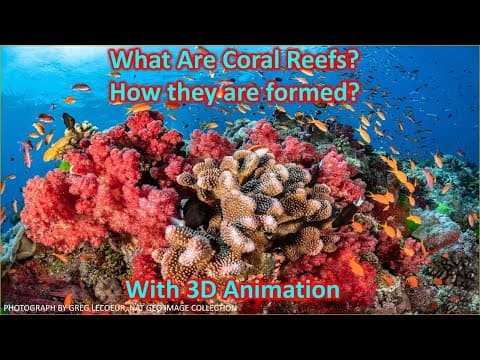
[0:10]Hello friends, welcome to another video of Z Taxs and today we are going to discuss about Coral Reefs. We will see what are Coral Reefs and how are these Coral Reefs formed. Here you can see an image of coral reef and these are these colorful structures which are located within the sea. So we will see how these colorful structures are formed why do they get these colors and what are they whether they are plants or animals. So, the coral reef word contains of mainly two words coral and reef. So first let's see what is a reef so reef is a ridge a ridge or a shoal of rock and it is relatively stable material lying beneath the surface of a natural body of water. So as we have seen on the surface of earth the ridges are narrow and elevated structures here we can see mid-oceanic ridge so this is the elevated structure within the sea. So these kind of structures are called ridges here on the seashore we can see that these are the elevated structure you can see that this is this region is slightly elevated from the region over here so this is also a reef. So a reef can be a rich or a soul so a rich is a long narrow elevated geomorphic landform as we discussed in the last slide. And a showl is a sandbank or a sandbar just below the surface of the water so these are also elevated structures within the sea and they are also just below the surface of the water. It can be created by abiotic sources that is by sand deposition or by wave erosion or it can be created by biotic sources that is by living organisms and the example are coral reefs. Now let's see what are corals so corals are basically classified as animals and they live in shallow sea waters. The corals are actually colonies of polyps so the whole structure is called coral but the organisms are called polyps. And all these polyp colony is held together by calcium carbonate and this calcium carbonate is actually secreted by the polyps itself. Here in this image we can see a coral reef this whole structure is actually a coral reef but these small nodules which we see each of these nodules is actually a polyps. And if you see the diagrammatic representation of polyp so it will look something like this where it has tentacles which we can see these smaller extending arms these are tentacles of this polyps and this is the body of the polyps which is connected to the substrate over here. So all these polyps are connected to the substrate below it which is made of calcium carbonate. Here is another closeup image where we can clearly see those tentacles and here is the mouth of these polyps. Now here we can see the diagrammatic representation of polyps where we can see that this is the mouth of the polyp through which it feeds and these are the tentacles. This is the body of this polyps and we can see that it is connected with the calcium carbonate substrate. So all of these polyps they are connected they are fixed with the substrate which is made of calcium carbonate so they are immobile living organisms. Now these polyps they live in a symbiotic relationship with zooxanthella which is an algae and it lives within the polyp's tissue here we can see that within the layer of this polyps there are zooxanthella. The zooxanthella is an algae and therefore it performs photosynthesis through which it generates food. And the polyps in return of this food gives CO2 carbon dioxide which is required for photosynthesis and protection. So in this symbiotic relationship the zooxanthella provides food by the process of photosynthesis while the polyps provides carbon dioxide and protection to the zooxanthella and both of them live in a harmonic symbiotic life. Here is another example or another diagram of our polyps where we can see that in these regions in the tentacle or in the upper body we have zooxanthella within the tissue of polyps. Here we can see what are the food sources of polyps 90% of the food required for polyps is obtained from the zooxanthella. While only 10% of the total food requirement is obtained by the tentacles these tentacles they catch the small fishes or small organisms and feed it in the mouth. So you can see that the polyps are mainly dependent on zooxanthella for its food requirements. The polyps are actually translucent or transparent that is we can see through them so it is the pigmentation of these algae of these zooxanthella that provides the color to the corals. So here we can see that there are different colors of corals and it is because of the zooxanthella which provides them different colored pigmentation. If we remove the zooxanthella then all these corals will appear white because they are made of calcium carbonate structures. So let's summarize what we have learned so far about the corals before moving forward. The first thing is that they are animals and they have tentacles they feed through this mouth. But they also have zooxanthella which is an algae living in their tissue which provides food by photosynthesis. Their body is attached to the calcium substrate and they are fixed in their position. Now let's see how coral reefs are formed. If we see the cross section or internal structure of these polyps we can see that it would look something like this it has these tentacles there is this exoskeleton of calcium carbonate there is this mouth. If we see a very basic diagram of this polyps then it would look something like this where we can see that several polyps are attached to the calcium carbonate substrate this white colored thing are the calcium carbonate substrate. This is a polyp and this is a cross section now here there is somewhere mouth of it located and this is the exoskeleton. Now when this polyps it breaths out carbon dioxide the carbon dioxide will react with the calcium in the sea water and it will give out calcium carbonate which is deposited here you can see over here. So over a long duration what will happen that this deposition will continue and this layer will increase and so will this polyp it will raise up it will increase in height. So this process is repeated for several years and that is how the coral reefs expand. Year after year the calcium carbonate secretions will be deposited accumulated and this will raise the structure or expand the structure. Now when this coral reefs over the time they die these calcium carbonated structures will remain and it will be replaced by another polyps. So this is how the colony of polyps continuously secretes calcium carbonate expands the reef and once it dies next generation of corals or polyps will replace it and the coral reef will expand. Now let's see what is the importance of corals. If you look over here then the corals they support very different types of living organisms. There are small fishes there are large fishes there are different types of plantation so it is basically a biodiversity which supports different forms of species. The healthy coral reefs contain thousands of fishes and invertebrate species found nowhere else on earth so these animals or these organisms and plants are endemic to only the coral regions which cannot survive anywhere else. The coral is also called marine rainforest because it supports many species of marine organisms just like a land rainforest supports a large number of organisms and gives out large amount of oxygen in the atmosphere similarly the corals they support large species of marine organisms and they also give out large amount of oxygen because they perform photosynthesis via the zooxanthella algae. The coral reefs also act as a buffer for sea waves storms and floods. Here we can see Great Barrier Reef along the coast of Australia so if any tsunami or any storm comes then these barrier reefs will absorb as much as 97% of the energy from the waves thus protecting the life and property on the coastal region. These reefs also help prevent beach erosion therefore they preserve the beaches. The coral reefs also emit large amount of oxygen in the atmosphere and they absorb the carbon dioxide dissolved in the water hence removing carbon dioxide from the atmosphere. The zooxanthella algae which lives in the corals it performs photosynthesis through which it converts CO2 into oxygen moreover there are several types of plants living within coral reefs.
[9:18]They also perform photosynthesis and increase the amount of oxygen and decrease the amount of carbon dioxide in the atmosphere. Next is there is some economic importance of this coral reefs they attract lot of tourism thus provide income to the local communities therefore there is great benefit to the local community for preserving this coral. The corals also support large number of fishes and therefore it supports the fishing industry so thousands of species of fishes are found in these coral reefs. There is also scientific and medical advancement from the coral reefs because there are many live saving drugs which are depended on the elements that are obtained from corals. Corals also help in understanding historical climatic conditions because the corals depositions last for very long time. They also store the climatic history of our earth therefore they are also helpful in understanding the past and predicting the future. Here are the four major coral regions of India the first is Lakshadweep then Gulf of Kutch over there right in over here in Gujarat then Palk Bay and Gulf of Mannar over here and then we have Andaman and Nicobar. So these are the four major coral regions of India remember both of these are considered as one. So one, two, three and four here are some other important coral regions of India which include Mumbai, Malvan, Goa, Anjadip Islands, Minicoy islands and then we have Parangipettai in Tamil Nadu near Puducherry. So I hope you liked our video on coral reefs and it provided you good understanding of what are coral reefs and how they are formed. In other video we will discuss different types of coral reefs what are the conditions which are helpful for corals as well as what is coral bleaching do watch those videos if you have liked this video then do subscribe to our channel and share with your friends if you like what we are doing then you can use the UPI ID over here to support us thanks for watching the video.


