[0:00]Imagine going on a weekend trip and never returning home. Not because you died, not because you were lost, but because you slowly stopped wanting to leave. This is the strange story of Nikki Jumpe, a school teacher from Tokyo in 1960s Japan. One summer afternoon, Nikki Jumpe leaves the city and travels to the coastal sand dunes of Japan. His hobby is very unusual: he collects insects, beetles to be precise. To him, insects are fascinating creatures, tiny beings struggling to survive in a harsh world. Ironically, that day, Nikki does not realize something. Soon he will become like one of those beetles. After spending the whole day searching the dunes for rare beetles, Nikki realizes that he has missed the last bus back to Tokyo. As the sun begins to set, an old villager approaches him. The man asks suspiciously, "Are you a government employee?" Jumpe shakes his head, "No, I'm here just to collect insects." The villager relaxes. "In that case," the villager says, "You can stay in my village tonight." Grateful, Jumpe follows him. But the village looks very strange. Instead of houses on the ground, there are deep sand pits dug into the sand. At the bottom of one pit stands a small wooden shack. A rope ladder hangs down. The villager points, "You will stay there inside tonight." Jumpe climbs down without asking any question. At the bottom of the pit, he meets a quiet woman who lives alone. She explains that sand constantly slides down the dunes. If she stops removing it every night, the houses will be buried. Jumpe listens politely, but he cannot understand what she says, why she stays there. He asks, "Why don't you just leave?" And the woman simply replies, "Leave? And go where? There is nothing to go." That night Jumpe witnesses something strange. After dark, the whole village wakes up. Villagers appear above the pits with ropes and buckets. The woman begins shoveling sand rapidly. Bucket after bucket is pulled up to the top. All night long, the same rhythm continues: shovel, bucket, rope, shovel, bucket, rope. Watching this, Jumpe feels uneasy, but he tells himself one thing, "Tomorrow morning, I will leave, of course." These mad people. Morning comes, Jumpe looks up to climb out. But to his surprise and shock, the rope ladder is gone. He shouts, "Hello, can someone lower the ladder?" No answer. And suddenly he understands the truth. The villagers have trapped him. They expect him to stay in the pit and shovel sand forever, just like that woman standing in front of him. At first, Jumpe refuses. He tries climbing the steep sand walls. He digs desperately, but the sand collapses again and again. After hours under the burning sun, he collapses from exhaustion. Soon he realizes something frightening. The villagers control the food, the water, everything. Without working, there will be no food for him, and he will die. So reluctantly, Jumpe begins helping the woman shovel sand each night. Days turn into weeks, weeks turn into months, and slowly the rhythm of the pit becomes his life. Jumpe still dreams of escape. One evening he finally succeeds. Using a rope he himself made, he climbs out of the pit and runs towards freedom. But the dogs begin to bark and the villagers chase him. In panic, he runs towards the sea. Suddenly, the sand beneath him becomes so soft, it becomes quicksand. He begins sinking. The more he struggles, the deeper he sinks. Finally, the villagers pull him out and carry him back to the pit. After that moment, something inside Jumpe begins to change. Months pass. One day Jumpe makes an unexpected discovery inside the pit. While experimenting with the sand, he finds a way to collect water from it. Moisture slowly traps. It gathers in a trap he builds. Right, do you understand? Moisture slowly gathers in a trap he builds. For the first time, Jumpe feels proud. He has created something useful, something meaningful, and slowly his obsession with escape fades. Then one day the woman becomes seriously ill. The villagers take her to the hospital. For the first time in months, the rope ladder is left hanging there. Jumpe easily can climb up and go and run and be free. He actually comes up, stands at the top of the dune, looks out towards the sea. He knows he can leave and return to Tokyo, but then, he pauses. He thinks about the water trap he invented. He wants to show someone how it works. So slowly he turns around and goes back down into the pit. Years later, the official report simply says, "Nikki Jumpe missing, presumed dead." But the truth is stranger. The man was never buried by the sand. He simply became a part of the life he once tried so hard to escape. Oh God, what is the moral of this tale? Sometimes the prisons we fear the most are the lives we eventually accept. Because human beings can adapt to almost anything, even a cage made of sand, right? Comment down if you love this story. Follow Tell-A-Tale with Hina for more.
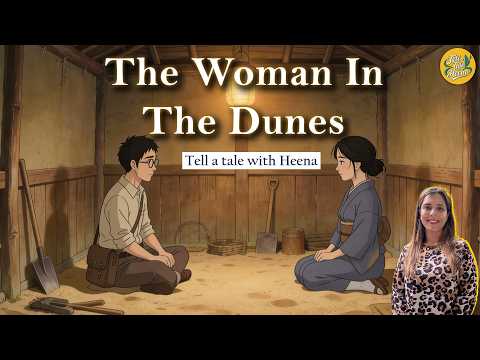
The Woman in the Dunes | Kobo Abe | Tell a Tale with Heena
Tell a tale with Heena
6m 37s863 words~5 min read
YouTube auto captions
Transcript source
YouTube auto captions
This transcript was extracted from YouTube's auto-generated caption track. The transcript below is server-rendered so it can be read, searched, cited, and shared without opening the original YouTube player.
Pull quotes
[0:00]Not because you died, not because you were lost, but because you slowly stopped wanting to leave.
[0:00]This is the strange story of Nikki Jumpe, a school teacher from Tokyo in 1960s Japan.
[0:00]One summer afternoon, Nikki Jumpe leaves the city and travels to the coastal sand dunes of Japan.
[0:00]To him, insects are fascinating creatures, tiny beings struggling to survive in a harsh world.
Use this transcript
Related transcript hubs
Watch on YouTube
Share
MORE TRANSCRIPTS


