[0:00]Think about someone you know, maybe a close friend, maybe a family member, maybe someone you went to school with, who is completely absent from social media. No Instagram posts, no Facebook updates, no TikToks, no stories. They have an account perhaps, or maybe they do not even have that. And when you ask them why, they give you some version of the same answer. I just do not feel the need. It is not really my thing, I prefer to keep my life private. And you nod, but somewhere in the back of your mind, you find yourself wondering, what is actually going on with them? Are they hiding something? Are they depressed? Are they just deeply introverted? Or is there something about them that the rest of us, endlessly scrolling and posting and curating, have not yet figured out? Because here is what I have discovered: The person who does not post on social media is not simply someone who forgot to download the app. They are operating from a psychological framework that is fundamentally different from the majority. And once you understand what that framework actually looks like, it might make you question everything about your own relationship with the screen in your pocket. Let us start with what social media posting is actually about at a psychological level. Because most people think they post to share memories, to stay connected, to document their lives, and on the surface that is true. But research tells a more complicated story. A study published in the journal Computers and Human Behavior, found that one of the primary motivators behind social media posting is what psychologists call impression management. The deeply human need to control how others perceive us. Every photo we post, every caption we write, every story we share is in some way a carefully constructed signal to the world about who we are, what our life looks like, and how we want to be seen. We are not just sharing moments, we are curating an identity, and we are seeking something in return. Validation, connection, relevance, proof that we exist, and that our existence matters to other people. Now, here is what makes people who do not post so psychologically interesting. They have either consciously or unconsciously opted out of that system entirely. And the reasons why fall into several distinct psychological profiles. The first is what researchers call a high need for privacy and autonomy. Some people have an unusually strong sense of boundaries around their inner world and their personal life. For them posting a photo does not feel like sharing, it feels like exposure, it feels like handing something intimate over to an audience that has not earned it. These are often people with a strong internal sense of self, who do not require external validation to feel secure in who they are. They know what they did on their vacation. They do not need 300 likes to confirm that it was meaningful. The second profile is rooted in social anxiety and fear of judgment, and this is more common than most people realize. For many non-posters, it is not that they do not want to share, it is that the vulnerability of sharing feels genuinely threatening. What if nobody responds? What if the post performs badly? What if people judge the photo, the location, the life? The potential for public rejection, even in its mildest digital form, is enough to keep them permanently silent. So they watch, they scroll, they consume, but they never contribute, because contributing means being seen, and being seen means being evaluated, and that is a risk their nervous system is not willing to take. The third profile is perhaps the most psychologically evolved. These are people who have developed what researchers call autonomy from external validation. Studies on self-determination theory show that human beings have a fundamental psychological need for competence, connection, and autonomy. Most social media users are meeting their need for connection and confidence through posting and receiving feedback. But people in this third group have found ways to meet those needs entirely offline, through deep relationships, meaningful work, and a stable internal sense of identity that does not require an audience. They are not absent from social media because something is wrong with them. They are absent because they have found something more sustaining than likes. Here is something that the research makes very clear, and that I think is worth sitting with. A landmark study from the University of Pennsylvania found that reducing social media use to just 10 minutes per day led to significant reductions in loneliness and depression. Another study found that passive social media consumption, scrolling without posting, was consistently linked to lower well-being and higher rates of social comparison and envy. The people who are not posting are also, in most cases, not endlessly consuming either. And that absence of constant comparison quietly protects their mental health in ways they may not even fully realize. There is one more thing I want to say. In a world where the pressure to perform your life online has never been greater, where people photograph their food before they eat it, where holidays are planned around photo opportunities, where moments are increasingly experienced through a screen rather than through the senses, choosing not to post is quietly becoming one of the most radical acts of psychological self-preservation available to us. It is saying, this moment is mine. I do not need to share it to make it real. I do not need your validation to know that my life has value. The people who do not post on social media are not missing out. In many ways, and the research supports this, they have already figured out something the rest of us are still learning, that a life lived fully does not need an audience.
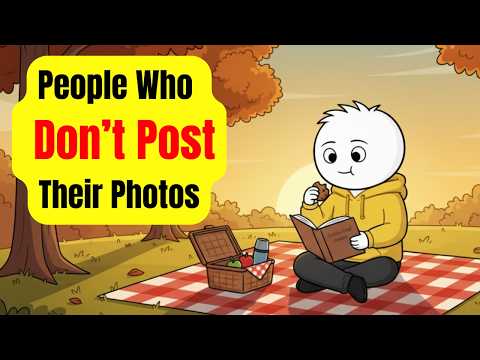
The Psychology of People Who Don’t Post Their Photos on Social Media
Psychology Signal
5m 18s982 words~5 min read
Auto-Generated
Watch on YouTube
Share
MORE TRANSCRIPTS