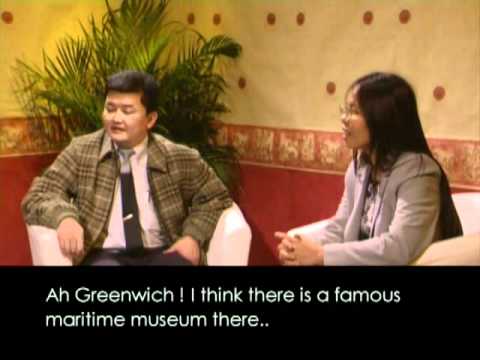
[1:12]Welcome to interpreting Asia, interpreting Europe. This program looks at two aspects of liaison interpreting: concentration and memory. An interpreter has to focus on what is happening and has to correctly remember details. In our drama for this program, a European businessman is about to arrange some social events for his visitors. He has a good interpreter and it seems that nothing can go wrong. But what happens if the interpreter is distracted? Is it possible to interpret one conversation and focus on something else at the same time? Well, that was an excellent day. Công việc hôm nay đã xong, tuyệt vời. Ừ, thế kế hoạch ngày mai thế nào? Yes, what about plan for tomorrow? Well, we're ahead of schedule, so I thought maybe you and your team might like a day off and do some sightseeing. À, công việc đã xong sớm hơn là dự kiến, cho nên ấy tôi nghĩ là quý vị có thể có một ngày dư ra để đi tham quan mọi nơi. Last year we took our Vietnamese guest to a place called Greenwich, which is on the River Thames. It's where the famous Maritime Museum is and, of course, uh very famous for uh Greenwich Mean Time. In Greenwich you can have one foot in the Eastern Hemisphere and one foot in the west. Năm ngoái, tôi có đưa một số quý khách Việt Nam của tôi đi cái khu vực Greenwich. Họ ở đây tham quan cái chỗ thuyền cắt thích xác với lại có thể một chân đặp vào bán cầu đông và một chân nữa ở bán cầu Tây.
[3:10]I heard there is a famous Maritime Museum there. That's right. So, um what we'll do is we'll pick you up at 8:30 a.m. sharp from the side entrance of the Metropol Hotel. À tôi tôi chúng tôi bố trí có xe đón quý vị vào 8:30 ở cái khách sạn Metropol Hotel đó đấy. And we'll take you to the center of London, which is Westminster. And there you'll catch a boat to Greenwich and you will see some historical sites like London Bridge, Tower of London, Kate Modern. À xe nó sẽ đưa quý vị đến trung tâm London, chỗ gọi là Westminster, chỗ đó là những cái khu vực lịch sử, có nhiều cái như chỗ hay ở đấy.
[4:02]And when you get to Greenwich you'll go on the Cutty Sark, which is a very famous boat which is um excuse me, you're catching this. Oh, yeah, yes, the Cutty Sark, Cutty Sark. Cutty Sark. And we've booked a restaurant for you, Fagan's, at 1:30 for 7, which is the corner of Black Heat and Eastern Lane. Sau đó thì chúng tôi sẽ đưa quý vị đến xuống dưới Greenwich. Ở đấy thì quý vị có thể lên tham quan chiếc thuyền cướp Cutty Sark. Rồi đó chúng tôi đã đặt một bàn cho bảy người ở cái khách sạn Grey Houn ở góc phố Black Heath với lại đường Waterloo gì đó.
[4:45]You can see that even the smallest distraction can affect the interpreter. This is especially true in a public space such as a hotel lobby, where this dialogue is taking place. The interpreter doesn't concentrate on the conversation and begins to make mistakes. The problem starts with the mobile phone ringing. Let's see that again. The host is talking about Greenwich, famous for Greenwich Meantime and its maritime museum. Listen for how the interpreter fails to deal correctly with these place names. Last year we took our Vietnamese guest to a place called Greenwich, which is on the River Thames. It's where the famous Maritime Museum is and, of course, uh very famous for uh Greenwich Mean Time. In Greenwich you can have one foot in the Eastern Hemisphere and one foot in the west.
[5:41]Năm ngoái, tôi có đưa một số quý khách Việt Nam của tôi đi cái khu vực Greenwich. Họ ở đây tham quan cái chỗ thuyền cắt thích xác với lại có thể một chân đặp vào bán cầu đông và một chân nữa ở bán cầu Tây. I heard that there is a famous maritime museum there.
[6:09]Quite clearly the host is confused. He has already mentioned the maritime museum, but it seems that the guest is talking about it for the first time. So what happened? The interpreter was not paying attention, missed out the information and has caused the confusion. And there's more. Because the interpreter is distracted, he makes serious errors concerning the arrangements for lunch. Listen carefully. And when you get to Greenwich, you'll go on the Cutty Sark, which is a very famous boat which is um excuse me, you're catching this. Oh, yeah, yes, the Cutty Sark, Cutty Sark. Cutty Sark, Cutty Sark. Um and we've booked a restaurant for you, Fagan's, at 1:30 for 7, which is the corner of Black Heath and Eastern Lane. I have reserved a table for 1:30 for seven people, at the Greyhound, which is on the corner of Black Heath Road and Waterloo Street.
[7:18]The interpreter's task is to convey accurate information, and the interpreter must be able to identify the vital information. If he doesn't focus on the task, then he cannot do it. If he doesn't concentrate, then he cannot remember. So, we have seen how the interpreter must concentrate. Now let's consider memory. With the very good memory, I don't think that anyone could act as a good interpreter. One of the first primary requirements for interpreters, I would name them like, uh, listening comprehension, like note-taking and memorization. I believe these are three most important skills and requirements. Of course, filming someone using their memory is a little difficult. But look at these professional interpreters at work.
[8:16]Using memory involves three stages: encoding, storage,
[8:32]and retrieval.
[8:37]You can see here that in many of these situations, it is not practicable for the interpreter to use a notebook. Okay. Okay, that's fine. But we are talking here of short-term memory, not the long-term memory of childhood experiences, but the immediate recall of messages, facts, and figures. Listen to the experts. To a lay person, an interpreter's ability to remember large chunks of information and details may seem amazing. Though interpreters may not have a better memory than those who don't interpret, they certainly know how to use their short-term memory more efficiently than others. So for me, immediate memorization is extremely important. Particularly in the context, number one, you are unable to take notes because you are not prepared for that. Number two, the speaker speak all either very fast that does not allow you to take note. Or number three, the circumstances there will not allow you to take note. or you have to stand or you're in a corner, you cannot write down. A lot of, I mean, uh, subjective circumstances under which you are unable to take any note at all. Memory skills are among the most important abilities that differentiate an interpreter from a bilingual who doesn't interpret. The fact that we can easily remember the contents of a two-hour movie but cannot remember what has been said, shows that it is easier to remember meaning, and meaning is the focus of memory in interpreting. Now, not everybody has a good memory. But fortunately, you can train your memory, and part of the preparations to be a successful liaison interpreter involves training your memory. Memory needs training, and then in training the memory for interpreters, you've got to do a lot of exercises. The purpose of memory training is to remember more and for longer, so as to expand the limitations of short-term memory or STM. While it would be unlikely that anyone could enlarge their STM capacity significantly over a short period of time. It is possible to help trainees organize information better, enabling them to store more information and remember it for longer. since the time when we were the students we often practice to train our memory by reading the passage. and uh well, uh the our mother tongue, Vietnamese, of course, and in English. And the passage at first was around just say 50 words and then we read the longer and the longer passage, 100, 150, 200 and even we read the passage as long as 400 words or more. One effective way of training students to organize the information better is to do logical analysis of the passages heard. Usually, we start with short, well organized and logically structured passages and ask the students to give the information back once they've heard it. We focus first on the gist of the whole passage and the links within it. By remembering the keywords and the logical links, interpreters can recall what was said in the original speech. And a detailed recording can be emphasized at a later stage of training. The passages used gradually become longer and less well organized, more representative of the kinds of speech most interpreters need to deal with in the course of their work. students can always train themselves to have a good short-term memory. For example, they can just follow TV or radio programs to do the shadowing exercises by by themselves. They just follow the speaker of TV or radio and they repeat the same thing of the speaker in order to get good short-term memory. The interpreter uses various techniques to help and improve memory, categorisation, generalisation, comparison, and mnemonics.
[13:37]You can train your memory yourself if you want to be a good interpreter. Start from now. When you've just heard a speech or talk on TV or radio, or have read a report or story or anything that interests you, try to give back as much information as you can. But don't forget that from a long-term perspective, building up your knowledge is a fundamental way to improve memory performance. Trying to remember something that you are already familiar with is much easier than trying to remember something that's brand new. This program has been about the need for focus and concentration, and about the important role of memory. You must use your short-term memory all the time. Memory is like a muscle. It can be trained. And finally, memory comes first. Your notes back it up. But taking notes is the topic of the next program. Don't forget to watch it.