[0:00]Which of these five chairs catches your eye the most? Don't overthink it. Don't judge its comfort or design. Just pause, look, and let your intuition decide. This isn't just a test. It's a doorway into a part of you that you rarely explore. Carl Jung believed that even our smallest choices are mirrors of our inner world. The archetypes that live within us, the unspoken desires we hide, the wounds we carry. Sometimes what draws you in reveals more about your soul than any words could. Can a chair uncover the secrets of your psyche? Can it reflect your shadows? Your search for refuge, or your deep desire for connection? Choose with your heart, because what follows is not merely an analysis of shapes. It's a story about who you are. The minimalist chair. At first glance, this chair seems ordinary. It doesn't try to stand out. It doesn't brag about colors or design. And yet, its simplicity has a quiet magnetism. There's something comforting in its restraint, a calm presence amid the world's noise. If this chair drew your attention, it's likely that deep inside you crave peace and clarity. Your mind longs for a space free of excess. No drama, no overwhelm, no suffocating expectations. You want to exist in stillness, in simplicity, in transparency. Jung once said that external order is often an attempt to balance inner chaos. By choosing this chair, you may unconsciously be seeking stability. You yearn for harmony. Perhaps because your life, or your past, has been marked by chaos, pain or uncertainty. Maybe you grew up in an environment where emotions were suppressed, and calm was rare. You learn to survive by simplifying, by reducing, by finding shelter in silence. This chair archetypally represents the hermit, the contemplator. He retreats not out of fear, but because he values his inner world more than external validation. He doesn't chase appearances. He prefers to observe from afar, to listen before speaking, to see without being seen. This archetype carries the wisdom of introspection, but also the danger of isolation. Your choice may reflect someone who guards their heart so carefully that over time, they lose touch with it. Yet the contemplator sees what others miss. They find meaning in simplicity, beauty in small details. They're reflective souls, attuned to subtle emotions, but often avoid deep connections because the intensity of others can overwhelm them. This chair might be your emotional armor, not out of rigidity, but as a quiet form of retreat. An invisible line whispering, I'm here, but not completely. I'm close, but not too close. That mechanism often forms in childhood, when showing emotion led to rejection. So simplicity became your shield, silence your refuge, and distance your safety. If you chose this chair, you likely value emotional stability. You feel safe in predictable spaces, in relationships that don't surprise you, in environments where everything is in its place. Your soul might be tired of excess, and your heart just wants a break from the world's chaos. But Jung reminds us, what we repress doesn't vanish, it hides. Simplicity, though beautiful, can also be a curtain that conceals fear. Fear of emotional disorder, fear of losing control in intimate chaos. Do you fear the storm? Is silence your sanctuary or your cage? Your choice whispers, I want peace. But the deeper question is, do you truly have it? Or are you just projecting it outward, hoping it will someday return inside? This chair is more than an object, it's a symbol of a soul seeking lightness, yet afraid of life's intensity. A soul that fears that if it feels too deeply, it may never recover. And there's no shame in that. It's simply another way to exist, another survival strategy, another archetype speaking through you. Because we are not only what we choose, but also the why behind that choice. The classic chair. This chair tells stories. When you look at it, you can almost smell the scent of old paper, feel the warmth of the wood, hear the echo of time passing through generations. It's refined without showing off, solid, grounded, anchored in history. It's not for those chasing novelty, but for those who value depth, meaning, and stability. If this chair caught your eye, your psyche likely longs for structure, for order, for a sense of purpose that feels timeless. You're someone who resists chaos, not only emotional chaos, but also intellectual confusion. You need a clear framework. You appreciate rules, clarity, and systems that make sense. You might believe that the world, though sometimes cruel, can still be understood, if we discover its inner logic. According to Jung, this choice aligns with the guardian or traditionalist archetype. The guardian protects, not just people, but also values, beliefs, and legacies. They feel a deep sense of responsibility, a duty to preserve order, family, and the principles passed down through time. It's an energy of care, but also of control, of safety, but also of boundaries. The traditionalist on the other hand, relies on what has stood the test of time. Not out of fear alone, but often out of respect for ancestral wisdom, or from an inner need to keep things in their proper place. By choosing this chair, you may be someone searching for a moral compass. You have principles. Perhaps you don't preach them, but they quietly guide your actions. They help you decide what's right and wrong. You dislike falseness, vagueness, and empty talk. You seek depth, truth, authenticity. But Jung reminds us, every archetype casts a shadow. Behind the love of structure can hide the fear of losing control. Behind attachment to tradition can lie the fear of the unknown. Do you fear chaos, not only in the world, but within yourself? What would happen if you let go of the rules, if you stopped following the script? If you simply felt. This classic chair isn't just an aesthetic choice. It's nostalgia. For a time when life seemed clearer, when roles were defined, and the world felt safe. Perhaps it echoes a childhood of strict rules but little warmth, or maybe you're trying to build now what you once lacked. A structure that helps you feel at home. You might insist on keeping things together, maintaining appearances, even when everything is falling apart. You value beauty not as fashion, but as meaning. Maybe you fear showing vulnerability and instead project grace and control. Maybe you wish someone could see the effort it takes to hold everything in place. Does that make you conservative? Not necessarily. Maybe it just means that in this chaotic modern world, you need something solid to hold on to, so you don't lose yourself. Jung wrote that the deepest transformation happens where consciousness meets the unconscious. By choosing this chair, you might be trying to anchor yourself in a world that keeps shifting. Structure isn't a cage. It can also be a form of freedom. The freedom of not fearing collapse. But ask yourself, do your rules support you, or confine you? Does your structure let you breathe, or does it suffocate you? This chair whispers, I need purpose. But sometimes, purpose isn't born from order. It rises from the chaos we dare to face. The cozy chair. This chair isn't just a chair, it's an invitation. Its soft curves and elegant presence seem to whisper, sit down, breathe, feel at home. It carries a quiet prestige, a touch of comfort and warmth. It doesn't just offer a seat, it offers a place, a space to rest, to feel safe. To finally let go of the rush and allow yourself the luxury of simply being. If this chair drew you in, deep inside you may be yearning to be seen, to be acknowledged, to have a place where your presence matters. A place where you can exist without fear of being ignored, forgotten, or dismissed. It's the choice of someone who, consciously or not, seeks to rest in their own existence. According to Union Depth psychology, this chair resonates with the sovereign or protector archetype. The sovereign isn't just a ruler, it's the inner symbol of dignity, of grounded authority, of someone who has learned to hold their own power. But reaching that inner sovereign often means walking through an old wound. The wound of rejection, of invisibility, of not being loved without conditions. Choosing this chair might mean you've developed a need for control, not out of arrogance, but because at some point in your life, the ground beneath you kept disappearing. Perhaps as a child, your emotions weren't valued. Maybe your needs were overlooked. Your presence made to feel conditional. So you built a strategy, if I'm strong, if I'm important, if I'm indispensable, then I'll be seen. This chair may also reflect the inner father archetype. The figure who might have been absent, emotionally or physically. By choosing this chair, you may be trying to build within yourself the solid refuge you once lacked. It's a place where you can finally hold yourself up, a throne not of vanity, but of survival. Yet there's a danger here sometimes. What begins as a refuge becomes a fortress. A place where you sit alone, disconnected from emotional intimacy. The softness of this chair says, I want comfort. But comfort doesn't mean laziness. Often it's a response to exhaustion, the soul's way of saying, I've carried too much for too long. Those drawn to comfort often bear hidden fatigue, mental, emotional, existential. They crave a place where they don't have to pretend, where everything feels right, where they can finally breathe. Yet even a cozy chair can become a disguise. A beautiful facade built by the ego to hide vulnerability. Because if you must always be strong, always capable, always in control. When do you get to be human? When do you cry? When do you allow yourself to be held, instead of holding everyone else, Jung taught that our shadow often appears in what we overemphasize. So if you surround yourself with symbols of power and comfort, it's worth asking, what am I compensating for? Does your desire for recognition come from a deep sense of insufficiency? Are your needs truly met, or just dressed in elegance? This chair might also symbolize your need to control your space, your environment, your emotions, your narrative. You decide who sits beside you, when, and how close. And while that can feel empowering, it can also become isolating. Do you fear letting go? Can you allow yourself to step down from the throne and still feel worthy? Because the true self, Jung said, is not revealed through control, but through the conscious act of surrender. If this chair calls to you, it might mean your soul seeks not just comfort, but acceptance. Not just power, but presence. Not to be admired, but to be understood. This chair whispers, I want my place. But sometimes, that place isn't outside. Sometimes, it's wherever someone truly sees you, even when you're not sitting on a throne. The expressive chair. This chair doesn't go unnoticed. It speaks through color, texture, and design, as if declaring, look at me. I'm alive. I'm different. It refuses to blend in or fade into the background. It's a statement, maybe even a cry of individuality. If this chair caught your attention, you're probably someone who rejects monotony. Inside, you lives a curious, spontaneous inner child. A free spirit that refuses to be boxed in by rules, or perhaps it's more than that. A creator who sees the world differently, more vividly, more deeply, more soulfully. Carl Jung called this energy the eternal child archetype. Innocent, raw, untamed, yet overflowing with creative power. It's the part of you that believes life is more than routine, that there's magic hidden in the everyday. That each of us carries a spark that must never die. It's a vibrant, electric energy, often misunderstood by a world that fears what it cannot define. By choosing this chair, you may be expressing your need for emotional freedom. You want to speak with your own voice, think for yourself, love on your own terms. Masks make you uncomfortable. Pretending feels heavy. You've probably been told before that you're too much, too emotional, too sensitive, too expressive. Maybe you were once asked to tone it down, to stay quiet, to fit in. And now, your soul refuses to shrink. It's claiming the right to exist in full color. But as Jung warned, even color can be a mask. Sometimes, what shines the brightest hides the deepest pain. Your creativity may not only be joy, it may also be your shield. Perhaps you laugh louder because you fear that silence will reveal your tears. This chair can symbolize a wounded soul, one that was judged for being authentic, for feeling too deeply, for trusting too easily. So now, that same soul strives to build its own world. More beautiful, more honest, more alive. This choice also reveals a longing for authenticity, even if it means standing alone. Because not everyone understands those who swim against the current, who speak in symbols, not clichés. But you know, a soul silenced too long begins to wither. Creativity, for you, isn't just art, it's medicine. It's your refuge. It's how you survive in a world that keeps trying to turn people into copies of themselves. Jung wrote, connecting with the eternal child is essential in the journey of individuation. Because it reminds us who we were before we learned to hide, before the world told us who to be. By choosing a colorful, expressive chair, you're not just remembering your true self, you're reclaiming it. But ask yourself, is your freedom complete? Do you fear that someone might take it away? Does your expression come from self-love, or from the need to be seen? This chair says, I want to be myself. But remember, you can also be yourself in silence, in sadness, in confusion. Are you willing to explore not only your colors, but also your shadows? Maybe you're a soul that needs not just space to create, but a place to be accepted. Not always radiant, sometimes lost, sometimes quiet, but always real. The resistant chair. This chair doesn't try to charm you. It doesn't seduce with color or comfort. It's austerity says everything. I'm solid, unbreakable. Made of wood and metal, it radiates strength, distance, and protection. It's not a seat for the fragile. It's a fortress, a wall built to keep the world out. If this is the chair you chose, your psyche may be speaking of endurance. You've learned how to set boundaries, not only with others, but also with yourself. Your emotional world isn't an open field. It's a citadel, a survival strategy. Maybe life taught you that the world is full of risks, that trust is a privilege you can't afford to give easily. In Union terms, this choice aligns with the warrior, or sometimes the hermit. The warrior fights not for glory, but to protect what truly matters. They're unafraid of pain, yet often carry it in silence. Strength, yes, but also weight. The hermit withdraws from the crowd, either by choice or necessity, searching in solitude for a place to heal and reflect. This archetype doesn't trust easily because life has shown that opening up can hurt. Choosing a chair like this may reveal that you've lived too much, seen too much, to trust blindly again. Your outer skin has hardened. But beneath it, there may be an old wound still unhealed. Perhaps you learned to lock your emotions away, to close your heart just to keep moving. Maybe your story carries an absence, someone or something that never fully healed. But your toughness also reflects minimalism, a return to the essential. You reject pretense, empty words, superficial bonds. You don't need luxury to feel whole, you need truth, authenticity, and safety. Jung noted that the warrior archetype often hides behind a defense mechanism that can lead to isolation. You protect yourself so you won't be hurt. But sometimes that protection becomes a prison. You might avoid intimacy because vulnerability feels like surrender. You might push people away, even while your soul aches for connection. Can you open the gates of your fortress, just a little? Can you take off the armor even for a moment? Can you allow yourself to be vulnerable, knowing it might hurt? But that it's the only way to truly feel alive. This chair says, I'm ready to endure. But remember, sometimes the greatest courage is allowing yourself to be soft. Your choice reveals a soul that doesn't break easily, that relies only on itself, yet quietly longs to be understood. And that understanding can only come when you dare to show your truth. Carl Jung wrote that real strength lies not in hardness, but in transformation. In the ability to embrace your full complexity, your shadow and your light, your power and your pain, your solitude and your need for connection. This chair is a declaration of survival, but also an invitation. A call to walk a new path, one where toughness meets tenderness, where you can be both warrior and beloved. Where the armor protects, but no longer imprisons. Choosing one of these chairs is not a trivial act. It's the voice of your unconscious speaking through symbols. Even the simplest shapes, colors and textures carry stories. Stories about your desires, fears, needs, and hidden wounds. What you choose reveals a fragment of your soul. Often unseen, yet deeply real. There's no right or wrong choice here. Each path is part of your journey toward wholeness. To look with the eyes of the soul is to realize that every symbol, every object that draws your gaze, has the power to guide you toward a deeper understanding of who you are and of the world you carry within. Because, as Carl Jung once said, until you make the unconscious conscious, it will direct your life, and you will call it fate. So listen closely, to the chair you chose, to the silence it evokes, to the story it's telling about you. Maybe it's not just a chair. Maybe it's a reflection, a mirror that quietly reveals the part of your soul that's been waiting to be seen.
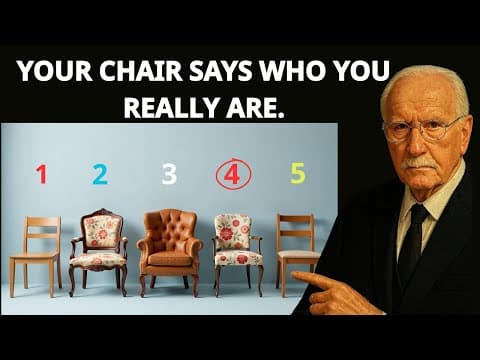
Choose a Chair Reveals Who You Are Carl Jung Psychological Test
Soul Mirror
23m 57s3,069 words~16 min read
YouTube auto captions
Transcript source
YouTube auto captions
This transcript was extracted from YouTube's auto-generated caption track. The transcript below is server-rendered so it can be read, searched, cited, and shared without opening the original YouTube player.
Pull quotes
[0:00]Carl Jung believed that even our smallest choices are mirrors of our inner world.
[0:00]The archetypes that live within us, the unspoken desires we hide, the wounds we carry.
[0:00]Choose with your heart, because what follows is not merely an analysis of shapes.
[0:00]There's something comforting in its restraint, a calm presence amid the world's noise.
Use this transcript
Related transcript hubs
Watch on YouTube
Share
MORE TRANSCRIPTS


