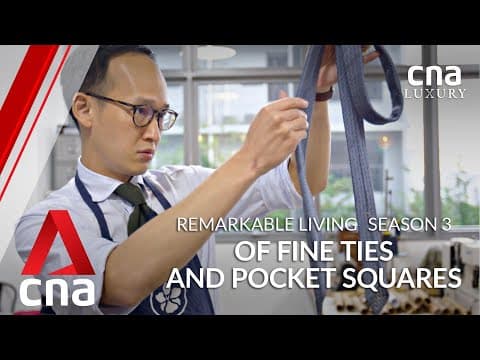
[0:09]I think in Singapore, people are so far removed from crafts, they don't even think that artisans exist. I guess the image of an artisan conjures up something like elderly people working in a dimly lit, shabby environment. People don't associate artisans with two young graduates like myself and Diana, of fine ties and pocket squares.
[0:48]I would say about half the visitors that come to our workshop are very surprised to find that 100% of the work is done on the premises. I think in Singapore, to the best of my knowledge, there are no other necktie makers. Self-taught tailors, Gerald and Diana make classically inspired ties, pocket squares, and scarves.
[1:09]There are fewer than 10 tie artisans in the world, and the couple in their early 30s are part of this exclusive group. We make ties that are supple and lively, and for us, it's very important that it's comfortable to wear, especially in a hot and humid climate like Singapore.
[1:38]A well-made tie starts with cutting on the bias at a precise 45-degree angle.
[1:49]A tie like this, although it looks reasonably well, it's made from exactly the same fabric, uh, it's going to have little sharp edges here at the side. So it doesn't drape as naturally as something that has been cut on the bias. It's absolutely fluid. The edges are meticulously hand-rolled and stitched to ensure fullness as opposed to a flat crease. That eventually results in a 3D plump finish that feels very tactile when you touch it.
[2:30]The couple design and make about 100 ties each month.
[2:41]I would say we are obsessive about things that we do, and we try and do it like over and over and over and over until we get it to a point like, oh, yes, that's it. We don't call ourselves artisans officially, I think it's a title that somebody bestows upon you. We're just regular craftspeople doing things to the best of our abilities.
[3:05]The beginnings of our business was that I wanted pocket squares for myself. As a university student, I had better taste than I had money, so I asked Diana, who's always been interested in crafts, if she could make me a pocket square from some of the vintage fabrics that we bought from Japan. The final product looked so good that they made more from the remaining fabric and sold them online.
[3:28]Months after graduating from university, Gerald and Diana started Vanda Fine Clothing. We don't have any formal training or experience when it comes to sewing, I'm fully trained by Diana. We re-engineered the process of making a necktie by taking apart some old ones, and over the course of a year, we finally figured it out. When we started the business in 2011, Singapore was known as a sartorial wasteland to many menswear aficionados. We wanted to flip the entire notion that Singaporeans can actually put out something good in terms of menswear.
[4:11]The couple rely solely on word of mouth via social media. They have since developed a cult following of menswear enthusiasts internationally and locally. This is a four-fold tie, if you count the folds, there's one, two, three, and four. Usually for four-fold ties, there is a little bit of a wool interlining that's halfway through the tie. It gives it a little more bounce and adds a bit of a wrinkle resistance to the tie. This is an unlined six-fold tie. So there is no lining whatsoever in the tie, and the entire weight of the tie comes from the fabric being folded over itself six times. A tie like this is extremely beautiful symmetrically, and it is also what we call a pure expression of cloth.
[4:56]In his unassuming atelier, Gerald often shares the finer details of fabric and fit with his clients. So the front is about two inches too long, and the back is about an inch too long. If we make this tie three inches shorter for you, it will be just perfect. A good tie is not only made well, but also fits the client right, in terms of proportions. If he has a very big face, you don't want to give him a very small knot that makes his head look even bigger. Once they find out that a tie can be customized to their height, to their torso size, we can change the knot size to suit their needs. Usually the client becomes almost a client for life. Vanda's clients are mostly professionals who have a discerning taste for old-world classics and styles. Vanda has a very thoughtful process in the whole creation of the tie. It doesn't just stop at the buying, it also continues on when you use it and you appreciate it more.
[5:54]Luxury really is a matter of time. That's one thing that we try and give to every single client. Every tie is made with individual attention to care, whether in terms of cutting or sewing or inspection, quality control, that truly is what makes a luxury product.
[6:15]We source our fabrics from the best weavers in the world. Probably up to 60, 70% of the fabrics we get are exclusive to us. That's a result of the close relationship that we have, dealing directly with the mills and suppliers, whether they are in Como, Italy, or in Sudbury, England, or Kyoto. Grenadine from Italy. Jacquard from England. Macclesfield prints from England.
[6:47]When we started the business, we were not even taking a day off, and after a couple of months, we decided to take one day off, and we realized how important that was for our mental health. There is a waiting list for Vanda's bespoke ties, but the couple chose to end their day punctually at 5:00 p.m., devoting time to other recreational pursuits. We like what we do, we're happy with the work-life balance that we have. We are basically very simple folks, we have very simple pleasures in life.
[7:18]In terms of dreams, I think our craft by its nature is not highly scalable. We like to retain full control of what we do, we prefer to grow organically as we have done in the past, and just reach more people globally that we have not been able to. That would already make us happy.