[0:06]Women's History Month! Do you know that every March, Americans celebrate Women's History Month? For real? Today, we are going to talk about the origins of Women's History Month and why it is so important to celebrate. You have probably heard about famous women in American History like Harriet Tubman and Abigail Adams. But what about Eleanor Dare or Mary Chilton? Eleanor Dare traveled to the Roanoke colony in the year 1587 and most likely gave birth to the first English child born on the North American continent. At age 12, Mary Chilton was so excited to get off the Mayflower that she jumped into the water and waded onto land, making her the first person on the ship to set foot on Plymouth Rock. Neither of these stories were well known until historians discovered the information, which is why knowing women's history is essential. To understand more, let's talk a little bit about world history, with an emphasis on his. For much of the world's history, only males have written and published stories about the past. This is because women were not treated equally to men, nor did they have access to the same opportunities and education. Here is an example. In colonial America, women could not own property or vote in elections. In many places, females were not allowed to go to school, and if they were allowed, they were not often taught the same subjects as males. This is because society at the time believed that women were fundamentally unequal to men, which seems kind of ridiculous when we talk about it today. However, this idea has existed throughout history and is a product of patriarchy. Patriarchy is a system of society or government in which men hold power and women are largely excluded. Where men were taught academic skills like reading, writing, and mathematics, women were taught domestic arts or how to manage a household. These differences in education maintained the power imbalance between men and women up until modern times. And even today, inequities between genders still exist. Which is why it is important that we celebrate Women's History Month. It is a way that we can celebrate the contributions of women, not only today, but throughout history. So, how did the celebration of Women's History Month start? Like many historical movements, a small group of people recognized the shortcomings in learning a male-centered history and decided to do something about it to create change. In March of 1978, a group of educators in Santa Rosa, California, thought that more could be done to further the cause of women's equality and to bring awareness to the significant historical contributions that women have made over the years. They planned a Women's History Week to correspond with International Women's Day on March 8th. By 1980, the movement had spread throughout the country and gained the attention of President Jimmy Carter. After meeting with women's groups, historians, and the National Women's History Project, which is now called the National Women's History Alliance or NWHA, President Carter proclaimed that the week of March 8th would be National Women's History Week. At the time, President Carter said, Too often, women were unsung, and sometimes their contributions went unnoticed. But the achievements, leadership, courage, strength, and love of the women who built America was as vital as that of the men whose names we know so well. Nice, President Carter! One year later, Congress joined with the President by passing a resolution declaring the week of March 8th as the official start of Women's History Week. Seven years later, Congress passed a law authorizing the President to proclaim March as Women's History Month! It has been celebrated that way ever since. Since then, the NWHA has selected a yearly theme for the month. And the rest, as they say, is herstory. What are some ways that you can celebrate the contributions of women throughout history? Hope you had fun learning with us. Visit us at learnbright.org for thousands of free resources and turnkey solutions for teachers and homeschoolers.
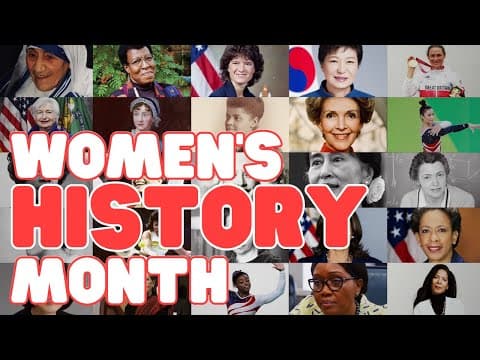
Women's History Month | Learn about women throughout history and why we celebrate them in March
Learn Bright
5m 30s677 words~4 min read
YouTube auto captions
Transcript source
YouTube auto captions
This transcript was extracted from YouTube's auto-generated caption track. The transcript below is server-rendered so it can be read, searched, cited, and shared without opening the original YouTube player.
Pull quotes
[0:06]Today, we are going to talk about the origins of Women's History Month and why it is so important to celebrate.
[0:06]You have probably heard about famous women in American History like Harriet Tubman and Abigail Adams.
[0:06]Eleanor Dare traveled to the Roanoke colony in the year 1587 and most likely gave birth to the first English child born on the North American continent.
[0:06]At age 12, Mary Chilton was so excited to get off the Mayflower that she jumped into the water and waded onto land, making her the first person on the ship to set foot on Plymouth Rock.
Use this transcript
Related transcript hubs
Watch on YouTube
Share
MORE TRANSCRIPTS


