[0:00]Oh, hey. So, uh, a stock is just a little piece of a company you can own. Buy a share of Apple, you own a piece of its legendary apple pie. When the company grows, the apple pie expands. Your share stays the same proportion, but it's suddenly worth way more. A shareholder is anyone who owns that slice. Once you buy an Apple share, you're like part of their story now. An investor is someone who puts money into a company or fund and plans to stick around, hoping it grows over time. A trader's different. They jump in and out fast, looking for quick wins. They might grab Tesla stock in the morning and sell it that afternoon if the price pops. One's playing the long game, the other's all about short moves. A public company is one that lets anyone buy its stock. It's gotta, share its numbers, follow rules, and stay open about how it's doing. Examples? Think Apple, Microsoft, Amazon, Coca-Cola, Nike. A private company is, uh, a business that keeps its shares in a small circle. Founders, staff, maybe a few investors. You can't just buy in on the stock market. And they don't have to share as much info as public ones. Examples? Ikea, Mars, SpaceX, all big names but still private. A stock exchange is where all the action happens. Think of it, uh, like this super-organized market where buyers and sellers meet. Examples? The New York Stock Exchange and NASDAQ in the US are the biggest. There's London Stock Exchange, Tokyo Stock Exchange, and Hong Kong Exchange. An index is kinda like, to think of it as a scoreboard for a chunk of the market. It tracks a bunch of stocks, or bonds, and rolls how they're all doing into one single number. The S&P 500? Oh, that's 500 of the biggest US companies, like Apple, Microsoft, Amazon, and Johnson & Johnson. All lined up in one place. The Dow follows a smaller bunch of really famous names. Think Coca-Cola, McDonald's, Boeing, and Goldman Sachs. And the NASDAQ leans heavy on tech stuff. You've got Apple again, plus Tesla, NVIDIA, and Meta. You can't actually buy an index. It's just, you know, a way to measure performance. But here's the cool part. You can grab index funds or ETFs that copy an index almost exactly. A bull market is, uh, a stretch of time when prices keep climbing, and people feel good about where things are headed. It's like the market's in a happy mood. A bear market is, uh, the opposite. Prices drop a lot and stay low for a while. People get nervous. A broker, or brokerage, is your go-between with the market. You open an account, drop in some cash, and, oh, they send your orders through the exchange. When you're picking one, look for low fees, an easy app, and support that actually helps. I use Interactive Brokers. Links in the description. But you've also got Fidelity, Schwab, or TD Ameritrade. A portfolio's everything you invest in. Stocks, bonds, cash, maybe funds or other stuff. A sector or industry is, well, a group of companies doing the same kind of thing. Tech's all about software, gadgets, chips. Energy covers oil, gas, wind, solar, you name it. Healthcare? Healthcare, hospitals, drug makers, biotech labs. Market cap, short for market capitalization, is a company's price tag in the stock market. You take the stock price, multiply it by all the shares, and, oh, that's the market cap. Equity is just the part of something you actually own after debts are taken out. In the stock market, equity means your ownership in a company, the shares you hold. Like, if you buy stock in Apple, that stock is your equity in the business. By the way, we put this video together as your go-to stock market dictionary. So save this video so you can pop back in whenever you need. So, uh, volatility's just how much prices bounce around. Big, quick swings mean high volatility. Exciting, but kinda risky. Slow, steady moves mean low volatility. Calmer, but, like, maybe a little less fun. Volumes, the number of shares traded in a set time. High volumes like, you know, rush hour traffic. Busy and fast-moving. Low volumes more like a quiet road, just a few trades rolling along slow. Liquidity shows how easy it is to buy or sell without, uh, messing up the price. If a stock's liquid, you can hop in or out fast at close to the listed price. Low liquidity means you might wait or settle for a worse price just to make the trade. So, dividends and distributions are just payouts from a company or fund. Cash, extra shares, property income, whatever form they take, it's profits coming back to you. Dividend yields how much income you get compared to a stock's price. Take the yearly payout per share, divide by the share price, that's the yield. If a stock pays $2 and trades at $40, it's 5%. If it jumps to $50, it's 4%. Share buybacks happen when a company spends its own cash to repurchase shares and take them off the market. With futures, fewer shares left, each one grabs a bigger slice of profits, which can push up the stock price. Capital is just the money you put in to help something grow, like cash you invest in a business or stock so it can make more. Capital gains and losses are different. That's what happens when you actually sell an investment. If you sell it for more than you paid, that's a capital gain. If you sell for less, that's a capital loss. Currency hedging, contracts that smooth those swings if you invest in overseas stocks. So you're really watching the investment itself, not wild exchange rates. An IPO, or initial public offering, is when a private company sells shares to the public for the very first time. Index funds are investments that copy an index, like the S&P 500 or Nasdaq 100. When you buy one, you instantly own a tiny slice of every company in that index. They can come as ETF or mutual funds, and they're designed to match the overall market's ups and downs. Because they hold all the stocks in the list, they give you a built-in mix of companies from different industries, and the lineup only changes when the index itself does. Honestly, this is what I use. ETF, exchange-traded funds, are baskets of investments you trade just like stocks on stock exchanges. Some super popular ones are VOO, which tracks the S&P 500, QQQ, which follows the Nasdaq 100, and IWM, which focuses on small-cap stocks. Ah, mutual funds are similar to ETF, but here's the difference. You do not trade them on an exchange. Instead, you buy through the company or broker that offers the fund. Places like Vanguard, Fidelity, Schwab, or even your bank's investing account. You buy or sell at one price after the market closes. That's called the net asset value, or NAV. Target date funds take care of the long game for you. You pick the year you'll need the cash, usually retirement, and the fund slowly shifts from stocks to bonds and cash as that date gets closer. So bonds are basically loans you give to governments, cities, or companies. They pay you interest, that's the coupon, and hand back your money when the bond matures. They're steadier than stocks, but the returns are smaller, and prices can dip if rates rise. Global funds take you beyond your home turf. They invest in companies or bonds from Europe, Asia, or even emerging markets. That adds growth and spreads out risk, but you also deal with politics, economies, and currencies. Think Vanguard Total International Stock Index Fund, or iShares MSCI All-Country World Index ETF. A blue-chip stock is a share in a really big, solid company that's been around a long time and makes steady money. Think Apple, Microsoft, Coca-Cola, or Johnson & Johnson. They're not usually wild movers, more like steady players you can count on. Dividend stock funds focus on companies that regularly pay higher-than-normal cash dividends. They're all about steady income and a bit of stability. Growth stocks on the other hand, are chasing fast growth. Think companies pouring money back into expanding instead of paying you cash right now. A good example of a dividend fund is the Schwab US Dividend Equity ETF. It holds a bunch of big, reliable companies that pay out regularly. Real estate investment trusts let you invest in income-producing properties, like a property, Apartments, offices, malls, or warehouses, without buying buildings yourself. They trade like stocks so you can get in or out fast, and most have to, uh, pay out a big chunk of profits as dividends. A popular pick is Vanguard Real Estate ETF. Money market funds, or cash equivalents, are, uh, safe places to park cash for a bit. They invest in short-term stuff like treasury bills or top-rated commercial paper. Returns are usually a little higher than a savings account, but lower than risky investments. So, commodities, usually through ETF, give you a way to invest in raw stuff like gold, oil, or wheat. They can help when inflation's running hot, but prices bounce around a lot. Supply, demand, weather, even, you know, politics can shove them up or down. Crypto, short for cryptocurrency, is digital money that lives online instead of in a bank. The most famous one's Bitcoin, but there are tons of others like Ethereum, Solana, or Dogecoin. Forex, short for foreign exchange, is where people trade currencies, like dollars for euros or yen for pounds. It's actually the biggest market in the world, running almost all day, every day. Penny stocks are those super cheap shares, usually under five bucks. They might look like bargains, but they're risky. Trading can be thin, info's sometimes sketchy, and prices can drop in a heartbeat. Futures are agreements to buy or sell something later at a price you lock in now. The something could be oil, corn, gold, stock indexes, almost anything traded in bulk. People use futures to protect themselves from price swings, like an airline locking in fuel costs. Others make big bets on where prices will go. The catch? Oh, leverage. You only put down a small chunk of cash compared to the contract's value, so gains can be big, but losses can snowball just as fast if the market moves against you. Options give you the right, but not the obligation, to buy or sell a stock at a set price before a certain date. A call lets you buy at that price. A put lets you sell. Traders use calls to bet on prices climbing or to lock in a buy price, and puts to guard against drops or bet a stock will fall. Options can even earn extra income if you sell contracts to other traders. If you learned something today, hit like and subscribe because we'll make another video like this. Intrinsic value or fair value is just an estimate of what a company's really worth based on its earnings, growth, and assets. It helps you look past the current stock price so you don't overpay or sell too soon just because prices wiggle. Book value is what a company owns minus what it owes. Basically, it's net assets. Divide that by the number of shares and, oh, you get book value per share. It's a quick snapshot of what the business might be worth if you closed the books today. Price to book ratio compares a stock's price to its book value per share. A high P-B can mean investors expect growth or, maybe, the stock's just expensive. A low P-B might point to a bargain or hint that something's off under the hood. P-E ratio, price to earnings, compares a stock's price to its earnings per share. A low P-E might mean a bargain or that growth looks slow. A high one shows people expect profits to rise. Normal P-E vary by indexes. So always check it against similar companies and the stock's own history, not just the market average. Fundamental analysis is all about, like, digging into what a company's really made of. This is Warren Buffett's style of investing. You look at revenue, profits, cash flow, debts, assets, competition, even how good the management is, then stack all that against the stock price. Technical analysis skips the business story and studies price and volume. Traders read charts, spot trends, and watch for levels where buyers or sellers might jump in. It's more about crowd behavior than balance sheets. Efficient market hypothesis says prices already reflect most of the information out there. If that's true, it's tough to beat the market again and again cuz, well, everyone's using the same data. Some folks think markets are super efficient. Others say prices overreact or miss stuff. The truth, probably somewhere in between. Oh. If this feels like a lot to take in, save this video as your investing glossary on demand. The bid is the highest price a buyer is willing to pay for a stock at that moment. Think of it as the offer buyers put on the table, the amount they're ready to spend to snag those shares. The ask is the lowest price a seller is willing to accept for a stock. It's basically the price tag sellers put on their shares, the least they're ready to let them go for. The spread's just that gap in between. When trading's busy and lots of people are jumping in, the spread's tiny. But in slower or riskier stocks, it can widen, making trades a bit pricier. A market order tells your broker, buy or sell right now. It fills at the best price available, which is quick, but you don't get to lock in the exact price. Especially if the stock's moving fast. A limit order lets you buy at the price you're after. You decide the most you'll pay to buy or the least you'll take to sell. The trade only happens if the market hits that number. So, you know, you've got control, but no promise it'll actually go through. A stop-loss order is used when selling. It's like a safety trigger. You pick a price below where you bought, and if the stock falls there, it sells automatically. It won't save you from every loss. Prices can, er, jump right past your stop. But it can keep a small loss from turning into, er, something ugly. Leverage means borrowing money to make a trade bigger than your own cash allows. Margin is money you borrow from your broker to buy more than your cash alone could. If prices rise, your gains look bigger. If they drop, losses hit faster. And the broker might demand more cash or sell your stuff. That's a That's a margin call. So, settled cash is just the money in your brokerage that's, like, fully cleared and good to spend. When you sell a stock, that money doesn't always land right away. Net liquidation is just what you'd have if you sold everything in your account right now and paid back any margin you owe. Buying power's, er, the max you can spend on trades right now. It's your settled cash plus any margin your broker lets you borrow. Cost basis is just what you paid for in investment, plus stuff like commissions or fees. When you sell, you check the price against your cost basis number to see your gain or loss. Market value is just what your investment's worth right now if you sold it. Like, if you've got 10 shares at $25 each, that's $250. Easy math. It's the live price times how many shares you hold. Average price is, uh, just the middle number you land on when you've bought the same stock at different prices. Take the total you spent and divide by how many shares you own. Like, say you grabbed 5 shares at $10 and later 5 more at $20. You spent $150. Hmm. Divide that by 10, and your average price is $15 for one share of stock. Shorting, or short-selling, always makes my head spin. Let me try to explain in the simplest way. So, uh, you borrow a stock from your broker. You sell those borrowed stock at today's price, say, uh, $1,000. Now you're holding $1,000 cash. But you still owe the broker those shares. You hope the stock price drops. If the stock does fall to $600, you buy the shares back for $600. Now you can return the shares back to the broker, and you keep the $400 difference as your profit. Ha ha. Hmm. Does that make sense? A short squeeze happens when tons of people are shorting a stock. But instead of falling, the price suddenly shoots up. When a bunch of people are in that position, they all panic to buy the stock back before the price climbs even higher. Remember, they borrowed the stock from their broker, so they need to buy it back to return it. And oh, all that buying pushes the price up faster, which makes more traders nervous, so they buy too, and the price keeps rocketing. I've uncovered some surprising money statistics that could make you completely rethink how you stack up against the average person. Watch this video right here and subscribe because we'll post another video like this.
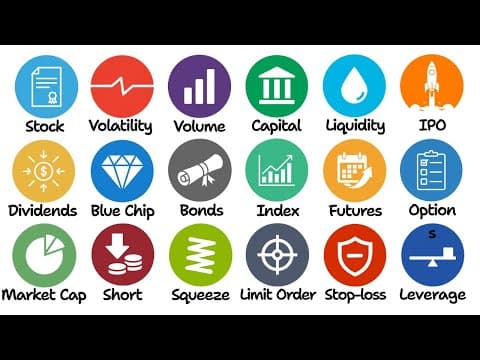
Every Stock Market Terms Explained for Beginners
Ken Index Investing
17m 50s2,934 words~15 min read
YouTube auto captions
Transcript source
YouTube auto captions
This transcript was extracted from YouTube's auto-generated caption track. The transcript below is server-rendered so it can be read, searched, cited, and shared without opening the original YouTube player.
Pull quotes
[0:00]An investor is someone who puts money into a company or fund and plans to stick around, hoping it grows over time.
[0:00]They might grab Tesla stock in the morning and sell it that afternoon if the price pops.
[0:00]It's gotta, share its numbers, follow rules, and stay open about how it's doing.
[0:00]Think of it, uh, like this super-organized market where buyers and sellers meet.
Use this transcript
Related transcript hubs
Watch on YouTube
Share
MORE TRANSCRIPTS


