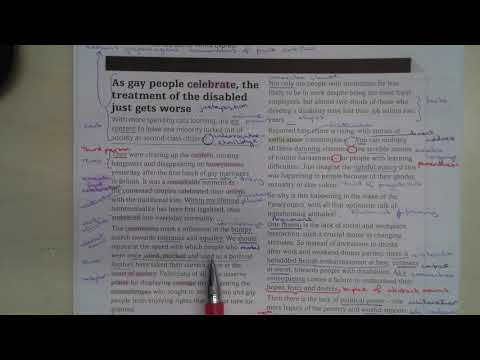
[0:02]Today we're having a look at text 1.2 in the anthology, which is Ian Burrell's article from the I newspaper. As gay people celebrate the treatment of the disabled just gets worse.
[0:14]So in terms of the genre, we've obviously got a news article which has been published in print and online.
[0:20]The audience then is obviously going to be readers of the I newspaper and the independent, those with an interest in current affairs, Burrell himself, or perhaps those with an interest in identity, sexuality and or disability.
[0:35]Um, and also just generally intelligent readers. The purpose then is to express his opinion about the issue of how disabled people are treated, and and to raise an issue online and get other people to think about it.
[0:48]So, um, let's look first of all at the kind of graphological features.
[0:53]So what we've got here is a kind of, even though it's been printed online, it's retained the graphological conventions of a print article, with the heading and subheading here.
[1:07]Um, we've also got straight away in the headline, this juxtaposition between the treatment of gay people and the treatment of those who are disabled, okay?
[1:17]So he chooses to establish this as a juxtaposition throughout, and he structures his entire argument around that.
[1:24]And what he's really doing is he's trying to get us to see the contrast between the two groups of people, that actually we've made this huge progress in terms of gay rights.
[1:34]And he feels like disabled people are kind of left behind and forgotten. So he's making it very emotive right from the outset.
[1:42]Um, he uses this semantic field of celebration around the idea of, um, gay marriage, and, um, that reinforces that juxtaposition.
[1:54]So I've highlighted some of that semantic field of celebration for you. So we get it, um, in the
[2:00]title here, we, in the heading, and then we also get it in this, um, first section, okay, the first paragraph, they were clearing up the confetti, nursing hangovers and disappearing on honeymoons yesterday after the first batch of gay marriages in Britain.
[2:11]It was a remarkable moment. Contented couples celebrate unions, embrace ceremonies, heart of society, praise and courage, okay?
[2:22]All of those words coming from the semantic field of celebration. Now, whilst that seems to set up a kind of very positive voice, it's only really there to draw a stark contrast with those who are not having the same kind of progress in the way that they're treated socially, to so, to create a real sense of skepticism about how disabled people are treated.
[3:17]Okay. Uh let's look at this little subheading with more spending cuts looming.
[3:20]Are we content to leave one minority locked out of society as second class citizens?
[3:27]It's really interesting that he's used this inclusive pronoun we, okay?
[3:31]What that's suggesting is that we as the readers and as society more generally are making an active choice to leave disabled people outside of society.
[3:42]So he's proposing in this article that it's not just about politicians not making the right choices, it's also that we have an element of responsibility too.
[3:51]So that's obviously going to make the reader feel really guilty, um, and that he's hoping, I think, is going to enact them to to make changes.
[4:00]He also poses it as an interrogative, okay? So that means that it's a real challenge to us.
[4:05]It's really making us think about either our prejudices or, conversely, our ignorance, maybe we just haven't thought about this subject before, maybe we're just not educated enough.
[4:16]And then what he does is he switches from this very emotive opening to the third person, and that gives it a much more detached voice, much more in line with kind of what we would expect from a news report.
[4:28]And obviously this is picking up on the idea of, um, having the first batch of gay marriages in Britain.
[4:37]Okay. So, um, what we haven't just looked at yet is this verb content.
[4:43]Are we content to leave one minority out?
[4:47]What that implies is that we are complicit somehow in allowing this to happen.
[4:57]Okay? And then we've mentioned this switch to the detached voice, um, in the opening, and we get a triplet at the beginning too, which really establishes a a literary tone with this triad.
[5:04]So they were clearing up the confetti, nursing hangovers and disappearing on honeymoons yesterday.
[5:11]Okay. So that's important. We've got this kind of literary tone, that's going to appeal to those intelligent general readers that we talked about in the opening.
[5:19]It was a remarkable moment as the contented couples celebrated their unions with the traditional kiss.
[5:25]Okay. So this adjective remarkable is showing us that this is a really striking moment, it stands out, it's really important in terms of showing us how much progress we've made with gay rights.
[5:37]The literary tone continues with the alliteration, the contented couples celebrate, and the alliteration also draws our attention towards this idea of celebration.
[5:48]Um, we've got this idea of unions, okay, some more positive language.
[5:53]Um, and then we get this prepositional phrase, within my lifetime, okay? And I think that's there, this makes it more personal, doesn't it?
[6:01]Okay? We've had a third person, kind of detached, formal tone, and this makes it clear that that's going to be something personal to him.
[6:08]He does have a daughter who is disabled, so this is contextually a really emotive subject for him, okay?
[6:16]Um, it's also there, that prepositional phrase, to show us how quickly, really, attitudes have changed.
[6:23]Um, homosexuality has been first legalized, then embraced into everyday normality.
[6:29]Okay, so really what this verb is doing is it's it's suggesting that this is welcomed with affection, okay?
[6:33]It's a really positive change that we're all celebrating.
[6:40]And then we get this ellipsis here, dot dot dot, okay?
[6:44]What that's doing is it's suggesting, and he uses this throughout to indicate moments when we need to consider something, to have a little pause, okay?
[6:52]And obviously what he's going to get us to consider is actually what attitudes were like before we got to this positive point.
[6:59]So the ceremonies mark a milestone in the bumpy march towards tolerance and equality.
[7:05]Okay, so obviously we've got this adverb bumpy, which is showing us that it's taken a long time to challenge these attitudes, um, and that it's been a very difficult journey.
[7:14]We then get these abstract nouns, tolerance and equality, with really positive connotations, you know, making us feel good as a reader that we socially have got to the point, um, where gay rights are are treated in a much more positive way.
[7:29]We should rejoice at the speed with which people who were once jailed, mocked and used as a political football have taken their correct place at the heart of society.
[7:54]That's kind of emotional, it's warm, it's affectionate, and he makes it clear that this is the correct place.
[7:58]However, just before that, we've had this triad about how gay people used to be used, so they were jailed, mocked and used as a political football.
[8:06]That triad really emphasizes their maltreatment, and this modal is interesting.
[8:12]We should rejoice, okay, there's perhaps an element there that implies that he can't, so that we should be celebrating this, but for him, he can't quite celebrate it yet.
[8:22]Um, politicians of all hues deserve praise for displaying courage in confronting the misanthropes who sought to stop lesbian and gay people from enjoying rights that the rest of us take for granted.
[8:34]Okay, so again, he's he's praising the politicians here, okay, we've got the verb praise, he he talks about their courage, so that abstract noun.
[8:43]Um, misanthropes are people who dislike humankind, okay?
[8:46]So he's suggesting that anybody who stands in opposition to gay rights is against the whole of humanity.
[8:52]And I think this is an important bit in terms of leading into his next argument, okay, that the rest of us take for granted.
[8:57]Obviously if we're able-bodied, we do tend to take our mobility for granted, and I think that's the analogy that he's trying to draw.
[9:07]We do start to get a bit of a shift towards skepticism here.
[9:10]Let's zoom in a little bit for you.
[9:16]Okay. So then we get this idea that problems remain, okay, and that's where the shift comes.
[9:20]There's an element of regret here with homophobic bullying in schools and bigotry abroad.
[9:25]So as humanity, obviously, he's pointing out that we're not there yet, it's not perfect.
[9:30]But, so the fronted conjunction saying, okay, there's this negativity, but let's stay positive, let's focus on how quickly attitudes can change.
[9:41]So this indicates hope, doesn't it? And I think the ellipsis is there to show, okay, this is hopeful, and obviously now he's going to present where else we need change.
[9:49]We've seen a similar rapid shift in attitudes on gender and race, for all the hurdles that still exist for both women and ethnic minorities.
[9:57]Okay, so this is important, what he's doing is taking the argument away from just our attitudes towards sexuality and gay rights, to other areas of discrimination and prejudice, um, sexism and racism.
[10:11]So then he's positioning the treatment of disabled people within the wider schema of prejudice.
[10:17]He does acknowledge, however, that there are still hurdles, okay?
[10:20]So there are still, we're not there yet, okay?
[10:24]So throughout all of the positivity is measured, yet, so that fronted conjunction.
[10:31]So we know now we've gone from a positive, we're going into a negative, and it all the discussion of diversity and self-congratulatory talk of tolerance, one minority remains stuck in the shadows of society.
[10:43]Okay. It really shows his distaste here as well, doesn't it? This fronted conjunction, as does the idea of being self-congratulatory.
[10:52]Okay. Um, that he's suggesting that we're like overly pleased with ourselves, okay?
[11:01]And then he uses this metaphor, along with the alliteration, so coming back to the literary voice, that we're that disabled people are stuck in the shadows of society.
[11:10]Well that metaphor means is that we just completely ignore them, you know, we're not even aware of it.
[11:16]Indeed, many members would argue that their life is getting worse, with hostility growing.
[11:39]These are people with disabilities, a group growing fast in our aging society.
[11:45]So I think this is an important point, this, um, sort of factual element, okay, that that makes us trust in him because it gives us this sense that he knows what he's talking about.
[11:55]This is a well-researched, informative article, as well as being an opinion article.
[12:00]Now these ellipsis, again, moments when he wants to us, as the reader, to consider the injustices of society or even our own prejudice.
[12:10]I think at these points he wants us to pause and feel angry about what's happening towards disabled people.
[12:19]Okay, so let's just skip back up to the top of the page.
[12:25]So, then we get this connective clause, not only are people with disabilities far less likely to be in work despite being the most loyal employees, but almost two-thirds of those who develop a disability have lost their job within two years.
[12:54]Again, ellipsis, we should be angry about this, you know, and also, I think that the whole point of raising the idea of people who develop a disability, he comes back to this in his conclusion.
[13:06]He wants us to kind of recognize that this could happen to any of us.
[13:10]Um, and he goes on to continue, it gets even bleaker.
[13:13]Reported hate crime is rising, with stories of awful abuse commonplace, you can multiply all these damning statistics, the terrible stories of routine harassment for people with learning difficulties.
[13:19]Okay, look at the alliteration here, the awful abuse.
[13:22]That modifier really draws our attention to the idea that people are going to be abused because of their disability, and it shocks us as the reader.
[13:30]He furthers that then with this direct address, you can multiply all these damning statistics, okay?
[13:38]And then we've got that modifier, that, um, adjective damning, really showing us that we should feel guilty about this.
[13:43]This is horrendous, we are part of the society that is allowing this to happen.
[13:49]And then he uses a parenthesis for explanation rather than to, um, give it as his opinion, the terrible stories of routine harassment.
[13:58]And again, the adjectives again, terrible, of routine, it's really emotive, isn't it?
[14:03]He's making it very clear that this is a horrendous place for us to be socially, for people with learning difficulties.
[14:11]Just imagine the rightful outcry if this was happening to people because of their gender, sexuality, or skin color.
[14:19]Okay, so by grouping all the other prejudices together in this triad, what he's doing is he's challenging us to recognize disability as a prejudice, and to kind of include it along with, um, being prejudiced against people because of their gender, sexuality, or ethnicity.
[14:56]Okay, but we're not having this rightful outcry because it's about disability.
[15:01]And he continues, so why is this happening in the wake of the Paralympics with all that optimistic talk of transforming attitudes?
[15:10]So we get this rhetorical framing here.
[15:14]It seems like a rhetorical question, followed by an ellipsis, but he then answers it, and I think structurally what he's doing is he's guiding us, as the reader, towards his point of view, okay?
[15:21]So obviously this is a question we should be asking, and then he's going to answer it for us.
[15:27]And that's how he frames his argument, so one reason is a lack of social and workplace interaction, such a crucial motor in changing attitudes.
[15:37]So instead of invitations to drinks after work and weekend dinner parties, there is befuddled British embarrassment at best, coldness at worst, towards people with disabilities.
[15:47]Okay, look at the alliteration here.
[15:50]It kind of builds up, um, this view of typical attitudes, um, and then that gets contrasted with coldness at worst.
[16:07]As a consequence, okay, so the connective there, really building cause and effect, helping us to understand his argument.
[16:14]Comes a failure to understand their hopes, fears, and desires.
[16:19]So here we've got a triad of abstract nouns, and they are also really emotive, okay?
[16:25]This is like the basis of humanity, isn't it? And he wants us to put ourselves in a position of empathy to consider what this would be like.
[16:33]Let's skip down to the last couple of paragraphs then.
[16:39]So he's talked about the kind of individual person within society, and now he's going to challenge, um, those impositions of authority.
[16:49]There you go. Okay, then there is the lack of political power, okay?
[16:56]And we've got the alliteration there, drawing our attention to the fact that there are people in authority who could change something about this.
[17:04]One more legacy of the poverty and woeful support endured by many disabled people.
[17:10]This adjective woeful really condemns those who are in political power, doesn't it?
[17:17]It suggests that this is totally unacceptable, as does the verb endured, okay?
[17:21]It makes it clear that this is a horrendous experience and it's totally unacceptable.
[17:26]Digital technology has helped but the idea of seeking a seat in parliament is a joke for people who struggle to obtain a seat on the bus.
[17:33]At the last general election, more than two-thirds of polling stations had significant barriers to accessibility. There's a real bitterness about this here, I would say, in terms of the voice to show, um, how outraged he is by the lack of accessibility.
[17:45]You know, that juxtaposition between not even being able to find a seat on the bus, and then, you know, it just being ironic that you'd even get a seat in parliament.
[17:54]I think what he's also doing here, which I missed out, sorry, is when he links, um, poverty with the politicians, that makes us really think that they are to to blame for this.
[18:05]You know, the fact that disabled people are not given enough support to enable them to work, his argument is that that has a massive impact on their ability to to be part of society and to have a reasonable life.
[18:18]At the last general election, more than two-thirds of polling stations had significant barriers to accessibility.
[18:24]So you can't get a seat on the bus, and you actually can't even get into vote, let alone be elected as a politician yourself.
[18:32]Again, we've got facts here, which is supporting his argument, but they're also showing us the absurdity of the situation, you know, how are we in a civilized Western society, when if you are in a wheelchair, you can't even get to vote.
[18:47]It is great to see Britain becoming more tolerant.
[18:51]So that kind of returns to the positivity of the gay celebrations, but, okay, so that fronted conjunction is showing us the contrast and really emphasizing the injustice.
[19:00]With more spending cuts looming, are we content to leave one minority locked out of society as second class citizens?
[19:09]So this was the opening question that he posed as his subheading, and he's really returning to it, and obviously having had all of this information, the response is obviously not.
[19:19]Just as with gay and lesbian people, disabled people only want the same rights as everyone else.
[19:24]And, so another fronted conjunction there, and this bit becomes really hard hitting.
[19:30]Remember that only one in six people with disabilities was born with them.
[19:33]One day this minority might include you, whatever your color, gender or sexuality.
[19:39]So obviously throughout, he's appealed to our empathy, and he's really highlighted how unfair the treatment of disabled people is.
[19:47]What we're seeing here is that he's trying to really get us to think that actually this could be us one day, okay?
[19:52]So that direct address there is really powerful.
[19:55]It's linked into the facts, okay, only one in six people with disabilities was born with them, so that makes us think that his argument is really credible, and we're left feeling with, um, the idea that actually this could be us.
[20:07]So it really challenges the reader to consider both their individual attitude towards disabled people and the way that they're treated by politicians and wider society.