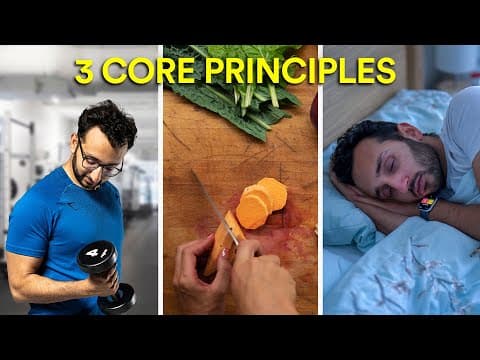
[0:00]So when it comes to building muscle, the three most important things we need to do are, firstly, progressively overload in the gym. Secondly, eat enough calories and protein. Thirdly, we need to prioritize our sleep and recovery.
[0:11]Now, this sounds pretty straightforward when you put it like that, but it's actually really hard to do in practice, and that's why in this video, I wanted to dive into firstly, why you should even care about building muscle in the first place.
[0:20]And secondly, how to actually build muscle in an efficient and evidence-based way, and then along the way, I'm going to share some of the top resources that have helped me personally on my own journey to trying to get a little bit more jacked.
[0:30]Now, if you're new here, hi, my name is Ali, I'm a doctor turned entrepreneur and author, and this video is part of Health Club, which is our ongoing series on this channel, where firstly, I try and learn about how to live longer and healthier.
[0:40]Secondly, I try to actually apply those insights to my own life, and thirdly, I make videos like this one sharing what I've learned in the hope that you might find something in here helpful as well.
[0:48]Even though I trained and worked as a doctor, the topic of how to build muscle was completely outside the scope of what we learned in medical, and so I reached out to a friend of mine, Steve Kamb, who's the founder of Nerd Fitness to help with the research for this video.
[1:00]And I actually first discovered Nerd Fitness when I was around 17 years old, when I first started to try to get into this health and fitness stuff.
[1:05]It's an amazing resource, they've got tons of blog posts and guides and articles around fitness and nutrition and sleep and like all of the fun stuff, and so I want to give a big shout out to their team for helping with the research and the fact checking for the stuff that I'm going to say in this video.
[1:17]Part one, why should you bother building muscle in the first place?
[1:20]Okay, so a lot of people think that building muscle is something that you only do for vanity and aesthetic reasons, but building muscle is not just about this.
[1:27]And the most important why that we need to have for building muscle is that building muscle is very good for our health in general.
[1:32]Now in Peter Atia's book Outlive, which is a fantastic book about how to live longer and healthier, he describes exercise as the most powerful longevity drug, and he talks about how exercise increases both the length and also the quality of your life.
[1:43]In the book he writes, I think of strength training as a form of retirement saving.
[1:50]Just as we want to retire with enough money saved up to sustain us for the rest of our lives, we want to reach older age with enough of a "reserve" of muscle (and bone density) to protect us from injury and allow us to continue to pursue the activities that we enjoy.
[2:01]Now, the problem is that it's a lot easier to lose muscle than it is to gain muscle, and our muscle mass starts to decrease by default as early as our 30s, which is actually kind of scary.
[2:09]But having strong muscles that we've built up over time can help us move better, it can help us stay balanced and upright, which reduces the risk of falling, because if you fall when you're old, you can break your hip and that basically ruins your quality of life.
[2:19]It helps you lift heavy things, which doesn't necessarily just mean barbells at the gym, it could mean that as you get older, you'll actually be independent enough to lift your own shopping bags and to be able to take stuff up and down the stairs, and it also helps slow down decreases in our bone density that happen over time.
[2:34]Now, the idea that Peter Atia talks about in his book, which I think is really, really cool, is the idea of the Centenarian Decathlon.
[2:40]So, imagine, like, let's say you live to be 100, what are the sorts of activities you would love to be doing as a 100-year-old?
[2:47]Would you like to be able to walk up and down the stairs by yourself?
[2:50]Probably. Would you like to be able to lift your grandchild up in the air?
[2:54]That would be cool. Would you like to lift up your own shopping bags? Sure, why not? Would you like to be able to walk on your own to the local bus stop or to whatever the train station without getting out of breath and becoming comatose?
[3:04]You'd probably want to do that. This is the idea of the Centenarian Decathlon, like, what is that series of things that you think you'd like to do in your old age?
[3:11]And then the idea is that once you know that, we kind of have to work back from that to figure out, okay, cool.
[3:17]So, therefore, how much muscle mass do we need to have when we're in our 40s? How much cardiovascular fitness do we want to be aiming for when we're 50, so that when we're 80, 90, 100, we can still be relatively independent?
[3:26]And this was the thing that really sort of sealed the deal for me in terms of building muscle.
[3:30]Initially, the reason I wanted to build muscle was so I could get a bit more jacked and, I don't know, become more attractive to women, but I'm married now, so that's less of a concern, but back when I was working as a doctor, I spent four months on a placement in geriatric medicine, which is sort of the care for the elderly ward.
[3:42]And there were loads of people there who were old and frail, and they didn't really have much of a quality of life, they weren't very independent, they had to go into a care home, and a lot of this stuff could have been avoided with certain lifestyle factors.
[3:53]Like, if someone was overly obese, they were way more likely to have a terrible time when they're older.
[3:58]If someone was very frail and they had a fall, and they were to break their hip or whatever, then suddenly your quality of life takes an absolute nose dive, and your chances of dying in the following year rise by an insane amount.
[4:08]And so the thing that I took away from working on that elderly care ward and reading about the Centenarian Decathlon stuff is that actually, you know, building muscle, it's not really for right now, because like, I don't know, me getting an extra few kg on my bench press isn't really going to change my life right now.
[4:22]What it will do is that, A, it builds the habit of doing weight and resistance training, which has been shown in all sorts of studies to be really, really good for you, and B, it means that as I get older, I'm hopefully going to lose less of my kind of independence and ability to do stuff than I would have otherwise.
[4:37]The second reason to build muscle is that, especially if you're a dude, having a reasonably muscular physique does make you more attractive to women on average.
[4:43]Now, we're going to do a really fun experiment here. This is from a blog post by a chap called Julian Shapiro. I'm going to show you these two images.
[4:49]This is picture A, and this is picture B. Now the question is, which of these two physiques do you think is more attractive to women on average?
[4:56]Whatever sex or gender you happen to be, I'd love to hear in the comments down below what you think, but this is what Julian wrote in his blog post.
[5:00]Many women describe men with huge physiques as similar to "girls wearing too much makeup." It's too much of a good thing.
[5:07]So, apparently, on average, women actually prefer this sort of physique, which, you know, reasonably muscular, but not like overly so, compared to this guy who's like way more jacked and is the sort of model that you'd see on like male fitness magazines and stuff.
[5:19]The point being that, yes, being and looking fit and healthy does make you more attractive to women, but you don't need to go overboard on it.
[5:25]And so, you actually don't need to do that much in the gym to get a physique that most women would would find reasonably attractive.
[5:31]And finally, the third reason why you should probably have a decent workout routine and aim to build muscle is that it really does help with self-esteem and confidence.
[5:38]Not because you're suddenly getting jacked, but actually because you've set this big long-term goal for yourself, you're showing up consistently, you're making small progress over time, you're experiencing the wins that you get from being able to progressively overload and lift a bit more weight than you could before, and it's also a great way to release endorphins, which are the feel-good hormones you get by physically pushing your body.
[5:56]Oh, by the way, if you are enjoying this video, then you might like to check out Brilliant, who are very kindly sponsoring today's video.
[6:01]Brilliant is a wonderful online education platform where you learn by doing, not just by consuming, and they've got thousands of interactive lessons in maths, and data analysis, programming, and AI.
[6:10]I've personally been using Brilliant for the last five years now, and I absolutely love it.
[6:13]They've got a great first principles approach to learning, which helps you build understanding from the ground up, and it's all crafted by an award-winning team of teachers, researchers, and professionals from cool places like MIT, Caltech, Microsoft, and Google.
[6:25]Brilliant helps build your critical thinking skills through problem-solving rather than memorization, so while you're building real specific knowledge on specific topics, you also become a better thinker.
[6:34]And the best part is, you can do this in just a few minutes every day, which is the absolute opposite of mindless scrolling.
[6:39]Their growing number of courses on programming are particularly good, and those can help you get familiar with Python and start building programs on day one with their built-in drag and drop editor.
[6:47]If any of that sounds good and you'd like to try out everything Brilliant has to offer completely free for a full 30 days, head over to brilliant.org/aliabdaal, or you can scan the QR code on screen, or you can click on the link in the video description, and that will also get you 20% off the annual premium subscription.
[7:01]So thank you so much, Brilliant, for sponsoring this video, and let's get back to it.
[7:04]Part two, how to actually build muscle? Key principle number one, progressive overload.
[7:09]Okay, so progressive overload is basically a fancy way of saying that over time you want to be lifting heavier and heavier weights.
[7:15]There are two apps that I personally use when it comes to progressive overload at the gym. The first one is the 531 app, which is just an app that someone's made that helps you just easily follow the 531 plan.
[7:24]So when I go to the gym, I look at the 531 app, and I'm like, all right, cool, what exercise am I doing today? And it just tells me exactly what weight and what reps I should be aiming for.
[7:32]So yesterday, for example, I had a bench press day. I used the 531 app to tell me that, okay, cool, after a few warm-up sets, I'm doing five reps at 60 kg, and then three reps at 70 kg, and then as many reps as possible at 75 kg.
[7:46]And that's how the 531 kind of workout plan works. The the your working set, you're trying to do as many reps as you possibly can with that particular weight.
[7:52]And secondly, I use a really good app called Strong, which is an app that I've been using for years to log most of my workouts.
[7:59]But then the nice thing about Strong is that I can put bench press barbell into Strong, and I could see that, okay, last time, like three weeks ago, I did seven reps at 75 kg.
[8:06]And so today, I'm going to aim for more than seven, and I was like trying to aim for 10, but the sort of when I got to seven, I was like, okay, I can't I can't do 10, that's going to be that's going to be too hard, but I managed to do eight, and then I broke a personal record because it's like, oh, before, I only did seven reps at 75 kg, and today, I did eight reps at 75 kg.
[8:24]Great. That is progressive overload. It's where you're lifting a little bit more each time, but what's really helpful for that is to have some sort of log of what your workouts are.
[8:31]Because it's impossible to remember that, oh, you know, on the 12th, four weeks ago, last time I did this particular workout, this is the exact weight that I lifted, and therefore, this is what I should aim for next.
[8:40]I found that tracking my workouts helps make them feel like more of a game, feels like more of a a fun thing that I'm doing.
[8:46]And also helps me set a particular goal, and I did seven reps last time, I'm going to go for eight reps today, that sort of thing.
[8:52]And there are four key factors that it's worth appreciating to help you maximize your chances of building muscle.
[8:57]There is volume, intensity, frequency, and specificity.
[9:01]Now, if you're a complete beginner to working out, or even if you're an intermediate to working out, you should probably just follow a plan that someone has come up with.
[9:07]I'm currently following the 531 method. I don't know if it's by I read the book about it, it seemed legit.
[9:11]Or you could go to a personal trainer at the gym and just ask them to give you a plan.
[9:14]Pretty much every reasonable workout plan will have all of these factors taken into account, but for me, I found it helpful to kind of understand a little bit of the theory behind it, so that I understood why the 531 plan works, or why StrongLifts 5x5 works, or you know, all of that fun stuff.
[9:27]So, volume is basically the amount of work that you're doing, and in your workout, it's calculated by multiplying your sets by your repetitions or reps.
[9:35]So, for example, if you do three sets of squats, each with 10 reps, then your total volume is 3 times 30, which is 30 working reps.
[9:43]Most experts say that for most of our exercises, we should be aiming for a rep range of 5 to 15, which means doing five repetitions is fine, and up to doing 15 repetitions is fine.
[9:53]When you get into like 25 and 30, that is also fine, but then it just takes ages, and it sort of feels a lot more taxing on the body and stuff, so generally 5 to 15 is what most people recommend.
[10:02]And ideally, if you want to maximize your gains for a single muscle group, like, let's say quads or hamstrings or biceps, we want to be aiming for 6 to 10 sets per workout, and that could roughly translate to two to three different exercises.
[10:13]So, let's say you're working on your quads, you could do three sets of squats, which would hit your quads, you could then do three sets of leg press, which would also hit the quads, and then you could also do three sets of leg extensions, which would be nine sets hitting the quads in particular.
[10:25]Personally, I don't like to think too hard about this stuff because it gets it gets kind of complicated, and people way smarter than you and me who specialize in gym bro stuff and who have spent their lives in the gym, have just come up with exercise plans.
[10:35]So, I think just following a plan is the way forward, but of course, it's useful to understand the theory as well, just in case you happen to be at a hotel gym where you can't quite follow your plan, it doesn't have the equipment.
[10:44]Then in that case, understanding the theory behind this stuff, you can then create your own workouts if you have to, but ideally, you wouldn't have to, you would just follow someone's pre-existing plan.
[10:51]Anyway, secondly, intensity is the weight that you choose to lift.
[10:55]How much weight should you be lifting with each exercise? Well, follow the plan, but what most of the expert recommendations say is that you should be lifting to within one to three reps of failure while maintaining appropriately good form.
[11:07]So, for example, yesterday, I did a bench press session, I was following the 531 plan, and this basically means that you could technically and physically do one or two or three more reps of that exercise, but you choose not to.
[11:18]For example, you could do 12 squats at 70 kg, but you instead do 10 reps in a single set, which leaves two reps in reserves, or RIR is sometimes used, and this would be a good level of intensity.
[11:29]If you're trying to bicep curl this glass, for example, and, you know, it would take me thousands of reps of this to get anywhere near failure, which is why I would need to increase the weight of whatever I'm bicep curling so that I can stay within the 5 to 15 rep range, but also having enough intensity that I'm only leaving one to three reps in reserve.
[11:46]Thirdly, we have frequency, which is how often you work out each week.
[11:50]If you're trying to get the most bang for your buck in terms of muscle gain relative to time invested, most recommendations say around three to four workouts per week is best for most people.
[12:00]Some people go up to five, and if you're a complete beginner, you can probably drop down to two workouts per week and just do a full-body workout each time.
[12:06]And that's because as a beginner, you don't need much of a training stimulus to make gains, you've got the beginner gains, the newbie gains, whatever people call them.
[12:12]In my case, I'm following the 531 plan, and I'm aiming for four workouts each week.
[12:16]Sometimes it's three, sometimes it's four, but like most weeks I aim for four, and each workout ends up being somewhere between 30 and 45 minutes, depending on what exercise I'm doing.
[12:26]Like if it's deadlift today, it takes ages to set up for deadlift, so it takes longer compared to overhead press, which takes a lot less time to set up for.
[12:32]The main thing here is what every single recommendation says is that consistency is one of the absolute most important things.
[12:37]You want to pick the workout routine, the workout regimen, the workout frequency that allows you to stay consistent, because consistency in the long term is what gives you results, like everything in life.
[12:46]And then finally, we have specificity, which means choosing the most appropriate exercise to apply tension to the target muscle that you want to work on.
[12:52]Again, all of this is taken into account if you just follow a plan. Go on Google, go on Reddit, go on Nerd Fitness, go on Jeff Nippard's YouTube channel and buy one of his guides, which I bought a little while ago, so they're really good.
[13:01]Just like follow someone's plan and you won't have to think about this. But the point of specificity is that, you know, there are certain exercises that target certain muscle groups.
[13:08]But the main thing to take away from this section is that, yes, of course, we need to be consistent with our workouts, and we need to hit the gym at least two times a week.
[13:15]But really, the key is progressive overload. Progressive overload is what makes muscles grow.
[13:19]You probably don't want to be doing the exact same workout every single time, you want to be increasing the weight or increasing the number of sets or increasing the number of reps over time so that your muscles become more and more taxed, and over time you'll find yourself growing muscle.
[13:32]In the video description, the guys at Nerd Fitness have very kindly put together some example exercises and also some example workouts, and we'll put loads of links to all of the sources and all of the stuff in the video description as well, if you want to explore this rabbit hole a little bit further.
[13:44]Principle number two, eating well.
[13:47]Okay, so when it comes to building muscle, yes, genetics does play a certain part.
[13:51]You probably have friends who seem to be jacked without doing any work, and if you're like anything like me, and maybe you're South Asian, you struggle to get jacked even when you put in a lot of time in the gym.
[14:00]But according to the research, lifestyle factors matter a lot more than genetics when it comes to building muscle.
[14:04]And so these are things like how you train, and your diet, and your sleep, and your stress levels, and all that fun stuff.
[14:09]Now, when it comes to eating, there are two key things that we need to keep in mind.
[14:12]The first one is protein. So, the question is, how much protein should you be having?
[14:17]Well, firstly, we need to have protein because protein is literally the building block of muscle, it allows muscles to grow and to recover, but the problem is most of us don't get enough protein.
[14:24]Now, the current international recommended dietary allowance RDA guidelines for protein intake says that you should be aiming for 0.8 grams of protein per kilograms of body weight per day.
[14:35]So, in my case, I weigh around 75 kg. According to the guideline, I should be aiming for 75*0.8, which is 60 grams of protein per kg per day.
[14:45]Now, according to Peter Atia, who is a doctor and a scientist who has researched this stuff, he literally says in his book, this is a complete joke.
[14:52]This is way too little. I don't know why the recommended dietary allowance is so low, but every fitness professional and person who studies this stuff.
[15:00]I've ever heard speak about this, and I've interviewed a bunch of them, have all said that that is just an absurdly low amount of protein if you're genuinely trying to build muscle.
[15:08]Now, if we ignore these international guidelines that apparently don't know what they're talking about, the actual recommended protein intake for people who are a healthy weight and trying to gain muscle is 1.6 to 2.4 grams of protein per kilograms of body weight per day, which is a lot more than you might think.
[15:23]So, in my case, I'm 75 kg, and using this recommendation, I should be aiming for 120 to 180 grams of protein every single day.
[15:32]That's actually weirdly hard to do. I've been tracking my protein now for a while using an app called Protein Pal. I sort of sometimes track macros using my fitness pal, but it gets a bit annoying.
[15:41]Maybe that's why I'm not as jacked as I could be because I don't track properly. It's just really hard to get enough protein.
[15:45]Like, how do you get 150 grams of protein per day? It's like, yes, you could have 50 grams of protein with three meals, but like, how do I get 50 grams of protein for breakfast?
[15:50]That's like, I don't know, a chicken breast and a half. Who has a chicken breast and a half for breakfast? It's just weirdly hard to do.
[15:57]I found the best thing is to just aim to have a protein shake first thing in the morning, and then for lunch and dinner, to be aiming to get a decent slab of protein with whatever I'm eating.
[16:04]And then aim for another protein shake in the afternoon, and that tends to get me up to the 150 grams per day, but it's weirdly hard to get enough protein.
[16:11]If you're not gaining muscle to the degree that you'd like, I've spoken to a bunch of people who specialize in this, and they're way more jacked than I am.
[16:16]A lot of it is down to, are you working out in the gym consistently enough, and are you eating enough protein?
[16:21]Those things seem to cover a wide majority of like the base of reasons why people struggle to gain muscle.
[16:26]Other than protein, the other important thing is calories, so you want to be make sure you're actually eating enough food overall.
[16:31]This is where things start to get complicated because in general, if you want to build muscle, you want to be in a calorie surplus, I.e., you want to be eating more calories than you're expending.
[16:40]The problem with that is as you build muscle, because you've got progressive overload and a good training stimulus, you're also going to get a little bit fat.
[16:46]And this is a problem that loads of people have. I've had this problem for years where I'm like, okay, I'm in a bulk phase, and so I gain muscle, and I'm making the gains, but then the belly gets bigger, and I'm like, wait, why am I getting fat? Like, you know, this is not what I was promised.
[16:57]I'm not going to go into the details too much in this video, I've done so much reading about this, watched a bunch of videos about it, I'll put some of the links down in the video description if you want to explore this rabbit hole.
[17:04]And there are loads of people on YouTube who are way more qualified than I am to talk about the ins and outs of bulk versus cut cycles or like, you know, or like lean gains while on maintenance calories and all that kind of fun stuff.
[17:15]But if you're a beginner and you're following a plan, hitting the gym three or four times a week consistently, and eating enough protein, you're probably going to be good.
[17:21]You probably don't need to think too hard about the calories, but if you want, you can, and you can find more information about calories as a specific topic.
[17:28]And then we come to principle number three, which is resting well.
[17:31]Now, one of the most important things to remember when it comes to building muscle is that our muscles are built when we are eating and resting, not when we're actually at the gym.
[17:38]So, firstly, let's talk about rest between sets during a workout.
[17:42]And the general rule with rest between sets is that you want it to be long enough that you can put in the same amount of effort into each set.
[17:48]And you want the rest to be long enough that you feel mentally ready to go again, and you're not limited by things like your heart rate or breathing rate if you're doing particularly high-intensity exercise.
[17:57]So, for example, if you're warming up or you're working with a lower weight, then you might only need to rest for 60 to 90 seconds in between sets.
[18:02]But if you're lifting super heavy weights, then you might even need to be resting for three to five minutes between sets, which can sound like a really long time.
[18:09]Now, during that rest time, it's totally okay to not do anything. Often in my rest time at the gym, I'm just listening to a podcast or an audiobook or taking notes on something on my phone.
[18:16]In an ideal world, if I cared about really maximizing the efficiency of my muscle gain, I would be doing antagonistic exercises during the rest.
[18:23]So, for example, I could be doing overhead press, which works the shoulders, and then during my rest from overhead press, I could be doing squats, which works a different set of muscles.
[18:30]And so, in a way, one set of muscles is resting while the other set of muscles is working, and that just makes your time at the gym way more efficient.
[18:36]The second important part of rest as it relates to building muscle is about sleep, and there have been a bunch of studies that have shown that not getting enough sleep actually shifts your body towards catabolism, which is a state that favors the breakdown of muscle, rather than anabolism, which is the state that favors the building up of muscle.
[18:52]So, if we care about building muscle, we really should be trying to get enough high-quality sleep, which will really help with that process.
[18:57]And if you're interested in learning more about that, you can check out this video, which is also part of our health club series where I do a deep dive into the science behind how to get better sleep.
[19:05]Thank you for watching. If you found this useful, and I'll see you hopefully in the next video. Bye bye.