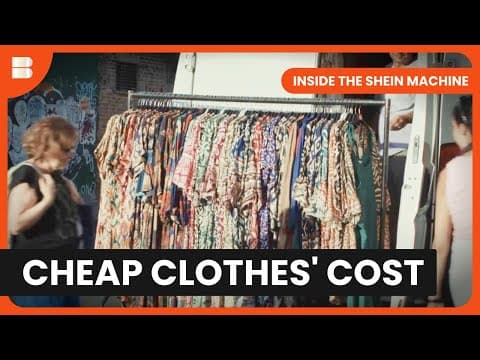
[0:00]I feel really really tired, exhausted, really exhausted. So, what time do you finish work? 2am or 3am.
[0:12]Shein is the fastest growing fast fashion brand on the planet. I'm here with a Shein haul. Selling cheap clothes in every colour, size and design. You can't finish Shein like you can't finish TikTok. From the point of view of marketing, they have absolutely nailed it. Shein have taken the fast fashion model of producing clothes and put it on steroids. This year, the company was valued at 84 billion pounds. But alongside its meteoric success, there are growing criticisms. Shein's business model is exploitation. I want to investigate the brand that's popping up on all our social media feeds to find out the truth about this fast fashion phenomenon. It's a story that takes us from the UK to China. I'm here to look for a job. Where for the first time, our undercover cameras will go behind the doors of Shein's factories. I'm working 17 hours a day. This needs to be shipped! It can't wait!
[1:27]I'm literally obsessed with it. Inside the Shein machine. My name is Iman Amirani. I'm a journalist and like most people, I've bought my fair share of clothes from fast fashion retailers over the years. If you type Shein into any search engine online, you'll see that nearly every newspaper and media outlet has done an article or a video or a story about one aspect of Shein at one point or another. Mostly, they talk about how successful the company is and how quickly it's managed to grow to be the biggest fast fashion retailer online. So I wanted to know how it's managed to grow so big, so fast. In the past few years, we've seen lots more fast fashion brands be born like misguided, Boohoo, I saw it first, ASOS, and of course Shein. Shein launched in 2015 evolving out of an online wedding dress wholesaler, Sheinside. Shein scrapes social media for emerging trends, turning them into designs which they commission in small batches from a network of thousands of factories in Guangzhou, China. These factories rely on an army of migrant workers to produce the orders as soon as they come in. Shein have this test and repeat method of producing clothing. They effectively treat it like a laboratory. So they can throw an idea at it. And if they do well and we buy lots of them, they produce lots more. This allows them to test out thousands of different styles on us every day. This machine operates on a completely different level. During the pandemic, Shein flooded the UK with its cheap, trendy designs through its innovative use of another Chinese success story, TikTok. Shein! They've used content creators as a way to almost be the faces of their brand. So you will see predominantly young women buying lots of clothes or being gifted lots of clothes from Shein. And because they're so cheap, it will be so easy for you to click these links and go and buy them for yourself. Shein's sales figures skyrocketed by almost 400% to 14.5 billion pounds. That website is becoming more and more tuned every day to convincing people to buy more and more fast fashion. And today, they supply 220 countries worldwide. When it comes to Shein, you don't know anything about how the company's structured. Where they pay taxes, where they produce let alone under what circumstances they produce. There's a lot of concern about how opaque the company is. Right now, a lot of people really do care about the conditions that people are working in. They also care about sustainability and the environment. But somehow Shein has managed to not have to really deal head on with many of these issues and continue to grow in popularity. And I want to know how they've managed to do this whilst providing more questions than answers. The Shein business model is really problematic at both ends. You have millions of people that are incentivized to buy stuff they don't really need. The other side, the problem is that production circles are so short and pressure is so high that workers are exploited and work absolutely inhuman hours.
[5:07]I want to understand how, despite these criticisms, Shein has managed to seduce shoppers like you and me. I'm going to meet one of their best customers, 17-year-old Safia. We've also got these which are so super cute. Look how pretty she looks as well. College student Safia works in a cafe to fun her shopping habit.
[7:02]When you live in like a small town, you meet people and you can probably tell me the exact same thing. The first thing they say to me is, where are you from? I've not seen anyone who's like a similar color to me in Scarborough. No. Not one. It's not like there's anyone who's similar to you, you stick out anyway. So I may as well stick out and look good sticking out. But that said, Shein is one of the worst because the prices are so cheap that people over consume and view their clothes as disposable. Amid the thousands of haul videos, there is a growing number of sustainability campaigners speaking out about fast fashion, with Shein as one of their main targets. This is the number of clothes these brands are selling on their US sites alone. Our planet can't sustain this amount of clothes. This, making these guys look insignificant, horrifying.
[7:53]I wanted to know if Safia had seen videos like these too. You hear things about every online shopping brand and you just think, oh, like is it true? Is it not true? Like where am I buying this from? Do you think about that? Oh, yeah. Because sometimes you'll post a video and someone will be like, oh, you know, this is like shipped from somewhere and it's not great. Like how the people are treated in like the factories and stuff that they're made in. Are they paid enough? Are they treated nicely? Online shopping brands are like seriously trying to gain our trust. They're trying to look better. Last year, Swiss human rights journalist Timo published a report about the pay and conditions in some of Shein's factories. His researchers spoke to 10 garment workers from six different suppliers and presented his concerns to the brand.
[8:42]After our report, Shein said they would investigate the allegations themselves. And now they did publish a sustainability report. In this report they said they had investigated 700 something suppliers. And the result was that 83% of them required immediate action. I want to know if Shein has taken the corrective action it commits to in its own report.
[9:14]I'm meeting with a contact who has extensive experience investigating Chinese manufacturing. As his work often exposes wrongdoing, we have agreed to conceal his identity. Hello? Thank you for coming to meet me today. Sure. I'm making a documentary looking into the Chinese online fashion brand Shein. And I'm trying to work out how they managed to make so many items of clothes at such a cheap price. We haven't done sweatshop stories for quite a few years, but 10 years ago, this was really, really common in China. The new Chinese government, they have called for good working environments. And this new law and policy has supposedly in practice for about eight years. So supposedly, this has improved a lot.
[10:02]What would you recommend as being the best approach to take to find out how these clothes are being made? Our investigative journalist can infiltrate into the factory and then find out what's really going on.
[10:16]The first hand, this is the best, strong evidence, which against the Chinese law, which against the human rights, the international common practices for workers. This will be the first time undercover cameras have been inside Shein's factories. What are the risks involved? Because Shein plays a very important part in that area, they should have very good connections with local government and the police. So they could also take our investigative journalist into the police station for further interrogation. I'm going to Panyu, Guangzhou to apply for a job in a factory to investigate the environment and conditions.
[11:17]Hello, I saw the recruitment poster. Do you still need someone? I'm looking for a job. What are the hours? Working hours. That depends on when the work is finished.
[11:38]How many days off in a month? So, normally it's one day off per month? There is no such thing as Sundays here. It's difficult to ascertain the working hours so it's not possible to ascertain the working hours. When you will finish work? There's more to do. You still have so much?