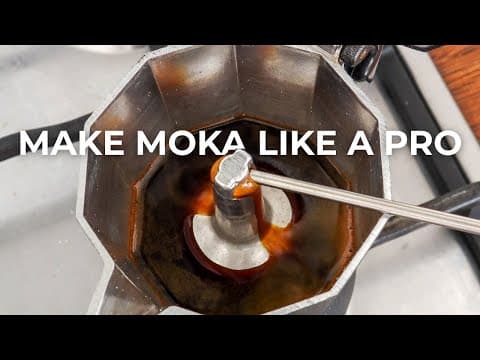
[0:00]Hi, Matteo here. In this video, I want to teach you how to make a great coffee using the mokapot. I will show you how to pack the coffee into the basket, the water to use, and the best practices to achieve consistency with this amazing brewing method. Let's first start with how does a moka pot work? The moka pot consists of three main parts, the boiler where we put our water. The funnel shaped basket where we put our coffee, and the upper chamber where the coffee is collected. The water contained into the lower chamber, when heated, creates steam pressure that pushes the water through the basket containing the coffee. That pressure ranges between one and two bars. Some pots can reach 2.5. It's very rare that a moka will reach higher pressure, because the valve in the boiler releases the excessive pressure for safety reasons. Here, I want to open a parenthesis to say that the extraction of the moka is very different from the standard 9 bar extraction that we use for espresso. That's why I always say that espresso and moka are two different brewing methods with two different brews as a result and different flavor characteristics. Anyway, going back to the moka. The water is pushed through the basket, extracting the coffee solids and goes all the way up through the chimney and finally collected inside the upper chamber. What do you need to brew your coffee with this method? Well, first of all, you need a moka pot. In this video, I'm using a three cups aluminum moka pot. You can use a stainless steel one, that is not a problem. But, I always suggest getting a really good quality moka pot because it will make a huge difference in terms of result in the final cup. Second, you need a scale to weigh coffee and water. This is very important because it can give you more control and consistency. I use a scale with a resolution of 0.1 grams for a better precision. But, a kitchen scale that show you only the grams is okay. A third thing that I always use is a thermometer probe. I use it to control the extraction of my coffee. This is not essential, but if you want to dive deep with this brewing method, it's an interesting way to improve your skills. Now, if you don't have it, you can buy it. It's very cheap, and also it can be useful in the kitchen in general. Then, I will explain how to use the probe in your moka later in this video. Other tools you might need are a grinder and a kettle. Using preground coffee is fine. You can still achieve a good cup of coffee with it. But, I always suggest to grind your coffee on demand for better aroma and flavors. And also, it allows you to change the grind size in case you need to. Talking about a kettle, I always suggest to use hot water to begin with. This gives an initial push to the moka and it will keep the pot on the stove for less time. Also, I always use an Aeropress filter that I apply on the moka metal mesh. That will give a better filtration and a better flavor clarity in the cup. Let's start to make the coffee. The first step is to weigh the coffee beans. For a three-cup moka, I usually use 17 grams of coffee. The dose can change with different coffee, but 17 is always my starting point. Now, grind size. The grind size for moka can be different, depending on the coffee we use, but also on your preference. If you want a stronger coffee, you can grind finer and or up dose the coffee in the basket. For example, if you want to make a milky coffee, such as a latte or flat white, if you want something more clean to drink black with less strength, you can grind coarser and or down dose the coffee in the basket. I always grind my coffee on demand using a comandante hand grinder. As a reference, I always grind at 12 regular clicks as a starting point. To give you a micron reference, I would say to grind your coffee between 400 and 500 microns. After the grinding process, it's time to put the coffee into the basket. This is a really important step because a good distribution in the basket is a half way to achieve a great cup of coffee. First, I want to share a trick with you. Take the upper part, open the lid, place it on the counter, and place the basket on top of it, to keep it balanced. So you don't risk to make a mess on the countertop. Now, start to place the grounds into the basket with the help of a spoon. Once you reach alpha for mount, grab the basket and give a couple of taps on the side to level the coffee and a tap on the counter. After this, place the basket on the moka, put the remain coffee and let's repeat the same tapping system very gently.
[5:41]Do not stress too much the coffee into the basket tapping too many times, because the friction between the grounds can create static and this can be very bad for distribution, because create clumps and this will bring you an uneven extraction. So, just a gentle tap, enough to level the coffee in the basket and then we can place the basket aside. Also, you don't need to use your fingers to level the coffee or press the coffee in the basket. When you level the coffee with your finger, you can create an uneven pressure of the puck, which can bring to a non uniform extraction. Also, if you want to level the coffee in the basket to replicate the nice pack of an espresso filter, you just need to take in consideration that the water in the moka comes from the bottom and not from the top, so leveling the coffee is pretty useless. Anyway, after the coffee, let's prepare our water. Water in coffee is really important. For example, for a coffee brewed with moka, water is 95% of the beverage. So, a good quality of water will give you the best results. I always use filtered water and never the one from the tap. I do this first for a better coffee quality, and second for a better maintenance of the moka pot. It also depends where you are from. For example, I'm based in London in the UK, and the water of the tap is really hard, bad for coffee, for the moka pot, and also for my health. Anyway, I always preheat the water before placing it into the moka boiler. This reduces the time for the pot to stay on the stove, so you don't have to wait too long to enjoy your cup of coffee. I usually hit the water at 85 degrees Celsius. But if you don't have a temperature control kettle, it's fine. You can bring the water to a boil and then wait for a couple of minutes. Now, pour the water into the boiler just underneath the valve. I always use a scale to be more accurate. This gives me the opportunity to be consistent every time, and I pour around 150 grams. After that, place the basket with the coffee inside the lower chamber and close the moka with the upper part. If the lower chamber is too hot, help yourself with a kitchen towel. Don't burn yourself. As I said before, I like to place an Aeropress filter on the metal mesh of the moka to achieve a cleaner cup. The paper helps to better filter the fine coffee particles for a better flavor clarity. This is not essential if you like to drink your coffee with milk, but if you like your coffee black, this can be a game changer. Now, let's place the moka on the stove. Keep the lid of the upper chamber always open. This avoids overheating and also gives you the possibility to control with your eyes the extraction flow. Very important for the next part. If you have a gas stove, always place the moka in the smaller diffuser at low heat.
[9:17]It's really important that the flame of the stove stays inside the bottom circumference of the pot for a better heat distribution. This gives you a better water heating, even if the power of the flame is low, and also avoids burning the ground coffee in case the flames climb the side of the pot. If you have an electric or an induction hob, you don't have the problem of the flames, but make sure to keep the heat low for a better result. Now, in this chapter, I want to briefly talk about the moka extraction dynamics. If you find this a bit boring, you can always skip this chapter and go to the next one. As I said at the beginning, the water contained in the boiler, when heated, creates steam pressure that pushes the water through the basket containing the coffee all the way up to the chimney, until it is collected into the upper chamber. This steam pressure is created in the head space between the top level of the water that we put into the lower chamber and the bottom level of the basket containing the coffee that we placed inside the lower chamber. We all know from school that water changes its status from liquid to gas at 100 degrees Celsius. But also, we need to know that the water starts to evaporate at a lower temperature, like, for example, 70 or 75 degrees Celsius. You can easily notice when you have your nice hot cup of coffee. You can see the coffee steaming from the cup, even if the temperature of the beverage is below the 90 degrees Celsius. So, keeping the stove at low heat is enough to let the steam build up the pressure needed. In fact, the water in the moka starts to extract the coffee around 75-80 degrees and not at 100 degrees. The fully quantity of the water inside the lower chamber is also able to control the temperature that slowly increases with the time. But what happens when the water starts to come up and the quantity of the water in the boiler starts to decrease? The temperature of the water inside the boiler rises faster, and this is a very important aspect to consider. The coffee brewing dynamics in a simple example works like this. First, we extract the acidity. Then, we extract the sweetness, and at the end, we extract the bitterness. The temperature of the water plays an important role in terms of extraction. It gives more power to the water to extract the solids from the coffee. So, if we block all the other variables and we change only the temperature, higher temperature extract more than low temperature. Now, if we think about the dynamic of extraction of the moka, we can say that when we start to extract the acidity, the temperature of the water is around 80-85 degrees. Then, the temperature increase, and we start to extract the sweetness, when the water is around the 90 degrees Celsius. And by the time we reach the 95 and above, we start to extract the bitterness. And because we said that the temperature gives the power of extraction, we can say that between acidity and sweetness, the extraction is easy to control, because the temperature of the water is lower. But between sweetness and bitterness, this extraction is harder to control, because the high temperature closes the time gap. This was a simple example that I wanted to explain. I know that there is more to talk about extraction, and I will be happy to answer your questions, if you have any. So I invite you to drop them in the comment section below. Now, going back to the extraction. How do we control it? How can we achieve a balanced sweet cup of coffee with our moka pot? And the answer is simple: we reduce the amount of brewing water. And by reducing, I don't mean to reduce the quantity of the water we place inside the boiler while we are preparing our coffee. But by stopping the extraction before all the water runs out from the lower chamber. Another aspect of extraction to consider aside the temperature is the water coffee ratio. If we fix all the other variables and we change only the quantity of the water we use to extract the solids from the coffee, we can say that lower amount of water gives a lower extraction, but a higher strength. And higher amount of water gives more extraction, but less strength. The secret is to find the right balance. Now, let's talk about what to do when the coffee starts to come out the chimney. In this chapter, I will explain the simple way without using the thermometer probe. If you use it, skip to the next chapter for the pro tips. As you can see, the coffee starts to come out slowly, and in terms of concentration is very rich. Slowly, slowly, the flow starts to increase, and here is where we need to be careful. When the flow starts to get faster and the color of the coffee starts to get lighter, turn off the stove and place the moka pot on the side. As you can see, the coffee is still coming out from the chimney, even without the fire underneath. This is because there is still some pressure accumulated in the boiler. Slowly, it will decrease until the coffee stops to come out. Taste the coffee. If it is good, perfect. If you notice that all the water has come out and the coffee tastes bitter, next time, remove the moka pot from the stove earlier to avoid over extraction. If the coffee tastes too sour, use all the water contained in the boiler. And if still sour, even after that, I suggest you to grind your coffee finer to increase the extraction of sweetness. This is the best practice to brew the coffee with a moka pot without the thermometer probe. Let's talk about how to control the extraction with the thermometer probe. After you place the moka on the stove, place the tip of the probe in the hole on top of the chimney. The thermometer captures the temperature of the air coming out from the bottom and the temperature of the metal. At the beginning, the temperature is low, and then it will rise gradually. This temperature is not the temperature of the water contained in the boiler. It's just a reference to understand the dynamic of the extraction and the flow rate. The temperature displayed when the coffee comes out from the chimney can vary based on different coffees or also different mokas. It also depends from the grind size your coffee has been ground or from the quantity of coffee you place in the basket. But now, I want to give you an example. For this coffee, the temperature when the coffee comes out from the chimney is usually around 60 degrees Celsius. If the temperature when the coffee comes out is lower, it means that the extraction happened faster. And if the coffee tastes under extracted, I know that next time, I need to grind my coffee finer. Instead, if the temperature when the coffee comes out from the chimney, it's above the 60 degrees Celsius, and the coffee tastes over extracted, I know that the next time, I need to grind slightly bit coarser. Now, the 60 degrees Celsius is just a reference. It works with my moka, maybe for your moka it will be different. But when you will find your temperature, stick with it and use it as a reference. Now that we set our temperature, let's control our extraction. Once the coffee starts to come out, the temperature of the thermometer starts to rise gradually as the flow of the liquid. If the flow rate is very fast or very slow, it doesn't mean that you grind your coffee to coarse or to fine. I mean it could, but also, don't forget that coffee, biology, processing can affect the flow rate and the extraction. Now, I want to talk you about the temperature at which you should turn off the heat. When I brew a new coffee that I never brew before, I usually give a 13 degrees difference between when the coffee comes out and when I should turn off the heat and remove the moka from the stove. So that means if the coffee comes out at 60 degrees Celsius, I turn off the stove at 73. Remove the moka from the stove and then wait for the flow to end. I taste the coffee, and if it's good, great. I will use this as a reference. If I taste the coffee and it tastes sour with a higher acidity and low sweetness, for the next moka, what I will do is to turn off the heat when the thermometer shows 76 degrees Celsius. So I'm using a difference of 16 degrees between when the coffee comes out from the chimney and when I turn off the stove. This will make sure that I will use more water from the boiler to increase the extraction, and I'm sure that my coffee will taste sweeter. You can always adjust turning off the heat in between or slightly bit more than 3 degrees. You don't need to follow these 3 degrees rules, buy something that's I like to use at home. If the coffee tastes bitter when I give the 13 degrees difference, it means that I need to stop the heat before, and usually I stop at around 70. If all the coffee comes out before reaching the 13 degrees difference, and it still tastes bitter, at this point, I will change the difference, because with every coffee it can be different. The main tip is to find the temperature range and play with it. This method will give you more control of your moka pot and give you a lot of satisfaction by drinking delicious coffees. I want to give you more information about what variables and how to change them to properly dial in your coffee with your moka pot. But I will do it in another video. Thank you very much for watching. I really hope that this video will help you to improve your coffee brewing with your moka pot. If you have any questions, or you want to share with me your method, please leave a comment below. If you like this video, please give it a like. It will make a huge difference. Also, if you are a subscriber of my channel, that is awesome. Thank you very much for sticking around, but if you're not yet, I think it's time to press that button. This will really help my channel to grow and give me the possibility to help you to brew amazing coffees. And for today, that's all. I'll see you in the next video, and in the meantime, I wish you a wonderful day.