[0:00]Sam Altman has a group chat with his tech CEO friends and a few years ago they all started taking bets on which year the first one-person billion dollar company would exist. He said it would be impossible without AI, but now it's going to happen. When that came out in 2024, no one took it seriously. But since then, a 50-person company hit $100 million in revenue and a $2.1 billion valuation. A solo founder built a product, found customers and crossed a million dollars in his first year with no team. And the tool that made both of those things possible is now available to everyone. So the prediction's already coming true. And to understand why, you have to understand what actually changed. In 2012, Facebook bought Instagram for $1 billion. Instagram had 13 employees and at the time, that felt like an anomaly, a once in a decade accident where timing was perfect and the product went viral before anyone had to actually build a real organization. Two years later, Facebook bought WhatsApp for $19 billion. WhatsApp had 55 employees serving 450 million users. Both of those were treated as outliers at the time. The general assumption was still that real companies needed real teams, sales, support, engineering, marketing, operations, finance. Each function needs people and people add up. Building a big company used to require a big team, and that's no longer true. For most of startup history, the constraint wasn't ideas, it was just execution. You could have the best product concept in the world, but if you couldn't write code, you needed a technical co-founder. If you couldn't run ads, you needed a marketing hire. And if you couldn't handle support tickets, you needed a support team. Basically, every new function meant a new person, and every new person meant more runway burned, more equity given away, and more management overhead. AI didn't just make each of these functions faster. It started replacing the need for a dedicated person to do them at all. Now, that doesn't mean that one person can do everything yet. There's still limits, and we'll get to those, but the constraint that used to make small teams impossible at a big scale is a lot smaller than it was two years ago. And there's a specific version of this story that most people are still getting wrong, the part about coding. Before 2025, most AI coding tools were basically a smarter version of spell check for code. You were still the one writing it, the tool just helped you finish sentences faster. A developer using GitHub co-pilot was still a developer. Claude Code completely changed that. When Anthropic launched Claude Code in early 2025, the biggest change was that coding got delegated. You know, you describe what you want in plain English. Claude Code reads the files, figures out what needs to change. It makes the edits, it runs the tests and shows you what it did. And if it makes any mistakes, it'll help you find them and fix them itself. For a lot of the work that used to require a developer, the founder is now the one directing, not waiting. That might sound like a subtle technical upgrade, but what it actually is changing is who can build. Think about what used to happen when a non-technical founder had a product idea and something broke. They had to find a developer, explain the problem, wait for it to get prioritized, wait for it to get fixed, and then check that the fix actually worked. That cycle on a good day took days. On a bad one, it took weeks or even months. And every cycle where a founder couldn't just handle it themselves was a cycle where momentum stalled, decisions got made by whoever had the technical access to make them. Claude Code compresses that cycle significantly. It's not perfect and it still works best when someone understands what they're asking for, but for founders who previously had no path into product without going through a developer, that changes how fast they can move. The people who figured this out first are running companies that three years ago would have required a full engineering team. So let's look at what that actually looks like. Danny Postma built Headshot Pro by himself. No co-founder, no engineering hire and without a traditional engineering background. He used AI tools to handle the product and SEO to handle discovery and did everything else solo. The product crossed $100,000 in revenue early on, and his team size documented publicly is one. What makes his story useful here isn't the specific number. It's that he's not an outlier who got lucky with timing. He understood the stack, built it from day one, and never hired a full person for the tools he could handle. But his story is still at the seven-figure level. The more interesting question is what happens when you take that same logic and apply it to a company building at an actual scale. Gamma is one of the best answers to that question right now. Gamma builds AI-powered presentations, websites, and documents. In November 2025, they announced $100 million in annual revenue, a $2.1 billion valuation, and 70 million users. Their team at that milestone was around 50 people. And if you break that down, $100 million in revenue across 50 people is $2 million in revenue per employee. A traditional software company at the same revenue level typically has 200 to 400 people. Gamma is doing the same thing with a fraction of the team, and the gap exists because they built AI into how the product works from the beginning. Danny and Gamma aren't doing different things. Danny's just earlier in the same journey. The logic is identical. Don't hire for what the tools can do, and your revenue per person stays as high as you grow. Linear is worth mentioning, too. It's a project management tool with a $1.25 billion valuation and a team that's roughly 100 people. That's not solo. It's not even close to solo, but for a company that size, 100 people would have been unthinkable five years ago. These companies aren't exceptions to the old rules. They're the beginning of the new ones. And there's one part of running a company like this that almost nobody talks about until it's already a problem, the money side. When you're the only person in the company, the things that usually get handled by other people don't disappear. They just don't have anyone assigned to them. Engineering is handled, the product gets shipped, and the customers come in. But knowing where the money is going, catching costs before they spiral, seeing your margins before it's a crisis, that still needs to happen. And most solo founders are tracking it in a spreadsheet they update whenever they remember to. That's what Roe solves. For example, banking, expenses, and Bill Pay in one place. Running automatically so the books stay clean without anyone managing them. You'll find a link in the description. Bessemer Venture partners tracks the fastest scaling AI startups, and the numbers are wild. The top companies are hitting $40 million in revenue by the end of year one, 125 million by year two, and more than 1 million in revenue per employee. These aren't projections either. That's what the actual fastest companies are already doing. Now, think about what a billion dollar valuation actually requires for an AI native company right now. Private market multiples for high-growth AI businesses had been running significantly higher than traditional software. In strong rounds, companies have been valued at 20, 30 times their annual revenue, rather than the 6 to 10 times you'd see in public markets. At 20 times ARR, you'd need $50 million in revenue to reach a billion dollar valuation. At the Bessemer Supernova pace, you're at 125 million in revenue by year two. The jump from solo founder to that kind of outcomes no longer blocked by the old math problem alone. The remaining question is whether one company can sustain that growth rate without the business quality breaking underneath it. And that depends a lot on what you're building and how it's structured. But the prediction comes with big limits, and most people skip over those. The strategic layer still needs a human. AI can build what you ask for, run the ops you've designed, handle the support volume and generate the content. But it can't tell you whether the market you're chasing is the right one, whether your pricing is leaving money on the table, or whether the company should pivot before the data makes it obvious. That judgment is still yours. High-stakes trust is still human. Enterprise sales, key partnerships, difficult investor conversations. Those are all kind of decisions that happen in a room with another person, and they still need a founder there. And the margin reality matters. Bessemer's fastest scaling companies were averaging around 25% gross margins. Traditional software does 60 to 80. That difference means getting to a billion dollar company isn't just about building fast. The business model has to be right too, or the math just falls apart as you grow. None of that means Sam Altman is wrong. It just means that the first one-person billion dollar company will probably won't make a big announcement about it. It'll just be a founder who built something good, kept the team small and one day hit a number that makes Altman's prediction feel obvious. He put a timeline on it, but the company's already being built or getting close. The only question is whether you're one of the founders building that way now, or one who figures it out later.
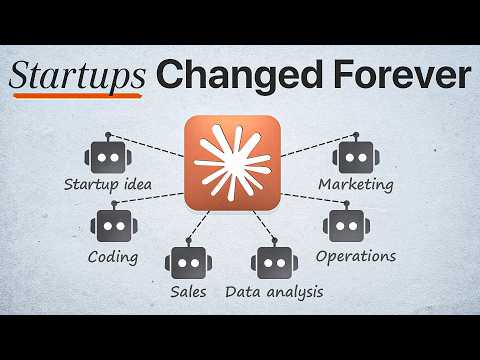
The One-Person Startup Era Has Officially Begun
Rho
8m 2s1,634 words~9 min read
YouTube auto captions
Transcript source
YouTube auto captions
This transcript was extracted from YouTube's auto-generated caption track. The transcript below is server-rendered so it can be read, searched, cited, and shared without opening the original YouTube player.
Pull quotes
[0:00]Sam Altman has a group chat with his tech CEO friends and a few years ago they all started taking bets on which year the first one-person billion dollar company would exist.
[0:00]But since then, a 50-person company hit $100 million in revenue and a $2.1 billion valuation.
[0:00]A solo founder built a product, found customers and crossed a million dollars in his first year with no team.
[0:00]And the tool that made both of those things possible is now available to everyone.
Use this transcript
Related transcript hubs
Watch on YouTube
Share
MORE TRANSCRIPTS


