[0:00]Now we return to Newsline with a closer look on Vietnam's combat against a pressing issue, plastic waste. Now in Hanoi, from the 1st of January 2027, the capital city of Vietnam will stop providing free non-biodegradable plastic bags in markets and convenience stores, according to a resolution recently adopted by Hanoi City's People's Council. Yes, and there's perfect ground to carry this out, Dylan, and uh dare I say it's high time that we do so. Because according to statistic from the Ministry of Agriculture and Environment, each year Vietnam discharges about 1.8 million tons of plastic waste. And in the world, more than 5,000 billion plastic bags and packaging are produced each year, according to the World Watch Institute. Used plastic bags and packaging are often buried, burned, or dumped into rivers and oceans, causing pollutions and non-biodegradable microplastics. Therefore, reducing plastic packaging has become an urgent priority. Plastic bags and packaging are still widely used in commercial activities across Vietnam. In response, many businesses and consumers are taking action with greener production and consumption choices in their daily lives. This milk production company has implemented a series of solutions to reduce plastic waste released into the environment. From reducing the size of the plastic seal on bottle caps, reducing the width of bottle bodies and labels, and reducing the amount of the shrink films used for bundle dairy packs. We have carried out many programs such as recycling packaging into reusable bags, classifying waste and collecting used batteries. We always try our best to minimize anything that could harm the environment. Not only businesses, but also many markets and supermarkets have gradually replaced plastic bags with environmentally friendly packaging. In the past, plastic bags were the common choice at supermarket, but now many retail chains have started to use biodegradable bags that are more environmentally friendly. This transition not only helps reduce the burdens of plastic waste, but also forster a new greener shopping habit among consumers. This supermarket has applied and implemented various programs to reduce the amount of plastic products in transactions such as offering paper bags and using cups and bowls made from sugar can bugass for ready-to-eat food. Since 2020, the supermarket has sold over 480,000 eco-friendly bags and more than 8 million customer have refused to use plastic bags. I am very willing to pay a bit more to buy a reusable cloth bag that I can use many times and help protect the environment. We have encouraged customers to move towards green consumption through various incentive programs. For example, if a customer does not use plastic bags, we directly offer a discount of 1,000 Vietnamese dong per transaction. From the efforts of businesses to the habits of consumers, public awareness around plastic waste reduction is growing steadily. Contributing significantly to Vietnam's efforts towards achieving net zero emissions by 2050. To better understand how plastic bags can be managed without harming the environment, our reporter Fihai spoke with Mr. Hoang Thanh Vinh, program manager for waste and circular economy at the United Nations Development program UNDP in Vietnam. Thank you for agreeing to join our talk today. In your opinion, what is the biggest challenge in managing and treating plastic bags after use in Vietnam today? Plastic waste, uh, in the environment and then over time it becomes microplastic. And microplastic can carry or can bring chemicals, so that can affect, um, animal and human health. So the cost for cleaning those contaminated plastic and then, uh, recover or recycling is so high comparing to the cost. Furthermore, the cost for production of plastic bags is very low. So people, you know, are easily to get the new plastic bags to carrying a different things. Uh, for the policy, there is a tax for plastic bags, which is a 50,000 Vietnam dong per kg, which is very small. So 1 kg of plastic bag, it can have like a 100 or even thousands of bags. So the cost for production is so low, it is very easily contaminated, and the cost for cleaning and recycling is very high. Your switching to biodegradable packaging has reduced the burden of plastic waste management, and what should be done to make these transitions more effective? I would say that yes, when switching to, uh, biodegradable plastic is a good thing. However, we need to be careful with the term, you know, biodegradable and compostable. Let's differentiate the two terms. Bio-based or fully 100% bio product, that's good. For example, the product made of rice or made of straw or made of grass. While compostable product, there are still a percentage of nylon or plastic in it. So that we need to be very careful with the second one. For example, bio-based product, let's reduce tax, while we should give more burden for the conventional or traditional plastics. One policy that I think Vietnam has been doing quite well, which is a EPR extended producer responsibility. Um, so that policy was promulgated with the law on environment protection in 2020 and becoming into force in 2022. However, the implementation is quite slow and, uh, the Ministry on agriculture and environment is now revising. Thank you for joining us.
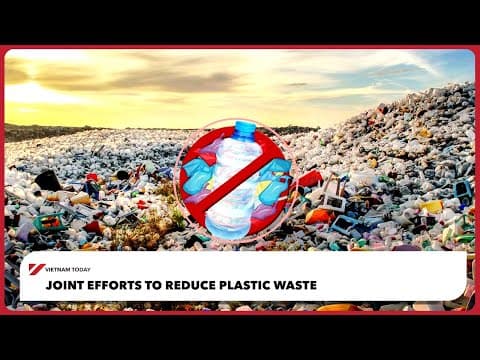
Joint efforts to reduce plastic waste | Vietnam Today
Vietnam Today
6m 48s872 words~5 min read
YouTube auto captions
Transcript source
YouTube auto captions
This transcript was extracted from YouTube's auto-generated caption track. The transcript below is server-rendered so it can be read, searched, cited, and shared without opening the original YouTube player.
Pull quotes
[0:00]Now we return to Newsline with a closer look on Vietnam's combat against a pressing issue, plastic waste.
[0:00]Yes, and there's perfect ground to carry this out, Dylan, and uh dare I say it's high time that we do so.
[0:00]Because according to statistic from the Ministry of Agriculture and Environment, each year Vietnam discharges about 1.8 million tons of plastic waste.
[0:00]And in the world, more than 5,000 billion plastic bags and packaging are produced each year, according to the World Watch Institute.
Use this transcript
Related transcript hubs
Watch on YouTube
Share
MORE TRANSCRIPTS


