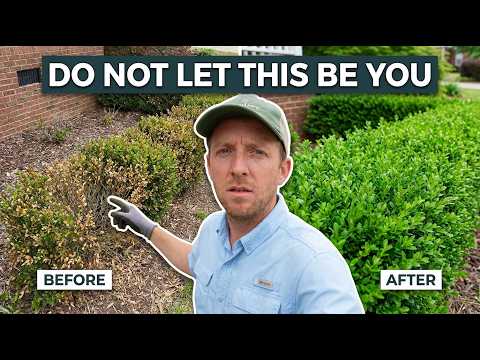
[0:00]Boxwoods, perhaps no other shrub in the landscape is more multipurpose than the boxwood. In this video, I'm going to give you my tips, tricks and hacks on planting boxwood, proper site selection, how to prune, how to fertilize, how to spot diseases and so much more. Hi, I'm Dr. Tom Warren and you're watching the Plant doctor. Let's get started.
[0:32]So spring is the perfect time to prune boxwoods. And the reason being is we get all this new fresh growth that comes out, and it gives us an opportunity to shape our boxwoods into really whatever shape we want. If you want a rounded boxwood, you can shape them rounded. Uh here I have more of a formal square hedge that surrounds this porch with some um, limelight hydrangeas behind it, so in the summer we get these nice beautiful flowers hanging over the top. But all you want to do is just come in and and shape that new growth, and you can cut it flat or rounded like I said. And you really can't hurt a boxwood by pruning it. You can prune down as far as the leaves go. I wouldn't go past where the leaves stop down in the plant. And as long as you're doing that, you're going to be just fine with pruning boxwood. Once you've pruned your boxwoods in the spring, you may find yourself needing to prune perhaps two or three more times throughout the growing season in order to keep your boxwoods in the shape that you want them. If you want to avoid that, a product you can use is Atrimac. So Atrimac is a plant growth regulator, so this has plant hormones in it that shortens the internode on a branch. So an internode is the distance between two leaves, so we're shortening that up, so the plant doesn't grow as fast as it otherwise would. You can apply that to these boxwoods and you would only have to prune one time in early spring. Once you've pruned your boxwoods to the desired shape that you like, you'll want to get the clippings out of the boxwood itself. Take a rake, go over the top of the boxwood really well, you're not going to hurt your boxwood raking the top of it out. What we don't want are those dead clippings decomposing down inside of the boxwood. That's just an opportunity for pathogens to start to feed on that decomposing material and potentially introducing bacteria or fungus to our boxwood, which we do not want. So make sure you clean up your area really good after you prune. One thing I don't want you to be concerned about when pruning boxwoods in the springtime is sometimes that new growth is going to come out very early in February and March. You're going to have a freeze come in, and it's going to knock back that new growth a little bit. It may look brown or it may die altogether. You can prune right over the top of that if you want to, you could cut down a little bit further into that. Eventually, you're going to have additional new growth come out and fill this up. Now, if you're going to use the PGR that I mentioned earlier, what you'll want to do is make sure that all these little brown areas are completely green before you apply the PGR. If you apply the PGR beforehand, it's just going to be brown on top all spring and summer, and we don't want that. Once your boxwoods have been pruned, it is a fantastic time to put out mulch if you need to put out mulch. The reason being is we've just pruned, we've clean those boxwoods off and there's still may be some clippings on the ground. And we can go back over the top with our mulch and cover that up and have a nice clean area in our landscape. And you can do this with bark mulch or like I'm using here with pine straw. If you're using pine straw, I have a pro tip for you here. Spread your pine straw out about a foot beyond the bed line.
[3:56]So get it out into the grass about one foot and then come back with a blower and lightly blow that pine straw back into the bed. It's going to roll under itself and leave a perfect crisp edge on your landscape bed. Fertilizing boxwoods couldn't be easier. They really don't need a whole lot of nutrients throughout the growing season. I use an organic fertilizer for them, this is a product from Espoma, and basically all I do is open this bag up and just liberally take a handful and spread it down the root zone of my boxwoods. Now, a pro tip for you with doing this. Espoma makes all sorts of organic fertilizers, they make Hollytone, they make Berrytone, but if you look at the guaranteed analysis of all those, they're all exactly the same. So it really doesn't matter what product you use from them. It's going to have the same nitrogen, phosphorus, potassium values, and it's going to have the same micro values as well. I'll make sure to leave a link down in the description below for this. If you don't have organic fertilizer on hand, a synthetic fertilizer that I like to use on these plants as well, is going to be Osmocote. Osmocote is a slow release fertilizer, it's going to feed for six months. So starting right now in March, you can go ahead and put it out, and it's going to feed throughout the entire growing season. Depending on the variety or cultivar of boxwood we're looking at, they're mainly rated USDA zones five through nine. I'm in zone 8A and they do extremely well for me here. This particular cultivar is winter gym and it holds its color in the winter better than some of the other boxwoods, and that's why I've selected this one. When you're at the nursery and you look at a tag on boxwood, it's going to tell you to plant them in full sun. And they do great in full sun, don't get me wrong. However, these are native under story plants in Europe and in West Asia and in Northern Africa as well. And being an understory plant, they're not necessarily in full sun all the time. Here where I have these, technically this is full shade, so I get about four hours of morning sunlight here where I'm at, and then from there, they're in the shade all day. And these have been in the ground for seven, maybe eight years now, and you can see how full and lush they are. So they can take a lot of shade. Another thing to consider with boxwoods with site location and planting outside of sun is going to be the texture of your soils. They do not like to have wet feet. If you have really heavy clays, you may need to amend the soil. They like a rich soil that is also well drained. They also do okay in semi-sandy soils as well. So when digging a hole for your boxwoods, you want to dig your hole twice as wide as the pot is. So this is about a, this is a Wendy Allan pot, so it's about, we'll say eight, maybe 10 inches in diameter. So I want to make my hole roughly 20 inches wide, and we want to make the hole as deep as the top of the potting mix that's in the pot, and so that's probably six or eight inches deep. So this is not a very big hole. So once your hole's dug, one thing I do want you to do, I'm going to get close up so you can see this. I want you to massage the pot really well, and the reason being is sometimes they get root bound like this one is. And so the roots will begin to girdle in the pot, they'll circle around, so massage it really good and slowly massage your pot off of the root ball until it comes off like that. And you can see here, these roots really aren't girdled all that bad, they're they're bundled on the bottom, but they're not wrapped around all that bad.
[8:08]Once you've removed your boxwood out of the pot, you can then place it in the hole.
[8:15]Make sure that the bottom of your hole is not too deep, as you see here, the top of the root ball is going to be level with the ground. And then with loosely amended soil, backfill so that there are no air holes in between your root ball and the native soil. If you're planting along with pre-existing boxwoods, you may need to go ahead and prune your boxwoods. The only purpose of this pruning is to get it equal height with your other boxwoods. Once you've planted your boxwood, it's a good idea to go ahead and put some mulch down around the boxwoods. This is going to do a few things for you. It's going to help maintain moisture retention within the soil, so those roots have plenty of water. It's also going to aid in weed suppression as well. And also if you're planting it in full sun and it's the middle of summer, it's going to help keep those soil temperatures down a little bit too. So there's several benefits to putting down some sort of mulch after you plant your boxwood. A side note about these particular boxwoods that you see here behind me. So my father passed away in 2021 from a sudden heart attack, and when we were cleaning out his things, I found some little bitty boxwood cuttings on the back porch up underneath the shade, and they had just started to root. And so what you're seeing here, these are roughly three or four-year-old boxwoods that came from little bitty cuttings that he started. And that's the cool thing about plants to me, sometimes they can be sentimental. Anything in the landscape can, I've got statuary and a few other things that that mean something to me personally, but uh these boxwoods were started by my dad. One thing you need to be aware of with boxwoods are boxwood diseases, and there's really just a handful of diseases that boxwoods can get. And most of them can be preventable just by where you plant them, or just proper cultural techniques. One of them I see a lot is Phytophthora root rot. And so Phytophthora is going to be a disease that gets into the roots and can cause plant death. But here again, this is a cultural thing. If you're not planting them in really saturated soils, you don't have a whole lot to worry about. Where I see Phytophthora the most is going to be where they're planted in excessively wet soils, and you you'll start and you'll start to see some yellowing of the leaves. And if you dig around the root ball, you're not going to have that nice uh whitish to brown root ball. It's going to be black and that indicates rot, and that's probably Phytophthora. Another one I see is boxwood mites. So boxwood mites are tiny little insects that get on the underside of the boxwood. A good way to scout for boxwood mites is going to be to take a sheet of paper, put it underneath those leaves, shake the leaves really good, and if you see little tiny insects crawling around on the paper, chances are those are boxwood mites. Winter injury is another thing that I see on boxwoods. Although that's technically not a disease or an insect, that's when we have a really harsh winter, and you may have some dieback on your boxwoods. So for example, in 2021, we had a really hard freeze here. We got down to single digits like five degrees and it had been really warm the week before and the boxwoods put out a bunch of new growth and a lot of that got hit really hard and it took a year or two for the boxwoods to fill back out, but they were okay. So if you live in an area that gets really cold, you may want to look into a more cold-hardy variety or cultivar of boxwood to offset winter damage. The most frightening of the diseases for boxwood is boxwood blight. So boxwood blight is a fungus that we have no cure, no treatment for. There are some cultivars that show some resistance and there's some active research going on in crossbreeding those to get resistance to blight, because it's taken out a lot of boxwoods, especially in the Mid-Atlantic states and the Northeastern states. Boxwoods that are several hundred years old have been killed by boxwood blight. The the easiest way to avoid boxwood blight is prevention. Always buy local nursery stock that's been inspected by your state. And if you can, propagate your own boxwoods. Don't bring anything in from offsite. That's how most boxwood blight is being spread right now is from unclean nursery stock being shipped to somewhere else that has clean nursery stock and then those spores spread into the nursery and then the new nursery has boxwood blight. So one way to mitigate this is if you can propagate your own boxwoods, but if not, go to a reputable nursery that's inspected by your State Department of Agriculture, and this will greatly reduce the chance that you'll end up with boxwood blight. In general, boxwoods are fairly drought tolerant. The first year that you plant them, you may need to water them perhaps once a week if you're not getting rain showers. But once they're established, you hardly ever have to water. Like I said earlier, these have been in the ground for seven or eight years now, and I never water these boxwoods, even in the summer, if we have a a mild or even moderate drought, these don't get water, and they look great year round. If you have a tip, trick or hack that we did not talk about in this video concerning boxwoods, please leave that down in the comments below. Here on the channel, we're a community of learners, and I would love to learn something from you, the viewer. Guys, as always, thank you for watching the Plant doctor, and until next time, happy gardening.