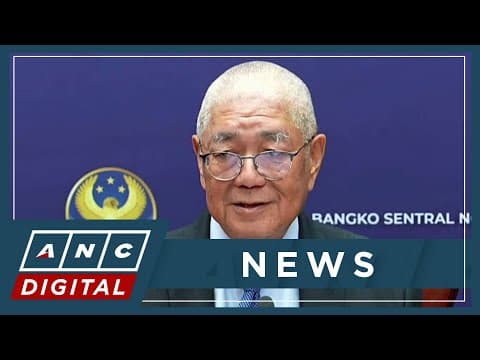
[0:00]Bangko Central Governor Ellie Remolona tempering his hawkish tone, saying one more rate cut next year is still possible.
[0:07]The BSP on Thursday delivered its eighth cut since the easing cycle began in August last year, bringing the benchmark policy rate to 4.5%.
[0:18]This, plus his thoughts on the output gap, a Triple R cut as well as on recovery in this chat with our very own Michelle Ong. Let's watch.
[0:29]Everyone's expecting you to be Santa Claus this year, um, and you did deliver a 25 basis point rate cut yesterday, but you did say you're nearing the end of your easing cycle.
[0:41]You say this 25 basis point rate cut may even be the last for now. I wonder, Gov, what makes you feel that you've done enough?
[0:52]Well, we're kind of close to uh what we can do.
[0:57]We can't do very much at this point, but uh we we did this uh Santa Claus time because uh growth was much weaker than we thought.
[1:09]And so we thought we could uh we could compensate for that a little bit with a with a cut and possibly another one down the road.
[1:19]So, safe to say, Gov, that we're looking at at most one more rate cut for next year?
[1:26]Because just this morning, the BMI, uh Fitch Solutions unit came out with a report saying they they're sticking to 50 bips cut next year.
[1:34]You're thinking one should be enough. At most. All things equal.
[1:39]Well, if if it's uh, if we find good news, then this this cut would be enough.
[1:46]So, if uh, if things turn out to be not as good as we think, then there may be another cut down the road.
[1:56]Hmm. What would good news look like to you? What what sort of good news are you waiting to see, sir?
[2:02]The the main thing is a recovery in growth. Uh growth was uh weaker than we expected for both the third quarter and we think that the fourth quarter as well.
[2:16]And that was the reason, that was the main reason for the cut. Inflation is uh very, very benign, so we're we're in very good shape when it comes to the inflation side.
[2:27]Hmm. Gov, I'm not sure if you heard of the rumor, but there was very loud market rumor a few weeks ago about an off cycle rate cut.
[2:40]What do you think the market or the general public maybe overly worried about when you think about the problem that clearly you you don't see as urgent because you did not pull that trigger on an off cycle rate cut?
[2:51]That's right. That's right. That's right. As you know, the issue right now at the moment is uh the scandal, the the flood control scandal and related uh governance issues.
[3:04]That's what's causing the slowdown. Business sentiment has been down and the and investment uh has been down.
[3:13]So that's a reason for the for the slowdown in growth.
[3:17]We we can compensate for that a little bit because uh we can do something on the demand side.
[3:26]Uh but uh we can't do everything. We So I think we can help this time and we may be able to help, maybe two months from now.
[3:39]But uh that's all we can do, maybe.
[3:43]Now on the on the possibility of an off-cycle cut. I think that would have made things worse, that would have shown that uh we're desperate and we're not desperate. I think uh when we look at the the horizon.
[4:03]We think uh we're in reasonably good shape.
[4:06]Hmm. All right. Yesterday, sir, you did say it all boils down to two things, the Goldilocks rate, which is trickier to estimate, and the output gap, which we will rely on for now.
[4:17]So why don't you tell us about the output gap that you're seeing?
[4:21]Well, the output gap is still somewhat negative and that's the reason for the for the cut.
[4:26]The output gap, by the way, maybe is just the difference between our potential and uh the demand for output.
[4:35]Now, the demand is weaker than our potential, so that justify the cut.
[4:41]Uh but that uh that difference is very narrow. So I think for now, uh the cut would put us right on the right on the potential output uh curve.
[4:54]And of course, Governor, the Philippine economy has been getting a string of downgraded forecasts from multilateral lenders and think tanks.
[5:01]ADB says we're going to grow 5% this year, World Bank at 5.1, whereas most of our peers in the region, well, they're getting an upgrade, most of them.
[5:11]What is your view on what you think will happen in the next 12 months?
[5:16]You think we're going to go back to above 6% growth next year?
[5:21]I I think not in the next 12 months. I think the the downgraded forecasts for growth are mostly about uh the loss of confidence uh due to the scandal.
[5:33]I think the government is seeing this as an opportunity for governance reforms. If realized, then we should start to recover by mid 2026.
[5:51]Okay. Mid 2026, yes. So we the the forecasts are basically downgraded for the first half of 2026.
[6:03]And we should be okay by the by 2027.
[6:06]This recovery and confidence, uh Governor, um, are you starting to see green shoots of these reforms that you think are critical?
[6:13]Well, we're starting to see a recovery in confidence.
[6:17]It's not as bad as it was uh a few weeks ago.
[6:21]As you know, the stock market has recovered, the the PMI numbers look better, uh, the and so the growth forecasts are bit higher than uh than before.
[6:34]We're seeing maybe a 5.6, a no, 5.4% growth in 2026.
[6:43]Hmm. And then then 6% in 2027. Hmm. Um, and that's on the assumption that things are recovering, that, well, hopefully, government infrastructure spending will return with reduced leakages and sentiment will improve.
[6:55]In the meantime, how else do you think, sir, can the Central Bank support the economy in this time of uncertainty?
[7:01]We had another analyst saying, everybody's just chiming in, Governor, as you can imagine. Yes, yes, yes.
[7:07]One said, you know, we'd actually prefer a triple R cut over a rate cut at this point. What what do you think about that?
[7:13]Oh, yes. I I have heard that, uh, these are two different things, as you know, Mimi.
[7:19]The the rate cut is uh is a cyclical thing, is a monetary policy thing.
[7:25]The RR cut would be a structural thing. It will if you cut, it will stay there. We're not going to uh move it up and down.
[7:36]Uh and we're in terms of the RR cut, it's it's a matter of timing.
[7:40]I I think we want to cut a bit more, but for now, because of uh because we still have uh too much liquidity in the system, it's not quite the right time for a an RR cut.
[7:54]But they're not the same thing. Hmm. Um, this RR cut, uh, there's too much liquidity as we speak. When are you looking at a certain window, Governor, when you might think an RR cut will finally happen and how deep will the cuts be?
[8:10]So we're we're at 5% now, which is already pretty good.
[8:14]I think I would be happy to go down to 2%.
[8:19]In the next two years? In the next in the next year or so.
[8:22]In the next year or so. All right. Um, on a more personal note, Governor, uh, I imagine you you have been comparing notes with your peers.
[8:31]I mean, the president very recently reshuffled the economic team of which you are a part of. How are things today?
[8:38]New faces, new names on the economic team of the president?
[8:44]That's uh, I think that's uh refreshing.
[8:49]The the new faces are welcome faces, I would say.
[8:52]All right. So we can expect refreshing things to happen next year. And among your central bank Governor peers, um, is there what what sort of conversations are you having with other central bank governors?
[9:04]Are you starting to see consensus on where rates should go? I mean, yesterday, you did say we still have global policy uncertainty with us, less of it now, but it hasn't gone away.
[9:15]Yes, yes, yes. Um, we don't compare notes on uh policy rates, uh Mimi.
[9:22]We compare notes on how we analyze uh the situation.
[9:30]So these days we're comparing notes on what scenarios we should be looking at, especially when it comes to to global trade.
[9:38]Uh-huh. And what are the scenarios that you're looking at, sir, in terms of global trade for 2026?
[9:44]So the scenario, of course, is still about uh US tariffs. How bad will they be? How low will they be?
[9:53]Uh and then how how to um how to feed that into our analysis.
[10:00]It's uh it's it's more complicated than it used to be.
[10:04]Uh uncertainty is not usually not a central part of the of the analysis. Now now it is.
[10:30]But based on what you're seeing now, sir, it's been it's been almost, well, nine months since the liberation news, the Trump liberation tariffs.
[10:38]It's not it it seems it's not as bad, right?
[10:43]It's not as bad. Yeah, you're right. Uh but at the same time, it's still not so clear.
[10:52]Uh where I think we're saying uh tariffs will affect between 15% and 50% of our exports, but we don't know exactly.
[11:05]So many moving parts, in the meantime, uh Governor, on on the bigger picture, we know that financial inclusion and deepening the capital markets have been a primary focus for you.
[11:15]I wonder, what's on top of the agenda for next year when in terms of these two things?
[11:22]Well, with with financial inclusion, we're expanding the goal to to financial health, which includes financial inclusion.
[11:33]Uh and we're doing we're we're because next year we're host of the ASEAN meetings.
[11:41]We want this to be a an ASEAN-wide project uh in terms of, for example, measurement of uh we we want to compare our progress, we want the same kinds of measurement.
[11:53]But also we want more connectivity across ASEAN so that it's easier for Filipinos to invest abroad, save abroad and for for other countries in ASEAN to also invest in the Philippines.
[12:10]All right. And in terms of, um, digitalization, sir, what what is your approach to adopting, uh, maybe digital currencies and tokenization as a way to deepen the markets?
[12:21]We're working on the we're working on projects that involve tokenization and involve what we call uh distributed ledgers.
[12:35]Uh that's still uh that's still work in progress. Uh I think the focus in uh we have a project, by the way, on the on cross-border retail payments that should be operational by by 2027.
[12:51]And now we're turning to uh wholesale, you know, larger payments. So whether we can have uh digital ledger payments within within the region.
[13:00]All right. Thank you very much. You too. Governor Eli and Merry Christmas again, sir.
[13:05]Thank you for this interview. We'll see you next year. Yes, uh Merry Christmas. All right.