[0:01]Welcome everyone. I'm Hortensia Dean. Today I will be presenting on Spanish or Español, one of the world's most widely spoken languages and the native language of the largest English language learner population in US schools.
[0:16]As educators, understanding the linguistic structure of our students' first language gives us powerful insight into how they acquire English. Throughout this presentation, I will walk through the background of Spanish, its phonology, morphology, syntax, and orthography.
[0:36]And I will highlight specific areas where Spanish speaking ELLs may face challenges or bring unique strengths to the English classroom. Let's get started.
[0:46]Let's begin with some background on Spanish. As you can see from the statistics on this slide, Spanish is a truly global language with over 500 million native speakers worldwide.
[0:58]It is the second most spoken language on earth by native speakers. It is the official language of 21 countries and here in the United States, over 42 million people speak Spanish as their first language.
[1:11]Spanish traces its roots to Latin, brought to the Iberian Peninsula during the Roman Empire. Over the centuries, it evolved through vulgar Latin and absorbed significant influence from Arabic during the period of Moorish rule, as well as indigenous languages of the Americas following Spanish colonization.
[1:30]Modern Spanish was standardized in the 15th and 16th centuries. For us as educators, perhaps the most important takeaway is that Spanish speakers make up the largest ELL population in US schools.
[1:46]Understanding this language is not just academic; it is directly applicable to our classrooms every day.
[1:54]Now, let's look at phonology, the sound system of Spanish and how it compares to English. This is one of the most important areas for understanding ELL challenges.
[2:05]First, vowels. Spanish has only five vowel sounds: A, E, I, O, and U, each with a consistent, predictable pronunciation.
[2:16]English by contrast has 12 to 15 vowel sounds, many of which are syllable distinctions that simply do not exist in Spanish.
[2:24]Spanish-speaking ELLs often reduce English vowels to the nearest Spanish equivalent, which can affect both speaking and listening comprehension.
[2:35]For consonants, Spanish does not have the TH sounds we use in English, neither the voiceless sound in "think" nor the voiced sound in "this".
[2:47]These require explicit phonics instruction. Spanish also tends to favor open syllables, syllables that end in a vowel, while English frequently uses complex consonant clusters at the beginning or end of words.
[2:59]Students may unconsciously insert a vowel before clusters, producing "e-school" for "school," for example.
[3:07]Finally, Spanish has a syllable-timed rhythm where every syllable gets roughly equal time. English is stress-timed, meaning stressed syllables are longer and unstressed syllables are reduced.
[3:20]This rhythmic difference makes it generally difficult for Spanish speakers to perceive unstressed English syllables.
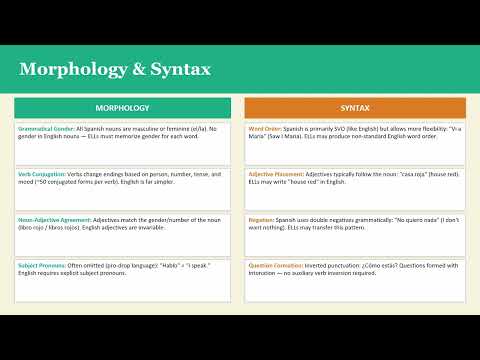
[3:29]This slide covers morphology and syntax, the structure of words and sentences in Spanish compared to English. Starting with morphology, one of the most significant differences is grammatical gender.
[3:40]Every Spanish noun is either masculine or feminine, and articles and adjectives must agree with that gender. English has no grammatical gender in nouns, so Spanish-speaking ELLs have to learn an entirely new grammatical dimension.
[3:57]Spanish verbs are also far more complex than English verbs. A single Spanish verb can have around 50 different conjugated forms depending on person, number, tense, and mood.
[4:10]While this means Spanish speakers often have strong intuitions about verb forms in their L1, it also means English's simpler verb system can feel surprisingly ambiguous to them.
[4:22]Adjective agreement is another key difference. In Spanish, adjectives change to match the gender and number of the noun: libro rojo versus libros rojos. In English, adjectives never change.
[4:40]ELLs sometimes over-apply Spanish patterns. For syntax, Spanish is primarily subject-verb-object, just like English, but it allows much more word order flexibility.
[4:50]It is also a pro-drop language, meaning subject pronouns are frequently omitted because the verb ending conveys that information.
[5:01]ELLs may drop pronouns in English, saying "is raining" instead of "it is raining." Negation is another transfer challenge.
[5:09]Spanish grammatically requires double negatives: "No quiero nada" literally means "I don't want nothing," which is non-standard in academic English.
[5:20]And in question formation, Spanish does not require subject-auxiliary inversion the way English does, which can lead to errors like "where are you going?"
[5:33]Let's look at orthography, the writing system. Spanish uses the standard Latin alphabet with 27 letters, and it has what linguists call a highly transparent orthography.
[5:45]That means the relationship between spelling and pronunciation is very consistent and predictable. Once you learn the rules, you can decode almost any Spanish word reliably.
[5:56]This is a significant contrast to English, which is notoriously opaque. Consider how the letter combination OUGH is pronounced differently in though, through, thought, tough, and cough.
[6:09]For Spanish-speaking ELLs who are already literate in Spanish, English's irregular spelling-sound relationships are a genuine cognitive challenge.
[6:19]Spanish also uses written accent marks (tildes) to indicate which syllable is stressed, for example, "café" and "árbol."
[6:30]English has no written stress marks, so ELLs must memorize stress patterns or pick them up through exposure.
[6:37]Unique to Spanish are the letters Ñ, which represents a distinct palatal nasal sound as in "mañana," and the digraphs RR and LL, which also represent phonemes absent in English.
[6:54]These are just spelling conventions, they carry meaningful distinctions as seen in "caro" meaning dear and "carro" meaning car.
[7:00]A key implication for teachers, Spanish literate ELLs often arrive with strong foundational literacy skills precisely because Spanish spelling is so consistent. We can build on that strength.
[7:16]So, what does all of this mean for us as teachers? I want to highlight six research-supported implications for working with Spanish speaking ELLs.
[7:26]First, leverage cognates. Spanish and English share over 10,000 cognates, words that look and mean similar things in both languages.
[7:35]Such as "información" and "information," or "natural" in both languages. Explicitly teaching cognates is one of the most efficient vocabulary strategies for this population.
[7:47]Second, focus on phonics and phonological awareness, especially sounds that do not exist in Spanish, the TH sounds, vowel length distinctions like "ship" versus "sheep," and consonant clusters.
[8:00]These need direct explicit instruction. Third, address grammar through contrastive awareness.
[8:09]Rather than penalizing students for L1 transfer errors like double negatives or dropped pronouns, name the difference between Spanish and English structure explicitly.
[8:20]This normalizes the learning process and reduces stigma. Fourth, treat biliteracy as an asset.
[8:26]Students who are literate in Spanish already understand how an alphabetic writing system works. Connect their knowledge of consistent Spanish spelling to the less predictable patterns of English.
[8:37]Fifth, attend to register. Spanish has a formal and informal address system that students already navigate in their L1. This awareness can be a bridge to understanding academic English register.
[8:50]And finally, be culturally responsive. Spanish is not one monolithic language. There are Mexican, Caribbean, South American, and many other regional varieties.
[9:03]All are equally valid. Using students' linguistic backgrounds as classroom assets rather than obstacles is both ethically grounded and pedagogically effective.
[9:15]These are some of the scholarly resources that informed this presentation. August and Shannon's edited volume from the National Literacy Panel synthesizes a large body of research on literacy development in second language learners and directly supports the orthography and literacy sections of this presentation.
[9:34]Garcia and Way's work on trans-languaging provides the theoretical grounding for the cultural responsiveness and biliteracy asset recommendations, the idea that students' full linguistic repertoire is a resource, not a barrier.
[9:48]Genesi and colleagues' synthesis of ELL research supports the instructional recommendations on slides five and six, including evidence-based strategies for phonological and grammatical instruction.
[10:01]Kiffer and Lexa's article on morphological awareness connects directly to the morphology section, specifically how understanding word structure in both Spanish and English supports vocabulary and reading comprehension.
[10:15]And finally, our course textbook by Seville-Troike and Barto provided the foundational second language acquisition framework that underlies the entire contrastive analysis approach used throughout this presentation.
[10:29]Thank you for listening to my presentation. I hope you've learned something today. Thank you once again.