[0:00]If you've ever planned something big and then done absolutely nothing about it, it is not because you're lazy. There's literally a neurological cycle happening in your brain that prevents you from pursuing your dreams. And in this video, I'll explain how it works and how to fix it. My name is Olga, I study cognitive science and computation at the University of Pennsylvania. And after the last four years of studying how the human mind works, I think this is probably the most fascinating and most useful thing I learned about. So procrastination researcher Tim Pichell has spent decades studying why people don't do the things that they promised themselves to do. And he found that procrastination is not a time management problem, procrastination is an emotion regulation problem. And here's what it means. When you have something important to do, like starting a creative project or submitting an application or doing a workout or an assignment. And you think about actually doing it, that's when your brain generates a negative emotion. It can be self-doubt, overwhelm, anxiety, fear. You might have fear that the result is not going to be good enough, and your brain does not like negative emotions. So it escapes. You start cleaning your room, you reorganize your desk, you pick up your phone, you start scrolling, and suddenly that negative feeling of dread goes away, and you feel relief. And here's an interesting part. That relief in itself is a reward. And in psychology, behaviors that get rewarded get repeated. So your brain learns, if I avoid a difficult task, I will feel relief, and it starts doing it automatically every time you're faced with something difficult. And your brain creates something called an avoidance loop, where you're faced with a difficult task, it triggers a negative emotion. Then you don't do that task, so you feel relief, and next time you're faced with something difficult, you again default to avoidance, because that's what triggers relief. And here's what's happening in your brain. Every time you're faced with a hard task, there are two systems that are competing for control. And the first is your amygdala, which is your brain's alarm system. It is essentially responsible for detecting threats in the environment. And if a task is seeming overwhelming or scary to you, it essentially treats that task as a threat. So it tells you, don't do this, run, this is dangerous, you have to avoid this. And the second is the part of your brain that actually makes you act. And neuroscientists call it the dorsal interior singulate cortex. It essentially, it takes the fear signal from the amygdala, if needed, it shuts it down, and then it actually pushes you to do the things that you're supposed to be doing. And when you procrastinate, your amygdala is winning, which is called an amygdala hijack, where essentially your emotional brain overrides your rational brain, and you flee from the task. And here's why it gets worse if you don't address it. Every time you're going through the avoidance loop, you feel dread towards the task, you avoid it, you feel relief. Every time you go through this avoidance loop, you are physically strengthening the neural pathway for procrastination. Because as we all know, what you repeat, you become. So the procrastination circuit gets faster, it becomes more of a default behavior for you, and your discipline circuit weakens, like a muscle that you stopped using. So if your brain is training itself to avoid and procrastinate, could you theoretically train it to do the complete opposite? Well, Tim Pichell spent 20 years of his career trying to answer that question, while the answer is embarrassingly simple. And the answer is, you have to just start. Just start. That's it. No need to finish it, no need to perform well, you just have to start the task for five to 10 minutes, and not think about the outcome. Essentially, you have to learn to interrupt the avoidance loop. And here's how you do it. Step number one is to catch it and name it. And when you notice yourself procrastinating, and you notice yourself avoiding something, think about the emotion you're experiencing. Are you feeling overwhelmed? Are you feeling anxious? Are you afraid that the result is not going to be good enough? Just naming that emotion is enough for you to switch from your emotional mind back into your rational mind. And second step is to make your task stupidly small. Essentially, think about what is the tiniest possible action you can set for yourself as the goal, just to make at least a little bit of progress. For example, don't think that you have to write a whole essay tonight. Think, oh, my task is to open the document in Google Doc and write for just 10 minutes. And don't think, oh, I have to do this hour-long workout, I'm really dreading it. Think of your task as just putting on your shoes and going outside. And the reason why simply starting something for 10 minutes is so powerful, is because the actual process of completing a task, it's almost always much easier than the extreme dread you feel before doing it. And Pichell showed this beautifully in this study where he gave 45 students pagers, and that was before smartphones existed. So he gave them pagers, he would page them eight times a day for five days, leading up to their academic deadline, on some in some class. And when the pager went off, the student was supposed to report how they were feeling, what they were doing, how they were feeling about the academic assignment that they had to do. The data showed that the students consistently procrastinated on the tasks that they found difficult or unpleasant or stressful. And they consistently replaced them with activities that were more interesting and more exciting, and of course, we all would do that, right? But here's what Pichell found most interesting. When students procrastinated early in the week, they would constantly justify it. They would constantly say that, oh, I work better under pressure, I work better close to the deadline. I will feel like it tomorrow. And they would say things like these to explain why they're not doing the task they're supposed to be doing. But when the deadline actually forced them to start, not one of them said that they were glad that they waited. They were all saying that they wish they had more time, they wish they started earlier, and that the task wasn't actually as bad as they thought. So you're not actually avoiding the task, you're avoiding the way that you think the task is going to make you feel, and your brain is wrong about it almost all of the time. And now you might be thinking, well, I don't just sit on the couch doing nothing. I'm actually busy all the time, so why can I not finally start this project that I've been putting off for months? Well, there's an answer to that. Your brain does not just let you sit there doing nothing, because that triggers guilt. And guilt is another negative emotion that amygdala is trying to escape. So it disguises that avoidance as productivity, and there's actually two specific disguises that I want to discuss with you. And the first disguise is perfectionism. And research has consistently shown that people who score higher on perfectionism are bigger procrastinators, because perfectionism essentially makes you afraid that your result is not going to be good enough, which makes you not even start in the first place. And researchers found that more perfectionist professors actually publish less papers than their less perfectionist colleagues, even if you control for how hard-working they are. Essentially, perfectionism makes you never start, so you never fall short. And disguise number two is productive procrastination. And this one gets everyone, it's the sneakiest one because you're not actually sitting on the couch, you are doing something, you're researching, you're reorganizing your desk, you're planning something. You're watching videos on YouTube about how to be more productive instead of actually doing the thing, maybe you're even watching this video right now instead of working on your assignment or working on your new project. I don't know. And Pichell's research calls this short-term mood repair. When a real task triggers anxiety or overwhelm or some negative emotion, your brain essentially decides to swap it for a safer and less risky task. That is still going to give you some sense of accomplishment when you finish it, but it's going to be without any risk of failure or judgment because that task is going to be less high stakes. Like instead of writing an essay, you spent an hour color coding your notes, or instead of applying to jobs, you spent hours perfecting your resume for the fifth time. And instead of starting a business that you've jumped off starting for years, you read 10 books on how to start a business. So you feel like you're making some progress, but the actual scary task that you actually have to do hasn't moved a inch. And again, remember, you're not actually avoiding the task, you're avoiding how you think the task is going to make you feel. But when you actually start doing it, you realize that the dread of starting is much worse than the doing, most of the time. So now you know what the avoidance loop looks like, how your brain disguises it, and how to break it. So subscribe if this helped, and please let me know in the comments what other topics or videos or ideas you would like to see in my YouTube channel, and I'm currently building out my YouTube channel, so any sort of support or likes or comments would be greatly appreciated. And I'll see you in the next one.
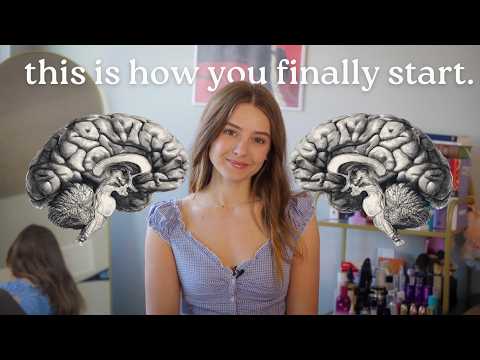
I DREAM BIG BUT DO NOTHING. the neuroscience behind why & how to fix
Olga Loiek
9m 38s1,669 words~9 min read
YouTube auto captions
Transcript source
YouTube auto captions
This transcript was extracted from YouTube's auto-generated caption track. The transcript below is server-rendered so it can be read, searched, cited, and shared without opening the original YouTube player.
Pull quotes
[0:00]If you've ever planned something big and then done absolutely nothing about it, it is not because you're lazy.
[0:00]There's literally a neurological cycle happening in your brain that prevents you from pursuing your dreams.
[0:00]My name is Olga, I study cognitive science and computation at the University of Pennsylvania.
[0:00]And after the last four years of studying how the human mind works, I think this is probably the most fascinating and most useful thing I learned about.
Use this transcript
Related transcript hubs
Watch on YouTube
Share
MORE TRANSCRIPTS


