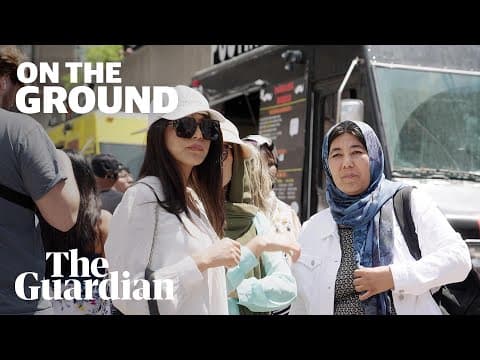
[0:00]We are here today because Canada is broken. Our kindness and generosity has given way to naivety and weakness. We do not want to be taken advantage of, tricked, lied to, and sold out by those we trusted to lead us.
[0:16]In recent decades, my home country, Canada has had the image of a successful and accepting nation, welcoming millions of upwardly mobile immigrants. You know, immigration in Canada is not just something that we do, it's who we are, it's who we've always been. But in the face of rising poverty, a housing crisis, and an influx of more than 1 million people last year alone, anti-immigrant sentiment is now growing with 60% of Canadians now saying it's too high. country does not need another million Uber drivers and Tim Horton's workers. Why are we bringing in so many people if we know for a fact that we don't have housing for them? And immigrants themselves, hoping for a new life, are feeling betrayed. The Canadian dream is something which is marketed really well. A lot of people in India especially fall for it really easy. I want to understand how public opinion has shifted so sharply and what this means for the country's future. We're going to have to figure this out. Like fighting is not really an option, I don't think.
[1:18]I moved to Toronto nearly 10 years ago and rented in a downtown neighborhood where many hold liberal views. But it didn't take long for me to see how much opinions have changed. What do you think is to blame for overall the cost of living in Toronto? Mass immigration without having like uh like services in place. People coming sold on this amazing life that we have. But a lot of people are that are coming here are seeing like can't afford rent. Let's get more people in because we have a demographic problem, but let's not put we should have also done the hard work of like, where are we allocating them? Do you think that the city has grown infrastructure-wise in tandem with all the people that have come to live here? No.
[2:00]That's sort of an known fact, right? That there's just not enough housing and uh the immigration where is like crazy. That discontent is backed up by data. In Toronto, rental costs are up 40% over the last two years. The cost of living has soared and in one of the wealthiest nations on Earth, one in four Canadians now live in poverty. By night, you can see the consequences of the city's rapid expansion. Scores of delivery drivers, most of them immigrants, wait for orders. David, who came here from Ukraine, is one of them. Half an hour, like three 40, like 5 kilometers. When you go for a drive then you have to just come back like 5 kilometers to the same place. Yeah. So that's all you're making is $3.40. Yeah. For half an hour. Half an hour, yeah. My plan was to become a track driver, you know. So I wanted to all I wanted is just make money for track school. Unfortunately, one and a half year I didn't make money yet. Because like, you know, it costs probably 10,000 you need. For track school. This is my dream, you know, to be a truck driver. I drive through all Canada, US. He told me he ends up becoming, you know, even every single month. You make 2 1/2, 3,000 max and he's even. The rest, you know, he he always even, nothing to save. The sheer influx of people into the city, alongside a lack of new housing, means people are forced to improvise their living arrangements. Anya Ettinger is a realtor, who's gained an online following chronicling some of the more extreme examples. 900 a month to share a not even a king, where you can comfortably put a pillow barrier, a queen sized bed with someone. She took me to see a new condo that had just been built, typical of new developments. Like for people who haven't been to Toronto, who don't know what's happening. Like how would you describe the market in the city right now? We're seeing bidding wars on rentals and people offering hundreds of dollars over asking, offering on places that they've never seen. This is a Wow. One bed, 2636, 453 square feet. Wow. I don't know whether to be in awe or depressed. This is an area where you would think that you would be seeing more affordable housing because the demographic is lower-income earners and there is quite a bit of poverty around. And yet, that's what's been offered. And I wonder like what are the the systems in place that are giving us these kind of results? It's it's too expensive to build right now. So if they build it, they need to charge these numbers. We have millions of people moving into Canada, who are often settling into Toronto and Vancouver. Why are we bringing in so many people if we know for a fact that we don't have housing for them and they may end up homeless? Like, we're letting people put themselves in a difficult position, knowingly.
[5:11]Across town, I met Pawan, one of a million international students in the country. Many come from India, drawn to educational opportunities in the promise of a permanent working visa. But those that arrive often find themselves unprepared for Canada's living costs. How is it for you to come here as a student and maybe there was a sense of promise in Canada and to see for a lot of people that's not what's happening. The Canadian dream is something which is marketed really well. And a lot of people in India especially fall for it really easy. They're not financially ready to you know, move to a country which is much more expensive. And be, they are not they don't have the required skill set sometimes. But they come here because back home, you know, they are told you earn in dollars, you're a rich man. They don't understand that you also spend in dollars here. And it feels like Canada's really setting them up to fail when they they give them visas, they say, come on over, come work here. See, I I wouldn't I personally won't say that Canada is setting up to fail. I think Canada is failing to, you know, provide them opportunities. Canada tried, but it failed because it led a lot of people come in in a short period of time, but the infrastructure was not able is not able to keep up with it. That failure has had repercussions across the city. Toronto has the largest unhoused population in the whole country, with around 35,000 homeless on any given night. Nearly half of those are from refugee or migrant backgrounds. Diana McNally is a crisis worker for this community, with her colleague Brian, who was previously unhoused. She took me to an encampment, one of an increasing number across the city. people who are housed always want to know the origin story. Well, how did you become homeless? How did this happen to you? I never had that question asked me of another unhoused person. And I understand that people who are housed want there, need there to be a reason for that to happen, because otherwise it could happen to them too. Now, I wonder in a cost of living crisis with rents jumping and incomes not going up, are you seeing more, or do you worry more and more people who have jobs are are not able to find a place to live? I mean, that's absolutely the case. I've seen lawyers, um, I saw a real estate agent, um, living basically in a storage shed, uh, who had a Rolex watch but was living in a storage shed. Since the 90s, we haven't had a national housing program. That has made any meaningful, uh, inroads into creating the kind of public housing that people need. And what every government has said instead is that we're going to outsource this to the private sector, and where has that gotten us? We are scapegoating them and saying the reason why you can't buy a home, or you can't find a rental apartment, that isn't under $2,500 a month, $3,000 a month, is because of foreigners coming into our country and that is absolutely egregious. The reasons for Toronto's housing crisis may be varied, but the scapegoating has only strengthened in recent years. Online, there's a growing backlash on sites like Reddit, where users share news stories criticizing mass immigration and what they see is political failures. I've come to the outskirts of Toronto to meet Ethan, the co-founder of a movement called Take Back Canada. He organized a protest to call for more restrictive immigration policies that will bring in what he calls peaceful immigrants who accept Canadian values. We do not want to be taken advantage of, tricked, lied to, and sold out by those we trusted to lead us. We're stealing the future that Canadians were promised, that our parents and our grandparents and generations before worked for, so that we could have something. And we were a very generous nation for a long time, you know, we've allowed a lot of immigrants in who, you know, just on the promise that they want to contribute to society in a positive way. And I think that's a very good and noble thing, something to be proud of. But what we're doing right now is just destroying the game for everyone. Do you fear that kind of protests against immigration could in turn increase xenophobia or have a kind of a backlash against people who are immigrating here? There's always going to be an element of people who are unable to separate race and ethnicity from having a system that brings people in that are not going to contribute to society. I mean, you're going to see xenophobia if this isn't put a stop to. We need to find what the level of political action will be that will get our government, our leaders to take us seriously and to fear wronging us. While Ethan claims the group isn't xenophobic, the Reddit group associated with the event was recently banned from the site. Despite the mounting push back, the government remains committed to promoting the benefits of immigration as an integral part of the Canadian identity. It's simple to me. Canada needs more people. You know, immigration in Canada is not just something that we do, it's who we are. It's who we've always been. At the annual newcomer day, newly arrived immigrants access services and learn about Canadian culture. Daniel Bernhard runs the Institute for Canadian Citizenship, which promotes the benefits of immigration. He's organized an event celebrating those who've just become citizens. My big learning from this experience is that this country is made up by the incredible diversity and talent that we bring in. And one of our big biggest responsibilities as new citizens is to continue to contribute in our very own unique way. That was my personal experience. It does feel in Canada that immigration is is entwined with this cultural sense that that immigrants make the country a better place, they grow the country literally and economically. But I wonder, is that starting to change? I think that it stands to reason that when people feel squeezed in their lives, uh, too many people chasing the number of apartments, superficially seems like a logical explanation, I think actually, when you look a little bit deeper, it's an incorrect explanation. The decay of public services and the lack of infrastructure through the 80s and 90s is coming back to bite everybody in the developed world, and we're no exception. I think we ought to we ought to recognize that. It's not about the population growth. I think we need a mind shift that immigrants actually have a lot to contribute here. It's not like we're doing you a favor and there's enough space for you, and so fine, we'll let you in. I mean, that's the word we use, we let people in, instead of recognizing we need this. Do we want to be prosperous or not? And if we do, we need to figure out what the next wave of this is and we got to hit it really seriously. I don't think we have a choice, because I think that people are going to come anyways. And we're so happy for all of the opportunities that Canada has given us. I personally come from Ukraine and I graduated from uh TMU University. Uh, as a social worker. I got to go to school, I got to finish my degree, I got to finally open my very first small business. It's easy talking to people to get caught up in what feels like a crisis in this city and in this country. But then to see people become citizens today, to watch them fulfill a dream they've had for years, it's just such a stark contrast and it's so powerful because it shows there's people who still have hope for Canada. 3, 2, 1! Woo! HCC. This is thank you so much, thank you.


