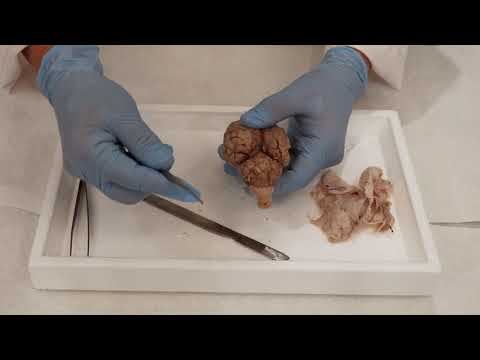
[0:10]Welcome to Biobox Labs. In this month's biobox, we get to learn all about the nervous system. That's the way our body processes and responds to the world around us. You're going to get to look at spinal cord and reflexes and all sorts of different tests to find out a little bit more about how it works. The highlight of the box is going to be the dissection of a sheet brain. So that is what we're going to talk about today. And we're going to get to dissect and look inside all the intricate things of a sheep brain. Now, sheep brain is not the same size as a human brain. A human brain is about this big. But, um, this is a model of it. The sheep brain is much smaller, which you'll see. As you know, sheep are not quite as smart as humans. But they still have similar characteristics that we're going to get to explore. So, what do we need to get started? We need our gloves. We need our goggles. We have a scalpel, forceps and a probe, and then you might want to grab your magnifying glass from your other bioboxes. And then we have our dissecting kit and most important of all, we have our preserved sheep brain that we're going to get to take a look at. Let's get started. The first thing you're going to notice is you might see that there's a lot of fluid around your brain. That's just the preservative, so don't worry about that. The next thing that you're really going to notice is that the whole brain is covered by this white fibery membrane. This is called a meninji and actually there's three layers of it. It looks like it's just one, but it covers the brain to protect it. And in your brain, inside of yours as well as in the sheep, it's actually filled with fluid, so that your brain actually floats inside your skull. And you can see that maybe that would be helpful if you ever hit your head, that your brain kind of just rests against it. If you have to hit it really hard to get a concussion, but that brain floating in there is really, really helpful for protecting your brain. So the first thing we're going to do is remove these meninges. So you can get your scalpel and you can see how tough it is. In fact, the name of it is actually called tough mother, duramater, the outer one, but that's the specific name of the menies. But we're going to kind of snip it away and try to get this off.
[2:33]So now you can just peel it away, carefully not to pull off too much of the underlying structures.
[2:54]So you can see that it takes a long time and you have to be really careful to remove it. But once you do, you can see all the actual structures of the brain underneath. So, we're going to take a look at the surface of it first. This is the cerebrum here, and it's divided into two sides. If you look here, here's the front, this is the back part of the brain. This is the right cerebral hemisphere and the left cerebral hemisphere. If I take my probe, you can actually see that there's a whole another layer or meninji layer here. And this one, if you pull it back, you can see that the brain actually has these valleys and ridges. They're called the Sula and the Jai and they help to actually increase the surface area. So the more ridges and grooves you have, Sula and Jai, right, the more brain cells you can actually have in your brain. So you can imagine, ours has even more than the sheep brain does, but they still have similar characteristics that we're going to get to explore. So in the cerebral hemisphere, there's actually four sections or lobes they call them. The very front one is called the frontal lobe. And this has such things such as decision-making, processing. It also has all the information that sends out motor function, they call it. Or really movement, like stimulating how you move your muscle, how do I move my fingers? All of that is handled in this frontal lobe. And speech, production of speech, how we move our mouth to produce words. That is in the frontal lobe. Behind it is the parietal lobe, and back here, the main thing the parietal lobe does is collect sensory information. So things like a touch and feel. That all is collected back in the parietal lobe. In the back section here are the occipital lobes, right and left side, right and left side, I should say. And these are all about vision. So collecting information, controlling the movement, how our eyes work. They also even have visual memories are collected in the audit, in the occipital lobes, in the in the sides here. This one's kind of degenerated. On the side here though, you can see it better. This is the temporal lobe and temperal lobes are all about hearing. Auditory information is collected and responded to in the temporal lobe. So those are the main functions of the cerebrum. In the back here, you can see the cerebrum. It's almost another lobe, but it's separate from the cerebrum. This particular lobe helps to collect incoming sensory information and outgoing motor function. And it helps coordinate them. So this is what makes you have a coordinated movement. For instance, if I want to grab this probe, I have to see it and then I have to cause a movement to grab it. And my cerebellum controls it. If my cerebellum's not functioning, I might end up going like that to be able to try to find it. So the cerebellum helps with functions like that and with balance and such. Then we have our brain stem here, which is composed of the midbrain in this section here. Which tends to look more at visual reflexes and such. The paws in the center section, it's kind of a little bit larger, that sends information back and forth to the cerebellum. And then up to sensory cortex, it also helps with the coordination of cerebellum. And then specifically this section is the medulla of langada. And that has centers that control breathing and heart rate, and those kinds of involuntary kinds of movements. And then you can see here, it begins down here. This is the beginning of the spinal cord that you can take a look at.
[7:29]What you might also notice on the underside of the brain, is that you can see here. This one is not real clear, but if I lift it up carefully, this is the occipital chiasma. So there are actually would be nerves here that would go out to each of the sheep eyes over there. You might also notice that there's a little bulb right here and here. These are the ol factory bulbs and help the sheep with smelling. So sheep are very dependent on the sense of smell. So their ol factory bulbs are much larger than human ones. But they're very important for a sheep in helping them with with protection and all that type of thing. Some of these little things sticking out here are cranial nerves that help with controlling different facial movements and such. Um, and I think that is the external surface. So now, we're going to dissect internally and see what we can find inside the brain. So we're going to take a dissection right down the midsagittal sulcus, they call this, this dividing line between the right and left hemispheres. We're going to go right through the cerebellum, through the brain stem, and through the spinal cord and open it up. And already you can see there's so much information stored within the brain in here. The other thing you can see right away is that there's light regions and dark regions. We refer to these as gray matter, the dark regions, and white matter is the lot the white light region. And if you take your magnifying glass, you can actually take a look at and see them even more close up. The gray matter, just like in the spinal cord, is responsible for processing information. That's where nerve connections take place. Whereas the white matter is where the um relay the the information. So maybe like the axons of the neurons and that type of thing. So this is where the information is relayed back and forth to other neuron connections. So you can see in the cerebrum up here, this is primarily on the outside of the cerebrum, is gray matter. That's where all the processing occurs. And then internally, if you dissect into the cerebral hemispheres, you'll see that's where the white matter is located and where all the nerve connections take place. Or the um pathways take place. So what's going on inside? The amazing thing here is you can now see the the rounded um the cerebellum here and here, the two sides of it. And you can see that it's almost looks like branchings of a tree. Sometimes people call the cerebellum, the Arborvite because it looks like the tree of life. It helps to coordinate so many different movements. You can also see the pathways down here, connecting from the midbrain up here to the paws, down in here and to the medulla. Now if we look inside the middle sections of the brain, you can see almost a ball-shaped structure here and here. This is the thalamus and there's actually one on the right and left side. This is like the relay center for sensory information. So everything coming up about touch comes in, relays in the thalamus, and then it sent into the right spot on the particular cerebrum, particularly the parietal lobe. So that's the thalamus. And then below each one of them, you can see on the right and left sides here is the hypothalamus. It's just below the thalamus and this is for things such as thirst or hunger, um body temperature regulation is all in the hypothalamus down in here. One more thing right here is kind of interesting. This is the pineal gland or the pineal body and you can see it on both sides. We just cut it in half. Um, this particular gland releases melatonin. People like to take melatonin to help with sleep because it actually triggers those types of things. Well, the your own secreted melatonin helps to control what you call your circadian rhythms, like your sleep and wake cycle. That's why if people take melatonin, it helps to help them fall asleep, just like the melatonin does in your own body. So you want to be careful how much you take because you have your own body, um sending it out. You don't want to disrupt too much of what your body's already doing. One last structure that I want to point out is this light band of tissue right here, circling around, circling around here. This is the corpus calosum, and you can see it's light. So you can tell it's a relay, basically where there's lots of axons sending information back and forth. And this is actually a band of fibers that connects the two hemispheres. It's really important that our right and left hemispheres, um connect with each other and give lots of information back and forth. You can also see one more little bonus thing is that there's an opening here and there's one here too. The brain not only has fluid surrounding it on the outside, which I said before. The brain actually has some fluid on the inside. So these are called ventricles where there's fluids, cerebral spinal fluid inside that actually travels into the two sides of the hemispheres. Travels down the middle, you can see there's a groove right there. So as well. So there's cerebral spinal fluid, that's there, bathing it and nourishing the brain tissues and keeping them ready to go. So I think that covers all the topics of this, um, sheep frame. Thanks for joining us today, and if you like this experiment, why don't you order your own monthly subscription box at bioboxlabs.com. And you can also check us out at bioboxlabs on Instagram and Facebook. See you next time.