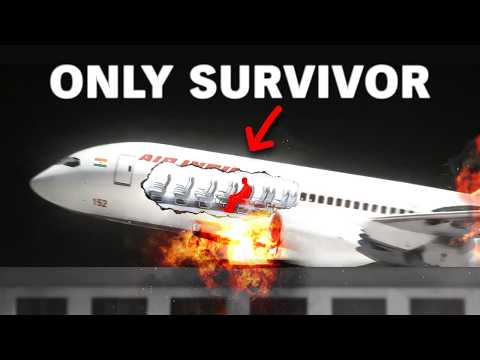
[0:03]Vishwash Kumar Ramesh and his brother are ready to board their flight. The temperature is pushing 37 degrees Celsius. This Boeing 787 bound for Gatwick Airport is supposed to take them home to London. Vishwash Kumar sits down in seat 11A. His brother is across the aisle in 11J. At this point, of course, neither of them knows what's about to happen. Shortly after takeoff, both engines fail. The aircraft loses altitude and crashes into a compound. 241 people on board are killed. 19 more die on the ground. Only one passenger survives. It's Vishwash Kumar. His brother doesn't make it. The images go viral. The sole survivor just leaving the crash site on his feet. The passenger in seat 11A lived to tell a tale about what had happened. When he's interviewed at the hospital the next day, he has no words. What was the situation yesterday? Can you describe for us please? I can't explain. Everything happened in my eye. I can't. Vishwash Kumar is not the only one. Time and again there have been horrible plane crashes that only a handful of people survived. In this video, we'll look at four of those deadly tragedies and at the people who somehow made it out alive. The Air India disaster with only one survivor, a jumbo jet that slammed into a mountain, a girl who fell from the sky, and a plane exploding into a gigantic fireball. Were those who walked away just incredibly lucky? Or is there something they all had in common? And what would really help you in the extremely rare event of a plane crash?
[1:53]This video deals with catastrophic accidents. But overall, flying has become extremely safe, and it allows you to visit places across the globe. Look at lens, for example, one of our 3D animators. Hey, I'm currently in China. When abroad, I always use Saily to get an eSIM. It's a no-brainer. Easy to install, available to basically any country, and the prices are fair. I'm going to be working remotely in different countries in Southeast Asia for a few months, cooking up some animations for you guys on the go. So, this time, I went with Saily Ultra. It's a subscription where you get unlimited data globally. Also, access to airport lounges and fast-track services, and you get access to NordVPN, NordPass, NordLocker and Incogni on top to stay safe abroad. I can only recommend it. The value for money is really solid. No matter if you're Lance checking out East Asia or just on holiday for a few weeks, Saily's got you covered. Head over to saily.com/ferntv or scan this QR code to get an exclusive 15% discount. Download the Saily app and use code FERNTV at checkout. And with that, back to the story. The investigation into the Air India Flight 171 crash is still in progress. But there's a preliminary report that helps us better understand what most likely happened.
[3:08]When the plane starts losing altitude, it first strikes several trees. Then, only 32 seconds after takeoff, it crashes into a compound. The buildings accommodate doctors and medical students working at a local hospital. On impact, the nose of the aircraft is slightly pitched upward. The tail section is sheared off at the edge of the first building. The rest of the fuselage keeps thrusting forward, tearing through walls and ceilings with devastating force. First, the right wing breaks off. The aircraft then slams into the next building, causing the left wing to come off as well. The wings and this part of the fuselage carried the fuel tanks. Vishwash Kumar is seated just ahead of that entire section. Evidence suggests the fuselage may have fragmented again, separating him even further from the wings. Being seated by the window and being separated from the wings and fuel tanks may have slightly increased Vishwash Kumar's chances of survival. This way his seat was not exposed to the gigantic fireball that occurred upon impact. In interviews following the crash, Vishwash Kumar said he escaped from the wreckage through an opening next to him. It's unclear whether that opening was caused by a rupture in the fuselage or whether the emergency exit door had been blown off. Vishwash Kumar was the only survivor. He left the crash site on his own feet with only minor injuries. But one extraordinary case is not enough to draw any real conclusions. So, we started looking for patterns. These are all the major commercial aviation accidents we could find since 1970 that only had one to five survivors. The larger the circle, the more passengers were on board. The yellow dots represent survivors. This is the deadliest single aircraft disaster in history. Japan Airlines Flight 123. And this is Air India Flight 171. That single yellow dot is Vishwash Kumar Ramesh. Our research was in part inspired by a similar data analysis conducted by Reuters. The news agency reviewed 1,400 commercial aviation accidents and found 45 cases were only one to five people survived. For 20 of them, they could even identify the survivor seat numbers or approximate seating locations. So, does where you sit on a plane affect your chances of survival? Vishwash Kumar was seated here, in the front section of the aircraft. Of all known survivors from major plane crashes in the last 55 years, 14 were seated here. 19 of them were seated in the rear sections of their respective planes. So were Yumi Ochiai and three other female passengers on Japan Airlines Flight 123. The Boeing 747 is on route from Tokyo to Osaka. The flight is completely booked with a total of 524 people on board. It's the day before a major three-day holiday season in Japan. Many passengers are flying home to see their families, including Yumi. She's actually a flight attendant at Japan Airlines. But today she's off duty and traveling as a regular passenger. She's seated in row 56 and casually flipping through a magazine. Then she hears a loud bang. The cabin pressure drops. Oxygen masks fall from the ceiling. A large part of the jet's 10-meter tailfin has broken off. It will later be revealed that the plane's so-called pressure bulkhead was not repaired properly after a hard landing seven years prior. Now that part breaks into several pieces and destroys critical control systems. From that moment on, the pilot can no longer control the plane. It starts climbing and descending on its own, while simultaneously rolling and yawing from side to side. Yumi gets up from her seat. She's trained for this and knows how to assist the crew. She shows passengers how to put on their oxygen masks and life vests, and how to brace for a potential impact. Many began writing farewell notes to their loved ones. The flight attendants try to calm everyone down. 44 minutes after takeoff and 30 minutes after the initial bang, the nightmare comes to an end. Yumi is strapped back into her seat and assumes a brace position. The right wing and one of the engines strike a tree. The plane rolls over onto its back and slams into a mountain ridge. The crash site is here, deep in a remote mountain range in Gunma prefecture. The rescue teams don't arrive until 15 hours later. Trees and wreckage parts are still smoldering. Medics comb through what is left of the aircraft. Yumi will later say the screams of many other survivors kept her awake all night. But at some point, most of them went quiet. To this day, it's unclear how many people had initially survived the crash. Experts think it's very likely that many more could have been saved if they didn't have to lie there all night, injured, out in the cold. It will later turn out Japanese authorities waited until the next morning to launch an extensive rescue mission. They simply assumed that no one had survived the crash. Apart from Yumi Ochiai, one other woman and two girls survive. 520 people die. All four survivors were seated back here in the rear section. The tail section has the horizontal stabilizer and the massive tailfin attached to it. That makes it a very solid structure. Statistics show that the middle seats in the rear of an aircraft historically have the highest survival rates. But the differences across cabin areas were marginal, and the researchers only looked at a limited number of crashes. The front section of the aircraft can also act as a crumple zone and absorb part of the impact's kinetic energy. Experts told us the odds of survival also depend heavily on how the plane hits the ground. That is, if it comes down in one piece.
[9:31]This is Juliane Koepcke. She is 17 years old and goes to school in Lima, Peru. Her parents are renowned biologists at a remote research station in the Amazon rainforest. It's Christmas. The night before, Juliane attended her end of school prom and graduation party. Her mother had flown in for the occasion. Now, the two are eager to get back to her father so they can at least spend New Year's together. The research station is located deep in the jungle. First, they have to fly to Pucallpa, from there, it's several days by boat. All flights from Lima to Pucallpa are fully booked. Except one. LANSA Flight 508. Juliane and her mother hesitate. Her father explicitly warned them about LANSA. The airline was only founded a few years prior and already lost two aircrafts in crashes. Leaving Lima the day before was not an option though. Juliane didn't want to miss prom night. So the two end up boarding a Lockheed L-11 Electra. Juliane sits in seat 19F in the second to last row. The plane takes off.
[10:43]Because it's Christmas, the mood on board is festive. The flight is scheduled to be only one hour. 20 minutes in, the crew starts serving breakfast. Juliane looks out of the window at the rainforest below. Then the plane starts shaking. A massive wall of clouds is building ahead of them. This time is completely different from anything I've ever experienced. The pilot doesn't go around the storm, but flies straight into hell. The world outside turns dark in the middle of the day, bolts of lightning keep flashing all around us. At the same time, an invisible force starts shaking the plane like a small toy. Luggage flies through the cabin. Passengers scream and cry. Juliane will later say she saw a gleaming white light above the wing. Then the aircraft starts plummeting towards the ground. At around 3,000 meters, it breaks apart. Juliane is ejected into the void. She is still strapped to her seat. The next thing I remember is hanging with my head down, while the jungle approaches me in slow circular motions. But it's not the jungle that's coming toward me, I am the one moving toward it. The treetops are grass green and dense and they remind me of broccoli heads. The images are blurry. I see everything as if through a veil. Then darkness surrounds me again. 20 hours after the crash, Juliane wakes up next to her row of seats. She's alone. I don't feel any fear, but an overwhelming sense of abandonment. The crushing realization that I'm alone. My mother is gone, although she was sitting right next to me just moments ago. Her seat is empty. Juliane starts walking. She follows a small stream of water to a river and lets herself drift in the current. That's what her father told her to do if she ever got lost in the jungle. She survives on some candies she found at the crash site. Along the way, she encounters martins, brocket deer and caimans. After traveling alone for 11 days, she is picked up by a group of rubber tappers. She will never see her mother again. Juliane is the sole survivor among the 92 people on board. To this day, it's still largely unclear how she could fall from 3,000 meters and live to tell. She thinks she owes her life to a combination of three factors. One, storm clouds often have powerful updrafts beneath them. The vertical flow of air may have slowed Juliane's descent. Two, the row of seats she was strapped to may have acted like a parachute, like a rotating propeller that reduced the speed of her fall. Three, the entangled lianas of the rainforest may have formed a kind of natural safety net to cushion her impact. In this case, where she was seated most likely didn't matter. Reuters reached a similar conclusion. Survivors of aviation disasters usually come from every part of the aircraft. In some cases, the only survivors are seated at the very front. In the cockpit. For pilots, takeoff and landing are the most critical phases of any flight. That's when most accidents happen. Partly because planes are more vulnerable to external factors during these moments. That's why aspiring pilots have to go through a rigorous selection process. Candidates first have to prove their resilience to extreme physical and mental stress. Then they face the airline's demanding recruitment tests. Only a few make it through the entire procedure, and after that, come years of training.
[14:38]James Pahlke met all the requirements to enter the training. This morning he's serving as first officer on a Comair regional jet. The sun is not up yet. Pohlke has logged over three and a half thousand hours of flying time on this type of aircraft. Captain Jeffrey Clay has also spent thousands of hours in this exact type of cockpit. It's shortly before 6:00 a.m. 47 passengers board the flight to Atlanta. The pilots prepare for departure. Lexington Airport has two runways. Runway 22 for larger passenger jets and a shorter one for small private aircraft, runway 26. They intersect. To get to the long runway 22, pilots need to cross the shorter one. Both pilots are familiar with the airport. Both have taken off from Lexington several times before, including at night. First officer Pohlke does not brief his captain about the fact that the taxi to runway 22 requires crossing runway 26. As the aircraft taxis, the two pilots casually talk about family planning. My wife wants four children. I was good at one. She wants four? Yes. It'd be like, honey. Clay stops the plane at the junction of runway 26. What happens next is documented in the official investigation report. They fail to notice the runway numbers indicating they're on the wrong strip. They also ignore the fact that their magnetic heading presets are not in line with their current orientation. Captain Clay hands control to Pohlke. The first officer sets thrust. To lift off, the aircraft needs to accelerate to 142 knots. But when they realize they're approaching the end of the runway, they're only at 131. Pohlke pulls back the control column. He wants to bring the plane into the air. But it's too slow.
[16:37]A local police officer and a public security officer are the first to reach the crash site. They pull an unconscious man from the wreckage and rush him to the hospital. It's Pohlke. Shortly after, ambulances and fire crews arrive. The firefighters knock down most of the fire within three minutes. But it's too late. All 49 of the other people on board die at the scene. The crash is what you would call a perfect storm. The official report primarily places responsibility on the pilots for taxiing onto the wrong runway. From engine start to takeoff, pilots are only allowed to talk about the upcoming flight. The records show they ignored that rule. At the same time, the airport charts used by Comair were outdated, and the air traffic controller could have seen that the aircraft was lining up on the wrong runway if he had been looking out the tower cap windows. But he had turned away to handle paperwork. The report also indicates that he was most likely fatigued at the time. The people that came on board the plane were my responsibility. They were my and Captain Clay's responsibility, and if there's anything that I can say to the family members is that is that I'm sorry, we made that mistake, because they lost their loved ones that day. And I just hope that God can give the family members some comfort, some peace, and some compassion, so that their burden gets less as time goes on. The survival stories of James Pohlke, Juliane Koepcke, Yumi Ochiai, and Vishwash Kumar Ramesh have very little in common. In crashes with only a handful of survivors, life or death is usually a matter of pure chance. But severe cases like these are absolute exceptions. Flying is actually the safest mode of transportation, and it's getting safer every year. The industry learns from every single accident. Regulations change, aircraft designs evolve, devices and mechanisms improve. The odds that your next flight will end in a forced landing or crash are extremely low. An MIT researcher calculated that you'd have to fly every single day for 55,000 years to die in a plane crash. And even if you were to emergency land or crash, your chances of survival would still be very high. According to the US National Transportation Safety Board, more than 95% of all passengers involved in plane crashes survive. Modern passenger aircraft are designed to be fully evacuated within 90 seconds, even if only half of the exits are usable. But it's still very important that you know how to act in a potential emergency. Many real life evacuations take longer than necessary because passengers freeze or don't know what to do. So next time you're flying, pay attention to the crew's security briefing and read the security card instructions, even if you're already familiar with both. Try to memorize the number of rows and directions to the nearest emergency exit. This would increase your chances of finding it if the cabin was filled with smoke. Some experts recommend booking a seat within five rows of any emergency exit. Also make yourself familiar with the brace position for a potential emergency landing. Controlled crash tests in the Mexican desert have shown that passengers in that position are less likely to suffer spinal cord or head injuries. Once the aircraft has landed, follow the crew's instructions and leave it as soon as possible. Do not take your hand luggage with you. There have been real cases where people couldn't get out and burned to death because passengers in front of them were too busy struggling with their hand luggage. If the aircraft lands on water, put on your life vest. But wait until you're outside before inflating it, otherwise it could block the way. If you want to be even better prepared for the absolute worst-case scenario, wear sturdy shoes, stay sober, and pick the right clothes. Experts recommend wearing cotton or wool, because synthetic fabrics like polyester can cause far more severe burns when they melt onto your skin. Whenever a plane crashes somewhere on the planet, it draws a lot of attention. Horror news and spectacular survival stories are the ones that stick the most. It's easy to forget that everyday life is full of much greater risks. Things like smoking, driving a car, or being struck by lightning. Maybe there's a simple reason we're so conscious about flying and so captivated by these disaster stories. Maybe we still can't quite wrap our heads around the fact that these gigantic birds of steel can actually lift off the ground.


