[0:09]Okay, well, having looked at how um timber is processed through the sawmill, we come to the end of that process after kiln drying, and then we have to do something called grading. And grading is a process whereby we select timber on the basis of some characteristic that we find desirable. For example, if we were going to use timber to make uh decorative furniture, we might be choosing timber on the basis of the figure. So we might be looking at things like grain pattern, whether there were ray patterns in the in the wood, we might have called a so deliberately to get some sort of attractive pattern in that timber. In which case we'd use something called visual grading. Um visual grading also used to be used at one point to um determine the strength properties of timber. Um and it was quite a skilled um technique, people had to be trained to do this and they had to develop a very good eye for looking at a piece of timber and determining what the strength of that timber might be, on the basis of the fact uh that it has a certain number of knots or that it has a certain grain angle, or it has a certain number of growth rings per unit length. Um it is a very skilled um technique and human nature being what it is, it's not perfect and also human nature being what it is, people tended to error on the side of caution, which is a good thing and understandable. But it meant that people tended to undergrade timber. Uh now we have extensive use made of machine grading, and the main purpose for having machine grading is that we want to um determine what the strength of timber is. Because we want to use the timber structurally, so we might be wanting to make a beam in a house that has to support a load, so maybe we want to put a grand piano upstairs. And we want to make sure that that beam is able to support the weight of a grand piano. So the sort of situations that we would be um wanting to know the properties of the timber would be a situation where we're applying a load to a beam. And it's quite easy to use the words load and the words strength and the word stiffness because they all have some sort of meaning in everyday language. Uh but it's important that we understand what these things mean in a scientific sense. So if we're applying a load to a material, we measure that in units, SI units of Newtons. And when we apply load to this material, it's going to deform, and the amount by which it deforms gives us a property called stiffness. So we've applied a load and this beam is deformed. So that deformation from the straight beam there, that deflection is related to how stiff the beam is. Uh and eventually if we keep applying a load, that beam will fail. So the property that we're interested in is the strength of that beam. Now, if we take this beam and we measure the strength and we break it, we can't use it anymore. So that's pretty pointless because we wanted to use it in the floor to support the piano. So the only way we're going to be able to get an indication of how strong a beam is going to be is by taking a sample of a population of timber beams of that size, and breaking some of them and measuring some other property. And that property is then used to indicate how strong it is. So we call that an indicative property, because whatever it is we're measuring, indicates the property that we want to know. So we might be measuring the deflection, the stiffness, and that we hope would be related to the strength. Okay, so we want to measure an indicative property and see if it has some sort of relationship to the thing that we're interested in, which is how strong that material is. So in order to do that, we do a test like this, maybe a four-point bend test, maybe we'll do a tensile test, some sort of test where we are measuring in our case, the stiffness of that material against the strength of that material. And in order to measure the stiffness, we have to determine what the deflection is. And that is reported as something called strain. And the force that we're applying is reported in something called stress. And I will talk about that in the next part of the talk.
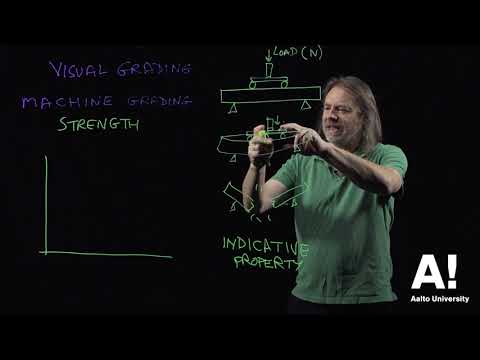
Timber grading (1) Strength testing, stress and strain
Aalto University - Wood Science
5m 50s787 words~4 min read
YouTube auto captions
Transcript source
YouTube auto captions
This transcript was extracted from YouTube's auto-generated caption track. The transcript below is server-rendered so it can be read, searched, cited, and shared without opening the original YouTube player.
Pull quotes
[0:09]Okay, well, having looked at how um timber is processed through the sawmill, we come to the end of that process after kiln drying, and then we have to do something called grading.
[0:09]And grading is a process whereby we select timber on the basis of some characteristic that we find desirable.
[0:09]For example, if we were going to use timber to make uh decorative furniture, we might be choosing timber on the basis of the figure.
[0:09]So we might be looking at things like grain pattern, whether there were ray patterns in the in the wood, we might have called a so deliberately to get some sort of attractive pattern in that timber.
Use this transcript
Related transcript hubs
Watch on YouTube
Share
MORE TRANSCRIPTS


