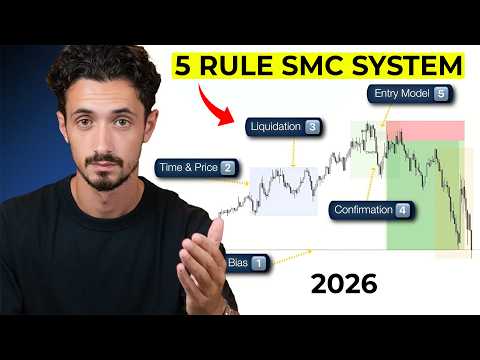
[0:00]To make money consistently in trading, you need a trading strategy that is repeatable, systematic, so it's rule based, and very simple to understand and easy to use.
[0:10]In this video today, I'm going to break down with you my trading strategy, and this is the strategy that I have used for the past four years.
[0:17]I have all of the data for the strategy that I'm going to share with you in just a moment. It's also the trading strategy that hundreds of my students have used to go on and take crazy amounts of payouts.
[0:27]So, what you're seeing on screen now is the trade that we're going to be breaking down at the end of this video.
[0:34]It's the trade that I took, it's the trade that many of my inner circle students took. On the right hand side, you'll see five-step SMC strategy, and you'll see the five rules of my system.
[0:43]I'm going to be breaking down each of these rules, and then at the end we're going to take all of our rules and follow them step by step, so we have a trading strategy that is working.
[0:50]Now, just before we dive into my five rules for this strategy, I need to tell you something that I wish someone had told me six years ago when I started trading.
[0:58]A trading strategy alone will not make you money. There are more important things in trading strategy. And so what I've done is I've comprised a free training, I'll leave the link in the description of this video.
[1:08]Of the other things that you need as well as this trading strategy, because the reality is there are millions of traders that have a strategy that works but still aren't able to make money from trading.
[1:17]In fact, the reality is is you've probably seen trading strategies that already work, but you still don't make money from trading.
[1:23]And that's because there are more important things in strategy that I want to break down to you.
[1:28]So again, I'll leave the link in the description for a free, enjoy. And now I'm going to show you the data to prove that.
[1:33]So here I am in my trade seller and I want to share with you my playbooks.
[1:38]This is the strategy I'm going to be showing you today is the intraday bias model, right? It's my best performing strategy.
[1:43]You can see here I've taken 230 trades, this starts at the beginning of 2023.
[1:50]So from 2023, up to today, 2025, 230 trades, 216% return, right? So we're averaging over, I believe it's like over 10% a month with this model, traded perfectly.
[2:01]You can see here all of the data on the model if I go into here, you can see these are the stats of the trade, right?
[2:08]You can see from the beginning of 2023, very healthy equity curve, you can see day win rate, you can see trades taken, win rate of this system.
[2:14]A huge misconception is I have a 33% win rate, people think that that's a bad thing.
[2:20]People just don't understand trading, win rate alone is useless, you need win rate plus average risk to reward.
[2:24]You can see here I have a 6.23 average win to loss ratio.
[2:29]Meaning for every one trade I lose, on average I win 6.23, right?
[2:35]So if I risk $1,000, then on average I will make 6.23 times my loss, right, which is my risk, which is $1,000.
[2:43]Yeah, this is all the data. Really don't need to go into too much detail about it. It's years and years of data with one model, and now we're going to show you exactly what that model is.
[2:51]So, let's dive in. So my first rule is directional bias.
[2:54]And essentially, what directional bias means, my primary objective when I come into the market is I need to understand which direction is the market going to trade in.
[3:02]And then I need to trade with that direction. It's very simple. Markets trend and you want to trade with that trend.
[3:06]It's the oldest saying in the book, right? The trend is your friend. But the reality is is you will make the most money when you trade with the direction the market is heading towards.
[3:13]But you need a way to understand what that direction is. So, step one, simple directional bias, very, very simple to understand to be totally honest with you.
[3:19]The market moves in phases, right? We have bullish phases, right? So we have these kind of expansion phases.
[3:27]We have consolidation phases, right? And then we have bearish expansion phases.
[3:32]All you need to do is understand the external swing points of structure and use those as your directional anchor.
[3:38]It simply means just find the areas of price where we see reversals.
[3:44]So you can see here price puts in a high, and then we reverse from this high, we put in this low.
[3:48]We reverse from this low, we put in a new high, we reverse from this high, we put in a new low, reverse from this low, we put in a new high.
[3:56]All of the reversal points, it's that simple.
[4:00]And that is what makes up your market structure. And it's a very simple thing that if your swing points are getting progressively higher, then the market is bullish and you want to look for longs.
[4:09]It's really that simple. When you get this high, at this point, you want to wait for price to start coming back and you want to identify this area here and you want to buy from that level, and I'm going to show you exactly how you do that.
[4:20]But that is literally how simple it is. Again, it needs to be stupidly simple.
[4:23]So many traders are overcomplicating trading today, and that's the reason that so many traders are failing because they think it should be complicated.
[4:30]Something that I struggled with. When I simplified my trading, I became so much more profitable, so much faster.
[4:35]Eventually, what happens is after we've had a period of, you know, aggressive expansion, or contraction, at some point in time, you'll kind of meet an area of consolidation.
[4:44]That's where price goes into this little bit of a choppy range where it's kind of undecided, maybe you spend a couple of days between, let's say we have a low down here and a high up here, right?
[4:54]And then price is just kind of just spending its time not breaking out of the highs, but also not breaking out of the lows, right?
[4:59]This is an area where there's a lot of fair value created.
[5:02]When you see price trading at the same level and not really breaking out of a high or breaking out of a low, what it means is that buyers and sellers are pretty much in agreement that price should be at this level at this given time.
[5:19]These are the areas that again, they're uncertain areas.
[5:23]These are the areas you really want to be avoiding, at least for me in this strategy.
[5:26]I don't want to trade in these consolidative areas, unless I can identify the swing areas.
[5:30]And usually what you see is after some type of range, right, we'll maybe get a continuation, which is possible, you may also get a reversal.
[5:38]A reversal is essentially we had a low here that put in this high, which is higher.
[5:43]So what happens is every time that we put in a new high, right, we go low, high, we pull back, we go higher high.
[5:48]So when we break this old high, right, that becomes a break of structure. Now what happens is this low that broke that high and the high that gets created, that's now your range.
[5:59]And then price comes back, puts in a new higher low, and then when it breaks above that high, that again is a break of structure.
[6:07]And so that becomes your new range. Now you have this low here to this high, and you're expecting that price is probably going to come back down a little bit and then trade above this high.
[6:17]Plain and simple. Now what ends up happening a lot of the times at some point in time, you will have a reversal, which I refer to as a change of character.
[6:24]Right? Think of character as a bull and a bear, two characters of the market.
[6:29]The bull represents increasing price, higher prices, the bear represents decreasing prices, lower prices.
[6:34]When you have a change of character, that's essentially saying that the bull was in control, price was increasing, and then the character shifts and now the bear is in control.
[6:44]Prices decreasing, very, very simple stuff. So we have a change of character, and that happens when the low that put in the most recent high is broken and traded through.
[6:53]And so instead of having a higher low and a higher high, we actually end up getting a lower low.
[6:58]So this low right here is lower than the previous low, that is a change of character.
[7:03]At that point price has likely shifted bearish. And so what do you think you're looking for? You're looking for sales, right? It's really that simple.
[7:09]You're just looking to sell the market. At that point, you go lower low, probably lower high, and then lower low, right, break of structure, lower low, lower high, lower low, break of structure.
[7:21]And now you're in a trend, and now this is your swing high, so you want to sell as long as price stays below that low.
[7:27]This is your swing low, when you sell, you want to trade into that low.
[7:30]You only trade on the pull back. So when price starts coming back up here, you patiently wait for your time to enter, which I'm going to tell you what that is in step five, and then when that signal occurs,
[7:41]you try to trade short and you trade short toward this low.
[7:45]That is literally the strategy. There's a few minor details and things that I need to explain that makes it better to understand, but in short, that's the strategy.
[7:51]I mean, we're selling a bearish market and we're buying a bullish market with a very simple reversal model.
[7:56]So that's step one. Now the reality is is that the market doesn't always look that clean, right?
[8:00]A lot of the times you'll have price action like this, because it's easy for someone to say, yeah, just buy the bullish trend.
[8:08]The problem that, you know, 99% of traders have is they don't really know how to identify the trend.
[8:14]They're looking for these swing points, but most of the time they're choosing the wrong ones, and the reason for that is because the market isn't as simple as the diagram that I just showed you.
[8:21]In fact, the market a lot of the times looks more like this, and for some reason for most people, this is often times confusing, but I'm going to simplify it for you right now.
[8:31]You can see here, we start with the low, right? Price trades higher, and then we put in a high.
[8:36]So at that point we have our set points. We have a low down here, and we have a high up in here, right?
[8:42]Let's already assume that we are bullish, right? So let's just assume that this was the price action.
[8:48]We broke structure toward the buy side, so we were bullish. So now what we have is we have the low that's in control is here.
[8:53]The high that's in control is here, and we're bullish.
[8:57]The directional bias is bullish, that's what we're looking for.
[9:00]Now what happens to a lot of traders is for one reason or another, is they start using this in here, this structure.
[9:07]And what they see is they see that these structure prices, and I'm going to show you this in the actual live market in a moment.
[9:12]But for some reason, they see these structural levels, price puts in a low, puts in a high here, oh, okay, now we have a lower low.
[9:19]And they look at this and they try to trade this internal structure. And so they're trying to sell here but when in reality price is still bullish.
[9:26]And so people get confused with these structure points and you need to understand which one is which.
[9:31]And so my framework of thinking is very simple. You have a swing low, you have a swing high.
[9:36]As long as price is inside of this box, it's internal structure.
[9:40]So when price breaks these structure points, we don't try to short. We're waiting for confirmation to go long. Eventually at some point in time, price breaks above this high, right?
[9:48]That's a break of structure. Now, with the same box that you had to understand what the internal structure was,
[9:54]when we break that high, and then that high begins to produce a reversal like this, now we need to identify our swing low.
[10:00]And all we have to do is go into the box and find the lowest point before the expansion.
[10:06]And that's our swing point. And so that right there becomes our swing low. And so now we have a new structural low.
[10:11]We have swing low down here, and we have swing high up here.
[10:15]And the same thing is true. We are just expecting higher prices.
[10:18]But the problem is is again, for some reason is, okay, sure, maybe you are not the type of trader that trades this structure, right, because it's it's simple to you.
[10:27]You see bullish, it's still bullish. Maybe you're the type of trader then that in this expansion phase like this, when price comes below this low, you now think that we've shifted bearish.
[10:37]Right? A lot of traders do this as well. They think that this is a change of character.
[10:40]And what happens unfortunately, is when they see this is a change of character, they try to start, you know, shorting the market, and they try to start shorting the market,
[10:49]you know, high in here or high in here, we try to trade lower. But the truth is is price is bullish, right?
[10:56]So you're on the wrong side of the market. And I think personally, the number one mistake that traders make is not understanding which direction the market is going to trade in.
[11:03]If you can understand that, you're good. And so this isn't a change of character, it's just a liquidation. Why? Because the swing low is down here.
[11:11]Here's the low. So if this low gets taken out, we're still bullish, because we're bullish until this low gets broken.
[11:18]So that's the reason that, you know, most people don't understand directional bias is because they get stuck in these internal levels, and I'll show you this right now in actual market.
[11:25]So, you can see that we're bullish, right?
[11:30]At this point in time, you're expecting higher prices. Now what happens is we end up shifting these lows.
[11:36]And so we become bearish, which is no big deal, that happens a lot of the time after a long bullish run, we become bearish.
[11:41]We have a change of character. So now we are looking for shorts.
[11:45]It's very simple. Our swing high is here, and our swing low is here, right?
[11:50]Both of the reversal points. This is the high, price reversed, it met this low, price reversed. So we're bearish. So that's our swing high in here, this is our swing low.
[12:02]We are just expecting price to take out this low, as long as it remains below this high.
[12:07]It's that simple. We play price.
[12:12]You will see that now we have broken below that low.
[12:16]And so again, remember the box method, right? If we have from this high in here to this low down here and we just draw it across, everything inside of this box was internal until we broke the low.
[12:25]We have to find the highest point before price breaks this low, which is where?
[12:29]Which is right here, right? The high of the Asia session. So now we have the swing high that breaks the swing low.
[12:35]That's a break of structure. And now we're starting to see this low produce a reversal. Now it's definitely a reversal. So,
[12:41]this is our swing low down here.
[12:44]Again, what are we expecting? This is our high, this is our low. We're just expecting price to trade toward this low and remain below that high.
[12:54]That's our bias, right? We can see here is that price reaches this high, fails to break above that high.
[13:03]Again, fails to break above that high again, and then has the aggressive sell off, and then we break this low.
[13:10]Break of structure. So now what we have is we have a new swing range.
[13:24]We have the low down here, and we have obviously the high up here.
[13:28]So it's the same thing again. We've had the reversal, we're just expecting that price will revisit these lows, and that's our re-down structure.
[13:35]And all of this time, I'm just trying to short the market.
[13:38]Providing that the other steps of the system align, which we'll get into. So again, we can see that this was our swing high, we had our swing low down here.
[13:46]What happens? Price comes back up to here before eventually selling off, and what, taking out the low.
[13:55]So then what happens? Price begins to reverse. So now we have what? New swing structure.
[14:00]We have a swing high, because it's the highest point before the break, and then we have our swing low.
[14:08]High, low, price comes back up. We start trading back down.
[14:12]Now this for me is not a break, because it is just a wick, it has to break below that low.
[14:17]Then it breaks below the low. So now our new swing high becomes here.
[14:23]And again, all we're trying to do in this market is just sell at certain areas with certain confirmation.
[14:27]So we have a high, we break down to the low, so that's our swing high.
[14:32]What happens? Price starts to pull back, so now we've found our new low.
[14:38]That low gets broken here. Where's the highest point? Price comes high, starts trading through, comes back up, goes higher.
[14:45]And then trades and breaks the low, and then it gives a reversal. So we have this is our low and this is our high.
[14:55]Price puts in a high in here, ranges around, and then it breaks the low. Then you come in and guess what?
[15:04]Now you have your swing high, which is up here, and your swing low.
[15:11]And then guess what? We're just looking for shorts. When I see my confirmation, which I'm going to share with you later, this is the type of trade that you get.
[15:17]And bear in mind, this is one trade. There has been many of these types of trades in all of this price action.
[15:22]Once you just understand exactly what the rest of the steps are. So that is directional bias, right?
[15:27]Very clear to see that we just trade along with the trend.
[15:32]We don't need to try and trade against it, because the trend is obviously in control. So, moving on to rule number two.
[15:38]We've done directional bias. Rule number two is time and price.
[15:43]You see, there are specific time windows that I execute my strategy in.
[15:47]Those time windows are as follows.
[15:50]For London, we can trade from 2 a.m. to 5 a.m. That's Eastern Standard Time.
[16:06]We can only trade inside of that window. If there is a trade that sets itself up at 1:58, I cannot take that trade.
[16:13]If there was a trade that sets itself up at 5:05 a.m., I cannot take that trade.
[16:17]Just inside of that window, I can take that trade. The second window that we have is 7:00 to 10:00 a.m. Eastern Standard Time, so New York time.
[16:26]So I have 3 hours in London, from 2:00 to 5:00 a.m., and I have 3 hours in New York, from 7:00 to 10:00 a.m. Now here's the truth.
[16:33]This strategy has relatively equal results across each time window.
[16:38]Some people can only trade London, some people can only trade New York.
[16:41]It's completely okay if you just have three hours a day to trade.
[16:44]You can still take this and still get the same results, because the results are split across both of these sessions.
[16:49]I personally like to trade both of them for the most part.
[16:53]So 2:00 to 5:00 a.m. for London session, and 7:00 to 10:00 a.m. for New York session. Now we move into step three, right, which is my third rule.
[17:02]Now my third rule states that in order for me to take a trade, I must see a liquidation first. What does that actually mean?
[17:09]What a liquidation is is a key area of price gets taken out before my trade enters.
[17:16]So if we look at this trade here that I'm going to be breaking down at the end, notice, in this blue box right here is Asia session.
[17:22]Right? In the green box is my London window, you can see 2 to 5, and my New York is 7 to 10.
[17:30]So this blue box here is Asia session. So if I want to trade in London session, for example, like I do,
[17:36]this short here comes in London session. For me to trade this setup, right bearish, I first need to see Asia session get taken out.
[17:45]So for example, if we're bearish like this, and then let's say, you know, we have this range here is Asia.
[17:54]And then let's say London session opens up and I get all of my confirmation, but we don't take out that Asia session high.
[18:02]I cannot trade. So this right here is going to represent our Asia, and then London opens and it gives me everything that, everything else I want to see.
[18:10]But we don't trade above this high first, I cannot take that trade.
[18:16]Because in order for me to take that trade, I need to see a liquidation. And a liquidation in this model is the Asia high.
[18:22]So here, I need to see this Asia session high here be taken out before I look for a trade.
[18:27]And if we are bullish, for example, right, let's say the market was bullish, like so, and the Asia session is in here.
[18:38]If London opens and gives me everything I need to see, I still cannot trade that because Asia session high remains not taken out.
[18:46]So if we have Asia like that, for example, and then London session, you know, is expansive like so, I still can't take that trade.
[18:54]I would need to see this happen, right? And then then I could take that trade.
[19:00]So step three is liquidation. I need to see a liquidation.
[19:05]And for my London model, it's typically Asia or Frankfurt. Now, rule number four is reversal confirmation.
[19:12]So, what a reversal confirmation is, is we may be bearish like for example, you know, before we take this trade, right?
[19:17]Let's go before this trade is entered. This is what the market looks like.
[19:22]We are obviously bearish. However, we don't know that price is going to take out this low right now.
[19:30]So if we just start selling all the time, we could end up taking 5, 6, 7, 8, 9 trades and they could all just trade straight through us.
[19:38]Because for all we know, price could come all the way up here, right, before it trades back down here.
[19:44]And also, another truth is, we don't know for sure that price is going to take out this low.
[19:49]We just know that that's the highest probability. There's more than a 50% chance that it will take out that low based on historical data.
[19:55]So, for all we know, we could trade through this level. So what we need to see is confirmation that price is going to reverse.
[20:00]And that reversal will indicate a higher probability that yes, now it is time to trade toward this low.
[20:08]And for that, my reversal confirmation is a very, very simple thing.
[20:11]You see, I use the 15-minute time frame for my strategy, the higher time frame.
[20:17]My lower time frame is 1 minute. So if I, for example, am bearish like this.
[20:22]Now when the market coming back up like this, right, we hit this low, we start trading higher.
[20:26]Guess what's going to happen? If we go to the 1-minute time frame and we look at this, the 1 minute is going to be bullish.
[20:33]You can already see it. The 1 minute, right, is bullish.
[20:40]Putting in these higher highs, right? All the way up until, you know, we're coming into London session.
[20:48]You can see that the 1 minute is bullish. And the current structural landscape of the 1 minute, we have a swing low down here, and we have a swing high up here.
[20:57]We break structure, so we're bullish. So if the 1-minute time frame is bullish, but the 15-minute is bearish, we do not look to trade yet.
[21:07]What we need to see is this low get taken out. We need to see the 1 minute also shift bearish with the 15-minute.
[21:13]And so then we have something that looks a little bit like this, right?
[21:16]Let's say you have the main time frame, you know, your 15-minute time frame is like this, and then as price starts to come back up, your 1-minute time frame is bullish.
[21:24]You don't know when price is going to reverse. If you just see you sell short here, and then price trades higher.
[21:29]You might sell short again, price trades higher, right? You could take multiple losses in a row.
[21:34]And like I said, for all we know, we might end up seeing price shift back to bullish.
[21:40]And so all of a sudden you might have just taken 6, 7, 8, 9, 10 losses because you couldn't wait for the confirmation.
[21:45]And that's what we see so much. We see traders that don't know how to confirm their trades and so they keep taking loads of losses on a trade.
[21:53]So you simply wait. As price pulls back up, the 1 minute is bullish.
[21:58]At some point, the 1 minute will shift bearish. When that 1-minute shifts bearish, now you can trade, and you simply just trade off the back of that 1-minute reversal and you take it down to the swing low down here, right?
[22:12]That is how we could get a higher win rate and a higher risk to reward, that's why our average win to loss ratio is 6.23 because we use this lower time frame.
[22:18]We're scaling down to get a more accurate kind of sniper entry if you'd like. And so that is our lower time frame confirmation.
[22:25]So let's say, for example, we break below this low, like that.
[22:30]Well, now the 1 minute is no longer bullish. The 1 minute is bearish.
[22:33]We have our liquidation of Asia session high. Now we're good to trade. And now rule five is order block, fair value gap, or inverted fair value gap, entry model.
[22:42]So what I do is after we get this 1-minute shift, like this, I usually go to a 5-minute time frame.
[22:49]On this 5-minute time frame, I'm looking for an order block, a fair value gap, or an inverted fair value gap that I can trade from.
[22:56]Ideally, if I can get a multitude of them combined together, that's going to be the trade that I take.
[23:01]So if we look at price right here, what we will see is, first and foremost, we have a bullish fair value gap here that gets inverted, right, traded through.
[23:08]So that becomes an inverted fair value gap.
[23:12]At the same time, we also have a 5-minute fair value gap here.
[23:16]We also have another 5-minute fair value gap here, right? And then we also have, you know, this M5 order block, right?
[23:23]You could use this buy to sell, you could use this as your order block, this final buy to sell, right?
[23:29]So here, you can see on the 5-minute time frame, we have an inverted fair value gap, an order block, and a normal fair value gap.
[23:35]Sometimes you might just get one of them. Sometimes you might get a couple of them. Sometimes you might get all of them.
[23:38]But I'm looking for the area of price where we get that confirmation, and then I'm just going to choose one of those areas and take my trade.
[23:44]And so, for example, short position in here, my stop loss would go above the high. Then where would I look at targeting?
[23:50]I am just trading in direction of the trend, right? The 15 minute is bearish.
[23:55]I'm expecting the probability indicates that we will get lower prices. So, if that's what probability indicates, then I'll just take my trade down to this low in here.
[24:02]And again, we can just use this inverted fair value gap, put our stops above the highs, and you can see here, one to 5.57 risk to reward.
[24:11]And if you risk $1,000 on this trade, you return $5,570.
[24:15]So that's why you can have a 33% win rate. Take 10 trades, let's say you just win three of those trades.
[24:21]But if my average is 6.27, let's just say six. If I take three trades at six, what do I return?
[24:26]18. If I lose the other seven, then I lose seven.
[24:31]However, at the end of those 10 trades, I've won 18 times my risk and I've lost seven times my risk.
[24:39]So if my risk is $1,000 per trade, I've lost seven trades, so I lost $7,000.
[24:43]I won three trades, but I made $18,000.
[24:46]The net profit is $11,000. That's how the risk to reward and win rate game goes together.
[24:51]And so that would literally be the trade that's taken. Of course, I said, you know, at the end I'll show you the trade strategy.
[24:55]I've kind of already walked you through everything.
[25:00]And what I will say is this is just one model, right? So this playbook, the playbook that we kind of went through here, which you can kind of see.
[25:06]This playbook actually does have multiple variations of it. One of those variations is this right here, which is my London sweep Frankfurt reversal model.
[25:15]I also have six other models.
[25:18]These same criteria. But again, those six of the models, those are kind of, you know, not really something, to be honest with you I'm willing to share on YouTube.
[25:26]But this one in of itself is more than good enough, you know, it's it's profitable enough, go and test it for yourself, and that pretty much becomes it, right?
[25:33]That becomes our strategy. We have a 15-minute time frame that is bearish, so we're looking for shorts.
[25:38]Is it between 2:00 and 5:00 a.m.? There's two. At the moment that we're going to take the trade, it's 3:30 a.m. Okay, great.
[25:43]Step one, step two, bearish in our time window. Third rule, do we have the liquidation? Yeah, we liquidate Frankfurt, we liquidate Asia.
[25:50]Okay, great. Step four, lower time frame confirmation. Has the 1-minute time frame shifted to align itself with the 15-minute time frame?
[25:57]Yes, it happens right here. Okay, great. There's five. There's four. And step five, do we have an order block, a fair value gap, or an inverted fair value gap on the 5-minute time frame to take the trade?
[26:07]Yes, we do. Those are all the rules that come together for this one specific model, and that would mean you have to green light to execute on this trade.
[26:15]Now again, look, we'll kind of see how the trade plays out and manages.
[26:18]But something super important is you can have a trading strategy.
[26:21]So many traders have trade strategies that work, and they still don't make money, because trading strategy is only 33% of the equation.
[26:28]There are two other things just as important, maybe even more important than trading strategy, if you want to consistently make money.
[26:35]And if you want me to break down those three things in extensive detail, I'll leave below this video a 45-minute free training breaking down the three things that you must have in order to make money consistently from trading.
[26:47]Let's see how this trade plays out, right? You can see price tags us in. It's hovering around price for a little bit.
[26:52]This is where psychology becomes important. Many traders are deviating from their plan.
[26:56]At this point, you can see, for me, it's just a game of following my rules. I also have rules in place for when I move my stop loss to break, even etcetera, etcetera.