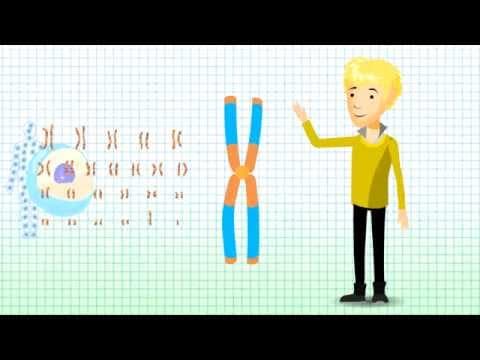
[0:00]Human beings are made up of millions of cells. Inside every cell lies a nucleus which holds 46 chromosomes. Our chromosomes carry genes which make us into human beings. Our chromosomes are numbered from chromosome 1 to 22, with chromosome 1 being the largest chromosome, and chromosome 22 being the smallest. The last pair of chromosomes are the sex chromosomes, with boys having an X and a Y, and girls having two X chromosomes. A Robertsonian translocation carrier describes a situation where someone has 45 chromosomes instead of 46. Robertsonian translocation only occur between the acrocentric chromosomes. These are chromosomes 13, 14, 15, 21, and 22. What happens is that two acrocentric chromosomes get stuck together making one large chromosome. The commonest chromosomes to become stuck together are chromosomes 13 and 14, and the next most common are chromosomes 14 and 21. Other possible translocations occur much less frequently. A Robertsonian translocation carrier is healthy. However, problems can arise should the Robertsonian carrier wish to have children. To become a parent, you have to make a mature egg or sperm. Each parent only hands on half their chromosomes into the egg or sperm. Normally, each pair of chromosomes come together, exchange genetic material, known as crossing over, prior to dividing. For Robertsonian translocation carriers, this process is more complicated. In this example, Carl is a translocation carrier. He has one chromosome 13 stuck to chromosome 14. He also has another normal stand alone chromosome 13 and 14. If he hands on the normal chromosome 13 and the normal chromosome 14, then the child will be healthy and have normal chromosomes.
[2:11]However, if Carl hands on the translocated chromosome on its own, that is the 13 and 14 stuck together. His child will be a healthy translocation carrier like himself. However, if Carl hands on the translocated chromosome together with one of the stand alone chromosomes 13 or 14, the baby would have a whole extra chromosome 13 or 14, as Carl's partner will hand on a stand alone chromosome 13 and 14 too. The baby will end up with three copies of either 13 or 14. This is known as Trisomy chromosome 13 or 14. Babies with Trisomy 14 will miscarry. Babies with Trisomy 13, known as Patau Syndrome, miscarry, although some may survive to birth. The condition is not compatible with life. If Carl carried a translocation involving chromosome 14 and 21, he would have a risk of Trisomy 14 or Trisomy 21, known as Down Syndrome. The risk of having a baby with Down syndrome is higher if the woman (example: Carl's sister) carries the translocation. Translocation families can also have a history of infertility. There are other very rare disorders which can occur with specific translocations. Your local genetic team would explain what your translocation means for you and what your specific risks are.