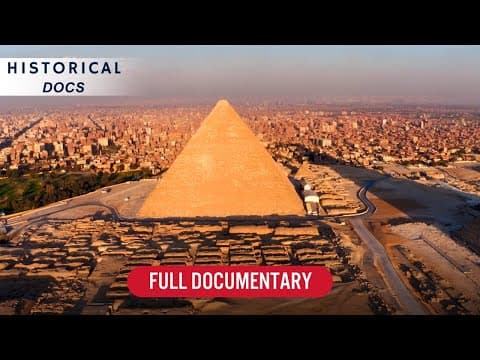
[0:01]Egypt's great pyramid, the tallest structure on Earth for thousands of years. It all started with the quest to make a gigantic pyramid that was perfect. Nothing on this scale had ever been attempted before. The Great Pyramid wasn't just a building, it is where the king would have lived eternally. For 4 and a half thousand years, how this supersized burial chamber was built has been an enigma. But could archaeologists now finally solve the mystery, thanks to amazing new discoveries? From a pyramid workers' journal lost for thousands of years. This is a very new way to see the building of this pyramid. to a mysteriously entombed boat being excavated right now at the pyramid's base. This is number one project not only in Egypt but in all of the world. Will these ancient clues and a pioneering new experiment help bring the incredible secrets of the Egyptians back to life? And reveal what it was really like for the people who lived and died creating the greatest monument the world had ever seen.
[1:31]The pyramids of Giza, a towering series of giant tombs built by the ancient Egyptians. The oldest and largest is the Great Pyramid. It's the only survivor of the seven wonders of the ancient world. This was the dream of the Pharaoh Khufu, who wanted the grandest tomb of all time. But exactly how such an ancient civilization could build this Colossus has been a mystery for millennia. And archaeologist Mark Lehner is still looking for answers. There are 2,300,000 stones in this pyramid. And when you look closely, you can see the marks of the human hand, chisel marks. Nothing like this had been seen before in the history of Egypt.
[2:33]What makes the pyramid even more of a mystery is how they managed to build it in this unforgiving desert. 4,500 years ago, the Egyptians completely transformed this sandy plateau overlooking the River Nile by building the biggest monument known to man. The base covers an area the size of 10 football fields. Builders found and transported so much stone here, they could have built a wall half a metre tall around the entire planet. But their mission was a monument over 140 metres high that would become the tallest building in the world for millennia. Building the Great Pyramid, achieving this, seems impossible. This is not something that was done by a primitive society. So how did the ancient Egyptians manage this incredible feat? Could a phenomenal new discovery 250 kilometres away reveal the answer? Wadi Al-Jarf is a remote desert settlement that the men who worked on the pyramids used as a supply hub. During excavations, archaeologists unearthed the most ancient papyrus manuscript ever found. Pierre Tallet is decoding the text and searching for answers that could finally reveal how the Egyptians built the Great Pyramid. Since the very day of the discovery, it was quite evident that we have the oldest papyrus ever found in the world. Pierre wants to see if this document really is about the Great Pyramid. Does it tell of the Pharaoh Khufu? Pierre thinks an ancient symbol known as a cartouche could give him the answer. The cartouche is kind of a circle in which the Egyptian people used to place the name of the ruler. You have the phonetic script of Kh, U, F, U, which is spelling the name of Khufu. It's an incredible breakthrough as this is the only papyrus from the time of Khufu that mentions the Pharaoh. But Pierre also needs evidence that it relates directly to the Great Pyramid. This small triangle is the shape of the pyramid. The name of the pyramid is 'Akhet Khufu'. The 'Horizon of Khufu', and we have it I think at least 20 times on those papyri. Pierre is in no doubt that this document was written by someone working on Khufu's incredible building. But the big question is who? Pierre manages to decode the author's name.
[5:39]It's a man called Merer.
[5:43]The papyrus reveals that Merer was an inspector in charge of a cargo boat and 40 elite workmen. He describes how his team's daunting job was transporting thousands of tons of stone along the River Nile. And Pierre now knows that Merer's destination was the construction site of the Great Pyramid. Pierre is revealing that the River Nile and cargo boats like Merer's played a bigger role in building the pyramids than many experts imagined. This is a very new way to see the building of this pyramid because we don't know so much about the way it has been built. And those documents are providing very precious information about the way the workers were able to build such a big construction. Pierre wants to analyse Merer's incredible journal in forensic detail to see if it can unlock even more secrets about how the Egyptians constructed Khufu's giant tomb.
[7:00]But in Cairo, one archaeologist wants to go even further. We have a lot of questions on the navigation on the Nile for the working boats carrying stones. I'm really excited. Mohamed Abd El-Maguid and his team think the best way to learn more about how Merer transported stone from quarry to pyramid is to recreate every step of his journey. Mohammed's plan is to build a wooden cargo boat using Merer's techniques and cut a stone from the same quarry that he used. He'll then attempt to sail the stone block up the Nile before dragging it to the foot of the pyramid. Merer added very good information for us and maybe experimenting with this will help will help a lot to to get a step forward in the field. Mohammed's first challenge is to rebuild Merer's boat. The papyrus reveals the vessel was strong enough to carry giant rocks, but Mohammed needs more clues about how it was made and what it looked like. He thinks the answers may lie 20 kilometres from the Giza pyramids in Saqqara. This is an ancient underground tomb that was built just after the Great Pyramid for a man called Ti. It's the grandest and most highly decorated tomb for any non-royal in this area, showing that Ti must have been very important. This is the statue of Ti. Ti was one of the high officials. We have a lot of descriptions of his jobs. One of them is the royal hairdresser. But it's not Ti's hairdressing that Mohammed is interested in. He hopes some extraordinary wall carvings will reveal the secrets of Merer's rock-carrying vessel. Ti's tomb is very famous for its scenes of boat construction. On only one boat you can count 13 person. Everyone is busy with something. There are no written accounts from Merer's time of how they built their cargo boats. So deciphering these scenes is Mohammed's best chance of getting his vessel right. First, he sees what tools they had. Here you can see them. They were using the saw. Here we have the adjusting using the small blade of the adze.
[9:45]Mohammed can tell that the Egyptians made their boat strong enough to carry huge rocks through the precision and strength of their joinery. Everything had to fit exactly. They put the plank and they start to push it into the hull to make one unit.
[10:07]Here you can see between the two planks we have a tenon. They have to hammer them to force them inside. There are a lot of things to to learn according to what we know from the old times. But most importantly, Muhammad can finally see what these boats really looked like and the exact shape they took. At the boat yard, the team is starting the build.
[10:37]Just like the carvings showed, in places the team will use long and very thick planks that run the entire length of the boat to give strength and stability. The tomb, it helped a lot in the development of the construction of the boat. The shape of the planks. The method of the assemblage, the importance of the beams. It will be interesting for us in order to understand how the ancient Egyptian man had all this trust in his skills.
[11:13]Muhammad's boat will carry an average-sized pyramid block. To cope with this two and a half ton stone, Muhammad's vessel will have to be incredibly strong. Transporting rocks by boat was much easier for the ancient Egyptians than hauling them large distances over land. But there's a mystery. Today, the pyramid is over 8 kilometres from the river. So how did Merer get his boat and massive cargo closer to the construction site? In the desert of Wadi Al-Jarf, Pierre Tallet is looking for clues that could reveal if Merer used rope to sew together his cargo boat.
[12:06]And Pierre thinks he's found the place where Merer stored his vessel. A set of caves that have lain undisturbed for thousands of years. What is strange here is that the place has been completely forgotten for more than four millennium. And it's very rare in Egypt to start excavation in a place which is absolutely not known before. So far, his team has uncovered 31 caves. They are known as galleries and are carved deep into the hillside. Merer used this one himself.
[12:43]When we excavated this gallery, it was completely filled up with potteries wearing the name of the team of Merer. It's about 23 meters long. It's one of the longer caves that we have here. The main purpose was to store the boats. So you had to have a cave that was very dry to avoid the entrance of water inside. Pierre's team have found fragments of the boats that Merer stored in these caves. And the evidence suggests that he did indeed use ropes to fix them together. Here it is really exceptional because we have found some very long pieces of wood. We have a large amount of ropes. So we also discovered they dismantled the boat, took off the ropes between the pieces of wood. This means that Muhammad will have to use just rope to hold his entire vessel together.
[13:49]So back in Cairo, Mohamed's team now know what they are up against. But will their sewn together boat ever be strong enough to take a huge rock?


