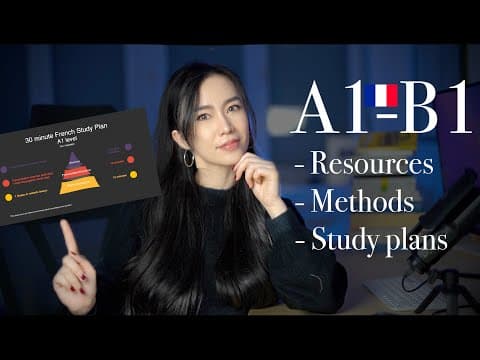
[0:00]Hi, guys, here's the video of the whole self-learning French package. Today, I'm going to share with you in detail the useful resources for learning French from A1 to B1.
[0:11]I will do another video for B2 to C2 next week, which will be in French. In this video, I will not simply be listing resources, but organizing them into different learning skills.
[0:22]And I will also tell you how to use them, how to organize them and how to balance them to make a perfect study plan. You might already have an A2 or B1 level.
[0:30]However, I will suggest you watch it from the A1 level because I will give you all the essential resources from the beginning.
[0:38]At the end of each level, I will also give you a 30-minute French learning plan and a two-hour study plan template for more intensive learners.
[0:46]If you are new to this channel, I'm Zoe. I obtained the DALF C1 level after learning French for one year in 2016 and then continuing my master's studies in sociology in France and now I'm doing a PhD between France and Germany.
[1:00]French is the first foreign language I learned to a proficient level. It's now my academic and professional language.
[1:06]I like to learn languages, actually everything in a structured way. After watching this video, I hope you can get a clear direction.
[1:14]If you appreciate my efforts and find this video helpful, don't forget to give me a like and support me and share it with your friends and family who are learning French.
[1:23]And please subscribe to my channel if you haven't done so. Vous êtes prête ? C'est parti.
[1:34]Before I start this video, I would like to say a few words about my French learning journey.
[1:38]I don't want to create the illusion that anyone can reach a C1 level in one year. I went to a language school with a very intensive program in France.
[1:47]You know that I speak five other foreign languages. Still, any of them could progress as quickly as I did with French because I was in an ideal learning situation.
[1:57]That was impossible for the other languages. I was only studying French. I had no other studies or work at that time.
[2:04]I did a lot of self-learning as well, and this is the part I would like to share with you today.
[2:10]I know it's motivating to choose an ambitious benchmark, but be realistic about your learning ability and situation, which will be healthier in the long run.
[2:23]For this learning period, you should have a basic concept of pronunciation, grammatical structures, learn some very common words, everyday conversation like greeting, introducing yourself, and asking for basic information.
[2:36]There are three main resources for self-study: a book, a website, and an app. The goal at the beginning is to discover the language, so don't rush to make a very ambitious plan if you have no experience learning a foreign language.
[2:51]Take your time and find a preferred resource and method. You can learn some basics and see if there are any similarities with your mother tongue or the languages you know.
[3:02]For example, if you know English or Romance language, such as Spanish, Portuguese, or Italian, you will find a lot of similar vocabulary.
[3:11]If you are a native speaker of these languages, please pay attention to the difference in pronunciation instead of just pronouncing in your language because it's easier.
[3:20]I will be sharing resources on pronunciation exercises. If you have little time and want to learn in a more fun way, an app can be a good choice.
[3:28]Here I recommend Busuu. I use this app to learn new languages like Spanish.
[3:39]Many of my friends learning French have used it and they really like it. What's good about this app is that there are videos of native speakers to put you directly in a real-life context.
[3:49]It's more dynamic than a textbook, and it breaks the learning down into small achievable lessons, which makes learning more accessible and more motivating.
[4:00]You can learn for 10 minutes or 15 minutes a day. I know many people think 10 or 15 minutes per day is not enough to learn a language, but believe me, guys, after learning six foreign languages, starting small and then growing big is a best strategy, and it works.
[4:17]As I keep saying, language learning is all about routine and consistency. Busuu's study plan fits the study style of breaking the language into chunks, reminding you when to study and setting realistic goals.
[4:30]If you don't know Busuu and want to use it to start your language learning journey, you can check out the link in the description box.
[4:36]The book can be an excellent option. Here I recommend Assimil French débutant et faux débutant. You guys know I like the Assimil method.
[4:44]It's great for self-learners. Each lesson is short and often takes less than 30 minutes to study.
[4:51]There are audios and exercises, there are versions in different languages, Arabic, Spanish, Italian, English, and German. You can check on their website. I will put the link in the description.
[5:01]The good thing about learning with a book is that you can easily set your plans like one lesson a day, every other day, or one chapter a week.
[5:10]They're reliable. There are useful phrases and dialogues. But the disadvantages are that there are few interactive features.
[5:17]Free website, I recommend two good websites for beginners. One is Podcast Français Facile, where you can have lessons with dialogues, grammar points, and exercises.
[5:27]You have videos and audios. They're great and well-structured. You can follow the program like here, lesson one, saluer, se présenter, un et une. A lesson is very short and has a specific point.
[5:39]You can do one or two or other lessons per day, depending on your time, and they are completely free compared to the expensive Assimil book.
[5:48]Another platform is TV5 Monde Apprendre le Français. They have lessons at different levels.
[5:54]Under the tab Langue Française, you will find high-quality and free articles, games, exercises, and videos to help you explore the French language.
[6:05]But the site is a bit difficult to navigate for beginners, so I recommend you save it. You can learn some basics with other resources before putting TV5 Monde into your learning routine.
[6:16]I don't recommend it to someone who wants to learn from scratch. The three most essential parts for beginners: pronunciation, vocabulary, and grammar.
[6:31]There is one thing that I used to do while learning French, and I feel so grateful that I made an effort to do it from the beginning.
[6:40]I make a plan to do intensive pronunciation exercises for a month and target all the difficult pronunciations according to my mother tongue, Chinese, like 'R-regarde', 'An-France', 'In-intéressant'.
[6:55]At that time I used the book Les 500 Exercices de Phonétique to do a few exercises a day.
[7:00]With time, I could recognize the nuances of each pronunciation better and I really paid attention to it, and I had a fairly clear accent from the beginning.
[7:10]Then I discovered many valuable websites and YouTube videos out there, you guys are so lucky, so don't waste these excellent free resources.
[7:19]Firstly, learn French with FrenchPod101.com, Pronunciation, Top 5 French Mistakes to Avoid - French Pronunciation, Learn French Pronunciation in 12 Minutes.
[7:29]Podcast Français Facile also has a lot of good exercises, YouTube channel, Comme une Française, French Pronunciation Practice with a REAL French speaker, very cute, clear, and useful.
[7:41]Choose the one you like, watch it, and practice. It won't take long, but it will benefit your whole French learning journey.
[7:49]You will learn basic grammar with the book, website or app I mentioned. You can also do some extra verb conjugation exercises.
[7:57]Whenever I start learning a language, I often put verb conjugations into my routine. They are just so important.
[8:04]They provide a basic for talking about everything that's going on around me, and it's also the most challenging part of French. So I suggest you incorporate the little conjugation exercise into your daily routine.
[8:17]Start with a verb in one tense a day, then gradually increase with the learning process. You can use the book Conjugaison Progressive du Français, Livre Débutant.
[8:27]You can also use the website La Conjugaison.fr or check with the dictionary. You can use Reverso.
[8:35]For the dictionary, I recommend Reverso and Linguee. They are sufficient for all levels. If you want to do more grammar exercises and you are like super motivated, you can use a website called Français Facile.
[8:48]This website is curious, guys. I mean, the website doesn't look very fancy. Of course, we don't need something fancy to learn a language, but the website style is a bit, I don't know how to describe it, vintage? I don't know, tell me if you can find a word.
[9:07]But it's so, so, so practical. Usually, I'm just looking for grammar points that I want to practice, like here, le futur, the future tense, le futur simple. You have every detailed explanation and exercises.
[9:21]If you prefer a book, you can try Grammaire Progressive du Français, Livre Débutant. If you are ambitious and want to add an extra task and learn vocabulary faster, you can download Anki Deck, 5000 most frequently used French words.
[9:36]This deck will be helpful up to B1 level. Another tip, start creating a French music playlist and get used to French songs, it's a good way to generate interest and motivation.
[9:49]Here are two templates of study plans for the needs of different learners. You can also combine them according to your personal situation.
[10:00]All the resources I mentioned in A1 level are also useful for this level, so I won't repeat them. From this level, start watching often French videos on YouTube.
[10:09]Any French learning channels like Parlez-vous French, Learn French Online, Français avec Pierre, they usually speak slow French and teach basic French vocabulary and grammar points.
[10:20]Don't feel lost in navigation. I know there are a lot of videos and channels. Just make a plan like watching one video a day, not much, but take notes to shadow and exercises, and listen to it repeatedly.
[10:33]Over time, you will feel progress. If you don't know how to do shadowing exercise, you can check out this video. If you feel you have progressed and want videos at more normal speed, you can check out French Mornings with Elisa, Easy French, and Piece of French.
[10:50]There are a lot of daily life topics. Another channel I recommend is InnerFrench. InnerFrench has interesting topics on French culture and society and talks slowly.
[11:04]Another quick tip is to bring French into your life as much as possible. How? You can use a fun Chrome extension, Readlang, which translates certain words into French while browsing in the website.
[11:19]Another tip I mentioned in another video is the audiobook. I used to read the whole of Le Petit Prince and L'Étranger with the shadowing exercise.
[11:29]I listen to them before I go to sleep. I use the same strategy. I did a page or even just a paragraph every day, but I did it consistently and finished the book. It's still one of my favorite language learning methods.
[11:42]Podcast, start listening to the podcast as much as possible. InnerFrench podcast is great. For the speaking skill of this level, you can find a tandem partner to correct your pronunciation and grammar.
[11:52]I hope you are lucky to find a constant study buddy to chat with often. You can watch this video if you want to know more about how I use Tandem to meet friends and practice the language.
[12:04]Here are two study plan templates for level B1. If you have any questions, write in the comments. If you know of better resources for these levels, share them in the community.
[14:48]If you like this video and find it helpful, please hit the like button and share it with others. Don't forget to subscribe to the channel. À bientôt les amis ! Ciao !
[15:05]Many French learning channels like euh Parlez-vous French, Learn French online. I just don't know how to switch. The InnerFrench podcast, uh, France, InnerFrench, InnerFrench.


