[0:11]What's up, sunshine? I'm Coy Wire, welcome to CNN 10, your fast pass to the facts, served fresh in just 10 minutes. We give you the what, letting you decide what to think. We begin with an update on the US and Israel's war with Iran. Tensions keep escalating in the Strait of Hormuz, the key waterway, aka oil superhighway, over which the US and Iran continue to fight for control. US President Donald Trump says the US military is now escorting cargo ships through the straight as part of an operation dubbed Project Freedom. This has drawn a sharp rebuke from Iran, who also carried out strikes on cargo ships and key United Arab Emirates oil port this week. Iran has also signaled that it has ways to further complicate this war, and it has threatened to attack any foreign military ships entering the waterway. And a new CNN investigation shows that Iran's nuclear capabilities may not be as defunct as previously thought. Our Katie Polglaize has an in-depth look at how some key parts of the country's nuclear supply chain may still be intact even after a series of US and Israeli strikes. Let's start at the beginning of the supply chain. Alongside the research, the process starts at places like these, Saghand Uranium Mine, where the raw material, uranium ore, is mined. In recent years, Saghand Mine has expanded significantly. You can see widening pits, growing piles of earth and diggers. We looked at recent imagery since the latest strikes and found no evidence of damage. In fact, from between the clouds, you can still see diggers operating at the site. So far, this indicates this stage of the nuclear supply chain may remain untouched. Next, the mind uranium ore is transported to production plants like this one in Ardakan. Here, it's converted into yellow cake, which is a type of concentrated uranium. We found this plant was substantially damaged in recent strikes on March 27th. An image taken the following month shows little change, suggesting the Iranians have not rebuilt this site yet. After this, the yellow cake is taken here to sites like this one in Isfahan to be purified and converted into uranium hexafluoride. And it's this one, this stage of the supply chain that has caused the biggest headache for the US and Israel. Back last June, French outlet Lemonde found this truck visible in imagery taken just days before the strikes. These blue containers are likely carrying uranium into the tunnels, experts told CNN. Days later, these facilities were substantially damaged in Israeli attacks. You can see several buildings wiped out. Then in early 2026, Iran covered over several entrances to these underground tunnels with earth, preventing people from accessing them. Further measures were taken this April when these road blocks were put up in front of the entrances to the tunnels. It could suggest there still remains something valuable down there. They were not, however, hit in the latest US Israeli strikes. Even experts we spoke to are unsure why. David Albright is a world leading expert on nuclear weapons. How much of a risk in the future is that stores in Isfahan Mountain? Well, I think it's a big risk. That's quite a bit of money in the bank. I mean, the amount of enriched uranium they've produced was equivalent to a full year's of production of their entire enrichment complex. And is believed to be mostly and almost all of it at Esfahan. In fact, the US believes this too, and their demand to remove this uranium has been a key issue in the stalling peace negotiations. And finding out exactly how much is down there is central to determining whether Iran remains a nuclear threat.
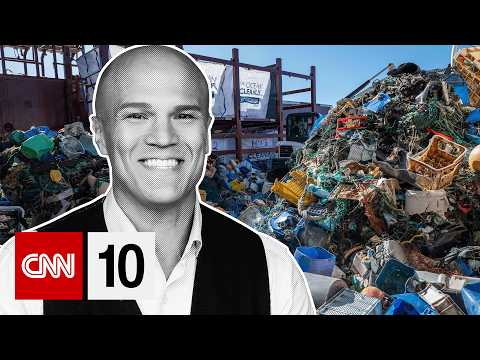
[4:39]Pop quiz, hot shot, what is the painting technique featuring small, distinct dots which form an image? Impressionism, Sfumato, Tenebrism, or Pointillism. You're on point like decimals if you said pointilism, the technique developed by George Sira and Paul Signac in the 1800s, use thousands of tiny dots of unmixed color to form one cohesive image. Now to the Met Gala, the annual celebration of art, culture, and fashion turned all the way up. Held every first Monday of May, it's a fundraiser for the Costume Institute at the Metropolitan Museum of Art in New York City. It attracts big donors and big time stars from all walks of life. This year's theme, costume art. Actor Ben Platt channeling a pointless masterpiece inspired by George Sarats a Sunday afternoon on the Island of La Grande Jatte. Some stars were almost entirely in disguise, Heidi Klum frozen in time like a statue by Italian artist Rafael Monte's veiled vestal. Hunter Schafer, Euphoria actor, wore a look inspired by Gustav Clint's painting, Mahler Primavessi. People on the red carpet said she looked like she walked straight out of the early 1900s painting. But you have to see this. Olympic phenom, Eileen Goo, resplendent, floating in a dress made of 15,000 glass bubbles. It took more than 2500 hours to make, and yes, real bubbles included. She says fashion, like sports, is about pushing limits and expressing your truest self. Now to the floating garbage patch, roughly twice the size of Texas. A new study finds the Great Pacific garbage patch may be doing more harm than initially thought. Airborne microplastics appear to be absorbing sunlight, potentially adding to global heating. Why does this matter? Rising temperatures can fuel extreme weather, disrupt ecosystems, impact life on land and sea. Who better to break it down than our chief climate correspondent, Bill Weir. Hi, Bill. Coy, yeah, I remember the first time I heard about the Great Pacific Garbage Patch, that 20 years ago, I imagined a floating dump you could walk around on, but actually it's more like a a plastic soup. Thin plastic soup, where you could take a, you know, a a siphon and and go through and get little pieces of plastic, bottles and old fishing nets that are breaking down, packaging from around the world. And it's all contained thanks to these circular currents called gyres, uh there, and we've always cared about the impact of this monstrosity both on the fish and the bird life, the whales and sea turtles that actually have to swim through and eat from that pollution. But this new research looked at the effects on global warming. Because as that plastic breaks down and atomizes, it gets into the air and even a tiny little piece, a dark piece of plastic absorbs 75 times as much solar energy as a clear piece of pollution floating out there as well. And because this patch is twice the size of Texas or three times the size of France, that's a lot of tiny particles floating in the air contributing to overall overheating. Now, it's a small percentage relative to what's happening because right now, Coy, I don't know if you know, ocean temperatures are off the charts, like record shattering highs and it's not even springtime and El Nino hasn't even kicked in yet. So the weather created by these overheating seas is a more oppressing concern. But as for the plastic, it's also worth noting, last year over a hundred countries came to the table, ready to negotiate a global plastics treaty to get countries to reduce and reuse and recycle best they can. But it was blocked in the end by countries that produce a lot of oil, gas and petrochemicals like the United States, Saudi Arabia, and Russia. Coy.
[9:33]Today's story, getting a 10 out of 10, turning graves into gardens of gratitude. In Florida, eighth grader and Girl Scout, Cassandra Seldon saw something she could not ignore. The Miami City Cemetery, which she walks by every day on her way to school, is an historic resting place for hundreds of war veterans. But Cassandra noticed, they needed some TLC. So she stepped up and cleaned their graves as a part of her Girl Scout Silver Award. I just think that it's so wrong that these veterans they served our country and they helped us gain our freedom, so I think that they should be respected. Over a year-long mission, Cassandra rallied volunteers and veterans, cleaning more than 1700 graves. And she didn't stop there. She built a digital library for each restored veteran's grave so families can locate their loved ones. Her project may be complete, but Cassandra's impact, the veterans, they're etched into history. That is awesome stuff. All right, congrats to our Your Word Wednesday winners, Mr. Sherman and friends at Woodward Academy in the ATL, Georgia, submitting resplendent, an adjective describing someone or something shining brilliantly, dazzling or richly colorful. Way to work, squad. Thank you for making us smarter today. We have some shout outs as well. Mrs. Blondin at Beacon Middle School in Lewes, Delaware. Thank you for commenting and subscribing on our CNN 10 YouTube channel and making us a part of your day. Finally, going above and beyond from Lake Zurich, Illinois, listen to this. Turn on CNN 10. We are super hyped. We say hands clap. We say 10 out of 10 for shout out on your word Wednesday every Wednesday. Everybody loves CNN 10.
[12:12]That was good. Yeah. Jonathan, James, Mason, Mr. Nikki at Lake Zurich Middle School South. We did not know you had game like this. And Mr. Nikki, your World History songs on YouTube are the stuff of legend. Keep rocking, y'all, stay creative, stay kind. I'm Coy Wire and I will see you tomorrow right here on CNN 10.