[0:06]hello everyone and welcome back to Everyday English Academy where we make English simple and enjoyable.
[0:17]I'm Sarah and I'm Mike. Hello to all of our wonderful listeners wherever you are in the world right now.
[0:25]Mike, you seem very relaxed, very calm.
[0:31]Do I? Well, I just got back from visiting my cousin in the countryside. I spent three days there.
[0:39]Wait, wait, wait. You went to the countryside? You, the person who always says, I need my coffee shop on every corner.
[0:50]I know, I know. I surprised myself too, but Sarah, something changed.
[0:57]What do you mean? Did you finally learn to appreciate silence?
[1:02]Not exactly silence. There was a rooster, a very loud rooster every morning at 5:00 AM.
[1:10]Oh, no. That doesn't sound relaxing at all.
[1:15]It wasn't at first, but then I don't know, I started enjoying the fresh air, the space, the stars at night. It was strange.
[1:26]Wow, this is big news. City boy Mike is becoming a country person?
[1:33]Haha, I didn't say that. I still love the city, but now I see both sides.
[1:39]Well, this is perfect timing because today we are talking exactly about this topic.
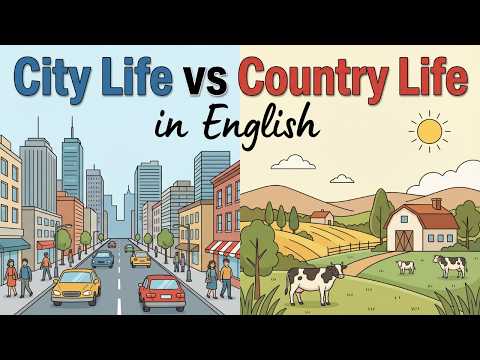
[1:47]City life versus country life, which one is better?
[1:51]And spoiler alert, there is no right answer.
[1:56]That's true. It depends on the person, but we are going to explore both sides today.
[2:03]Yes, and before we dive into this fun conversation, we have a small request for all of you.
[2:11]If you enjoy learning English with us, please subscribe to Everyday English Academy.
[2:17]Hit that subscribe button and give this episode a like. It really helps us reach more learners like you.
[2:26]And share this with your English learning friends. Learning together is more fun.
[2:31]Thank you so much. Now Mike, let's start with the basics.
[2:37]What exactly do we mean by city life and country life?
[2:42]Good question. City life means living in a big busy place, lots of people, lots of buildings, lots of activity.
[2:53]Think of places like New York, London, Tokyo or Paris, big cities with millions of people.
[3:02]Yes, and country life means living in a rural area, small towns, villages, farms, lots of nature and open space.
[3:13]Rural is the opposite of urban. Urban means city, rural means countryside.
[3:21]Exactly. So today we are comparing these two very different lifestyles.
[3:27]Let's start with city life. Mike, you live in a city, right?
[3:32]I do. I live in a medium sized city, not huge like New York, but still pretty busy.
[3:39]What do you love about living in a city?
[3:42]Oh, so many things. First, convenience. Everything I need is close by.
[3:48]Convenience means things are easy to get or easy to do, right?
[3:54]Exactly. If I need food at 11 PM, I can find a store. If I want coffee, there are 10 coffee shops within five minutes.
[4:06]Haha, see, you do love your coffee shops.
[4:10]I can't deny it, but it's not just coffee. I can find restaurants, gyms, hospitals, banks, everything is nearby.
[4:21]That's true. In a city, you don't have to travel far for services. Everything is accessible.
[4:28]Another thing I love is the variety. So many different restaurants.
[4:34]Italian, Chinese, Mexican, Indian. I can try food from all over the world.
[4:42]Cities are very diverse. Diverse means many different kinds of people and cultures.
[4:49]Yes, I meet people from different countries, different backgrounds. It's exciting.
[4:57]What about entertainment? That's another big advantage of cities, right?
[5:01]Oh, yes. There are always things to do. Concerts, museums, theaters, cinemas, festivals. You never get bored in a city.
[5:13]Never. Last weekend I went to an art exhibition. This weekend I might go to a live music concert.
[5:21]That sounds amazing. What else do you like? Job opportunities?
[5:26]Job opportunities. Cities have more jobs, more companies, more industries, more chances to find good work.
[5:34]That's a huge reason why people move to cities, better career options.
[5:39]Exactly. If you want to grow professionally, cities usually offer more possibilities.
[5:46]Okay, but Mike, let's be honest, cities aren't perfect, right?
[5:52]No, definitely not perfect.
[5:55]What are the downsides, the negative parts?
[6:00]Well, first, it's crowded. There are people everywhere all the time.
[6:06]Crowded means too many people in one space, like a crowded bus or a crowded street.
[6:14]Yes, during rush hour the subway is packed. I mean, you can barely breathe sometimes.
[6:21]Rush hour is the time when everyone is going to work or coming home from work, usually morning and evening.
[6:30]Right, and the streets are full of cars. Traffic jams everywhere.
[6:35]Traffic jams, when cars move very slowly or not at all because there are too many vehicles.
[6:43]It's frustrating. Sometimes it takes me 40 minutes to travel 5 km.
[6:49]That's terrible. What about noise? Oh, the noise, huh?
[6:54]Cars honking, construction work, sirens, people shouting.
[7:00]Cities are loud, very loud.
[7:04]Sometimes I can't sleep because there's noise outside my window, a party, a car alarm, something.
[7:10]That sounds stressful. And speaking of stress, city life can be very fast paced, right?
[7:18]Yes, the pace of life in cities is fast. Everyone is rushing, hurrying, running.
[7:25]Pace of life means how fast or slow your daily routine feels. Cities have a fast pace.
[7:33]Exactly. People walk fast, talk fast, eat fast. There's always this feeling of hurry. It can be exhausting.
[7:41]It can be exhausting. What about the cost? Is city life expensive?
[7:47]Oh, yes, very expensive. Rent is high, food is expensive, transportation costs money.
[7:52]I've heard that a small apartment in a big city can cost as much as a big house in the countryside.
[8:02]That's absolutely true. My friend pays 15 dollars a month for a tiny one bedroom apartment.
[8:11]Wow, that's a lot.
[8:14]It is, and don't forget pollution. Cities have more pollution because of all the cars and factories.
[8:22]Pollution means dirty air, water or environment. It's harmful to our health.
[8:30]Yes, sometimes the air quality is so bad that it's hard to breathe. You can see the smog.
[8:38]Smog is a mix of smoke and fog. It makes the air look gray and dirty.
[8:45]Exactly. So while cities offer a lot, they also come with challenges. Now let's talk about country life.
[8:55]I grew up in a small town, so I know this lifestyle well.
[8:59]Really? Tell me about it.
[9:02]Well, the first thing I loved was the space. So much open space, fields, forests, hills.
[9:12]That sounds beautiful. Very different from concrete buildings everywhere. Haha, yes.
[9:19]Yes, instead of buildings, you see nature, trees, flowers, animals.
[9:26]And the air must be cleaner, right? Oh, much cleaner. No pollution like in cities. You can take deep breaths and smell fresh air.
[9:38]That's what I noticed at my cousin's place. The air felt lighter somehow.
[9:44]Exactly. And it's so much quieter. No car horns, no sirens, just birds singing and wind in the trees.
[9:54]That must be relaxing. It is. The pace of life is slower too. People don't rush, they take their time.
[10:04]So the opposite of city life, completely opposite.
[10:08]In my town, people would stop and chat with their neighbors. They weren't always checking their watches.
[10:17]That sounds nice, less stressful.
[10:20]It is. You feel more connected to nature and to people around you. Life feels simpler.
[10:27]What about safety? Is the countryside safer than cities?
[10:32]Generally, yes. There's less crime. Everyone knows everyone, so people look out for each other.
[10:40]Like a community. A real community where people care about their neighbors.
[10:44]Exactly. If you need help, someone will help you. It's very friendly.
[10:50]And I bet it's cheaper to live there, right?
[10:54]Oh, yes, much cheaper. You can buy a house with a garden for the price of a small apartment in the city.
[11:02]Food is often cheaper too, especially if you grow your own vegetables.
[11:08]Your own vegetables. That's very country.
[11:12]It is, but it's also healthy and fresh. You know exactly where your food comes from.
[11:19]Okay, but Zara, country life must have some disadvantages too, right?
[11:25]Of course, it's not paradise. Tell me the truth, what are the problems?
[11:31]Well, the biggest problem is you're far from everything, very isolated.
[11:38]Isolated means you're alone, far from other people and places.
[11:44]Yes, the nearest supermarket might be 20 km away. The nearest hospital, maybe 40 km.
[11:53]That's far. What if there's an emergency?
[11:57]Exactly. It takes longer to get help. And if you need something urgently, you can't just walk to a store.
[12:05]What about entertainment? Are there things to do?
[12:08]Not really. No cinemas, no theaters, no concerts. If you want entertainment, you have to travel to the city.
[12:18]That sounds boring for young people.
[12:21]It can be, especially for teenagers. They often feel like there's nothing to do.
[12:27]What about jobs? Are there good job opportunities?
[12:31]No, that's another big problem. There aren't many jobs in the countryside.
[12:37]Most people work in farming or small local businesses. So if you want a career in technology or finance or something specialized, you have to move to a city.
[12:49]Exactly. Many young people leave the countryside to find better jobs in cities.
[12:54]What about transportation? How do people get around?
[12:59]Well, you need a car. There's no subway, no buses every 10 minutes. Public transportation is very limited.
[13:09]Public transportation means buses, trains and subways that everyone can use.
[13:14]Right, and in the countryside there might be one bus a day or no buses at all. So if you don't have a car, you're stuck.
[13:24]Pretty much, and that's expensive too. You need to buy a car, pay for gas, pay for insurance.
[13:34]What about internet? Is it good in rural areas?
[13:38]Oh, the internet. That's another issue. It's often slow or unreliable.
[13:46]That's a problem if you work from home or study online.
[13:51]Definitely. I remember trying to watch a video and it would stop every 30 seconds to buffer. Ha, frustrating.
[14:01]Very. So you see, both city life and country life have good points and bad points.
[14:10]It really depends on what you value, what's important to you personally.
[14:16]Exactly. Some people need excitement and opportunities, they choose cities.
[14:22]And some people need peace and space, they choose the countryside.
[14:28]What about you, Mike, where do you see yourself in the future?
[14:33]Hmm, that's a good question. I think I want both.
[14:38]Haha, both. How does that work?
[14:41]Well, I'd like to live in a city for work and opportunities, but have a small house in the countryside for weekends.
[14:49]Oh, like a vacation home. Exactly. Best of both worlds. I can enjoy city life during the week and escape to nature on weekends.
[14:59]That's actually a great compromise. What about you in the long term?
[15:05]Maybe when I retire, I'll move to the countryside permanently, when I don't need to commute to work anymore.
[15:13]Commute means travel to work or school every day, like your daily journey to the office.
[15:21]Yes, commuting in cities can take so much time, an hour each way, sometimes more.
[15:29]That's two hours every day just traveling.
[15:34]Exactly. So when I don't need to commute, I can live anywhere and I'd choose somewhere quiet and green.
[15:42]That makes sense. I used to think I wanted to live in a big city forever, but now I'm not so sure.
[15:51]What changed? I miss the simplicity of country life, the fresh air, the stars at night, the friendly neighbors.
[16:00]So you want to move back?
[16:03]Not right now. I like my job and it's in the city, but maybe in a few years I'll look for something smaller.
[16:11]Like a small town, not a village, but not a big city.
[16:16]Exactly. A small town with maybe 50,000 people, big enough to have shops and restaurants, but small enough to feel like a community.
[16:27]That sounds perfect, like a middle ground.
[16:30]Yes, you get some convenience but also some peace, the best balance.
[16:36]I like that idea. Now let's help our listeners practice talking about this topic.
[16:43]Good idea. Let's share some useful phrases.
[16:47]If someone asks you, where do you live, you can say I live in a big city or I live in the countryside.
[16:57]You can also be more specific. I live in a suburb.
[17:01]A suburb is an area near a city but quieter and more residential.
[17:13]Right. Or you can say I live in a small town in the mountains or I live near the beach.
[17:22]What if someone asks, do you like where you live?
[17:26]You can say, I love it. It's very convenient and there's always something to do.
[17:33]Or it's okay, but it's too crowded for me.
[17:37]Or even, not really, I prefer quieter places.
[17:41]What about talking about preferences? How do you say what you prefer?
[17:47]You can say I prefer city life because I like being around people.
[17:53]Or I prefer the countryside because I value peace and nature.
[17:59]You can also say, I enjoy city life, but sometimes I need a break from the noise.
[18:06]That's honest. What if you're comparing the two?
[18:10]You can say cities are more exciting, but the countryside is more relaxing.
[18:17]Or the countryside is cheaper but cities offer more opportunities.
[18:24]These comparisons help you express your thoughts clearly.
[18:28]What if you want to ask someone else about their preference?
[18:33]You can ask, would you rather live in a city or the countryside?
[18:39]Or what's more important to you, excitement or peace?
[18:44]Or simply where do you see yourself living in the future?
[18:50]These are great conversation starters.
[18:53]They are, and remember there's no wrong answer. Everyone has different needs and preferences.
[19:01]Exactly. Some people love the energy of cities, others find it overwhelming.
[19:08]Overwhelming means too much, too intense. It makes you feel stressed or tired.
[19:16]Right. And some people find the countryside boring while others find it calming.
[19:22]It's all about personality and lifestyle.
[19:25]So before we finish, let's review what we talked about today.
[19:30]We compared city life and country life. We talked about the advantages and disadvantages of each.
[19:38]Cities offer convenience, variety, entertainment and job opportunities, but they're crowded, noisy, expensive and polluted.
[19:49]The countryside offers space, clean air, peace and lower costs, but it's isolated with fewer jobs, limited services and less entertainment.
[20:01]Both have pros and cons. The best choice depends on what you value most.
[20:08]And remember, you don't have to choose forever. Many people move between city and country at different stages of life.
[20:18]That's true. Your needs change as you get older.
[20:22]Exactly. Now we have a question for all of you listening today. We want to hear from you.
[20:29]Where do you live and do you like it?
[20:33]Do you live in a big city, a small town, the countryside?
[20:37]Tell us in the comments. Write one or two sentences, for example,
[20:41]I live in a big city and I love the energy, but sometimes it's too loud.
[20:49]Or I live in a small village and I enjoy the peace, but I miss having restaurants nearby.
[20:55]We read every single comment. We love learning about your lives and where you're from.
[21:02]And writing in English is excellent practice. Don't worry about making mistakes.
[21:07]Exactly. Just share your thoughts with us.
[21:10]And if you enjoyed today's conversation, please subscribe to Everyday English Academy.
[21:16]Click that subscribe button so you don't miss future episodes. We have so many fun topics coming up.
[21:23]And give this episode a like. It helps us create more content for wonderful learners like you.
[21:29]Share this with your friends who are learning English. Let's grow our community together.
[21:35]Thank you so much for spending time with us today. You're doing amazing work with your English.
[21:40]Keep practicing, keep learning and keep going. You're getting better every single day.
[21:47]Whether you live in a city or the countryside, we hope you're happy where you are.
[21:51]And if you're not, well, maybe it's time to think about what you really want. hahaha.
[21:59]Good advice, Sarah. We'll see you very soon in our next episode.
[22:04]Until then, happy learning everyone. Goodbye. Bye.
[22:07]Goodbye. Bye.


