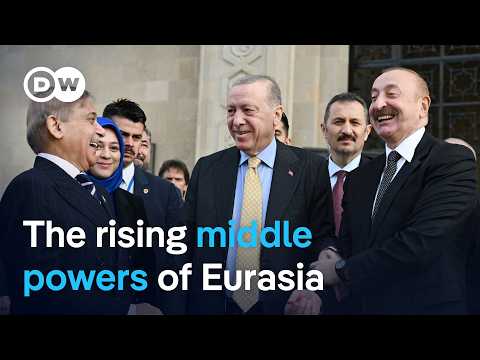
[0:00]If you haven't noticed, the world is changing with a lot of talk about the decline of America, its lost status as a superpower, the rise of China and the emergence of what many experts call multilateralism, where no one country has the most power. And where many middle powers try to pursue good relationships with as many countries as possible while hedging against the biggest states. Pakistan is a great example, the way it's stepped up to try to broker an Iran war ceasefire. Why would it do that? Pakistan, um, I think the fact that they're trying to mediate peace kind of reflects what China wants. China really doesn't like uh the continuation of the operations and the high oil prices and uh China is definitely not stopping Pakistan from mediating between the two sides. So I think it kind of uh fits both the American interests and the Chinese interests, which I think is very interesting, and it really shows the the swing state nature of Pakistan. That's Ken Moriyasu, senior fellow at the Think Tank, The Hudson Institute, and until recently a top international correspondent at Nikkei Asia. And if you caught what he just said, he called Pakistan a swing state, but he's not talking about the US elections, which is probably where you've heard the term about the states that sometimes vote for Republicans and sometimes for Democrats. He's describing a special group of middle powers in Eurasia.
[1:28]Ken's Swing States are Armenia, Azerbaijan, Hungary, Kazakhstan, Mongolia, Pakistan, Turkey, and Uzbekistan. All right, how did you do in geography class as a kid? Because buckle up, you are going to be seeing a lot more maps. Ken explains that we tend to think about great power competition taking place, for example, in the Indo-Pacific, and we forget about the same dynamic happening on land. My whole thesis about um China uh moving away from the Indo-Pacific is that China for 15 years has been trying to avoid dependence on the Indian Ocean. Because Indian Ocean is full of maritime choke points, like the Strait of Hormuz that we're witnessing right now, they are trying to avoid the maritime choke points. But uh my theory is that if the US wants to counter China, it has to move to the Eurasian continent and move to the land choke points, such as Azerbaijan. Azerbaijan and also Armenia, both are on Ken's swing states list, and they recently signed a peace agreement brokered by the United States. It's one of the few foreign policy wins, analysts, even those pretty critical of President Donald Trump, give him credit for. So Azerbaijan, Armenia have been going at each other for for many decades. Um, but they were ready uh for peace, uh and then they came to Trump and Trump um proposed uh creating a land connection between uh Azerbaijan and its exclave, uh through Armenia. And that's called the Trump Route for International Peace and Prosperity, TRIP. And that uh would uh kind of uh the current so-called middle corridor, uh goes through the central country in China, Central Asia, Caspian Sea, through Azerbaijan to Georgia and then to Turkey. That's the middle corridor. But this offers another route through the South without going through Georgia, through Azerbaijan, Armenia, and Turkey. So it gives um an alternative option to the middle route, which is the whole key of um the Eurasian uh connectivity to have multiple options. And we really don't know where Georgia politically is going, so it's always good to have another alternate. The next swing state is the only one firmly in Europe, that is Hungary.
[3:49]The middle power under Viktor Orbán managed good relationships with all three big players, China, Russia, and the United States. China has been really focusing on Hungary as the gateway to the European Union. It has been investing heavily there, uh this Hungary, uh kind of uh has because of its political leaders, has had uh problems having a friendly relationship with the rest of the EU. Uh China's uh taken advantage of that and offered uh Orban and his administration lots of investment. But Orbán also is very close to um, to the Trump administration. So they're really uh in the middle uh of these two sides. I think I think they're playing it pretty well, um, trying to extract benefits from both sides. So that's uh typically a swing state. We're heading to Central Asia next with Ken's take on Kazakhstan. The country is massive and smack in the middle of the Eurasian landmass. Kazakhstan, um, by its geography, it's right next to China on the west side. It is where the railroad in China to Europe passes through, uh largely because there are few mountains, it's a flat land. Uh Kazakhstan is very keen to invest. Uh it has oil, so it has it it's very rich. It has been investing in um railways and pipelines. Uh it's a crucial um connector state, um energy lifeline for China if it wants to uh move away from the Indian Ocean. But then again, uh Kazakhstan doesn't want to swap its traditional dependence on Russia with dependence on China that that would uh suffocate them. They they have something called the multi-vector foreign policy, they always like to have options open. So this has created an opening for for America to deepen ties. There are other Central Asian countries that Ken could have added to his swing state list. He picked Uzbekistan. Uh Uzbekistan is very interesting, um, it's the only Central Asia country that doesn't have a border with China or Russia. So it has a little more flexibility in foreign policy. Uh the Americans really are trying to strengthen relations with Uzbekistan. The country sandwiched between Russia and China also makes it onto Ken's list. Mongolia is ruled by both powers, and Ken says its history plays a role in the psyche of Russians and Chinese. Mongolia, uh, geography, um, really smack, uh, in the middle of Russia and China. Um, and also um a great history. The Mongol Empire really is um has such an impact on on modern day um foreign policy. Um, for instance, the Russian invasion of Ukraine is it comes from a a paranoia on the Russian side of needing to defend its borders, having buffer state, that comes from the memory of the Golden Horde, the the Mongolians, uh invading from the East for for many years. Um, so that really I think still has an impact. Uzbekistan, um, was ruled uh by one of the Chingus Khan's uh sons. Um, and China and uh was under the uh Mongolian Yuan Dynasty. Uh, really, there's much more uh history to to that land. Last, but not least, is Turkey. At the crossroads of Europe and Asia, it's a bit of a chameleon, able to play different roles in different regions. Turkey is the most important of the swing states and the most important for Japan, uh in its deterrent against China. Turkey, uh due to its geography, uh is is crucial. Um, but it also has multiple identities. It's part of the Islamic world, it's part of the Black Sea economic zone, so with Ukraine, Romania, Bulgaria and Georgia, their one block, uh the Balkan countries, and also Africa due to the former Ottoman period. I think for for Japan, uh and for the US, the key is Turkey's new interest in the Turkic states. The Organization of Turkic States has a much more potential to be a more coherent, stronger unit. And once they become a strong voice, uh I think they will be a presence on China's Western border. So, there you have it, the eight swing states of Eurasia, playing China, Russia, and the United States against each other. And inversely, Beijing, Moscow, and Washington must vie for their favor. And for now, one country is doing a better job than the other two. Can you guess which? Xi Jinping has been saying it all along, he wants to create a community of shared destiny or a shared future. And what that means is to build pipelines, build ports, to to connect the economic prosperity uh with China. So if China rises, all these neighboring countries rise with it, and um because they'll be so intertwined that when it comes to a vote at the UN or the WTO, these neighboring countries will vote with China. So what do you think? Do these swing states make sense to you and do you think it's really China that's coming out ahead? Let us know in the comments. That's all for now. DW News is giving you the latest and also sharing deep dives on here and across the rest of social media. I'm Melissa Chan, until next time.


