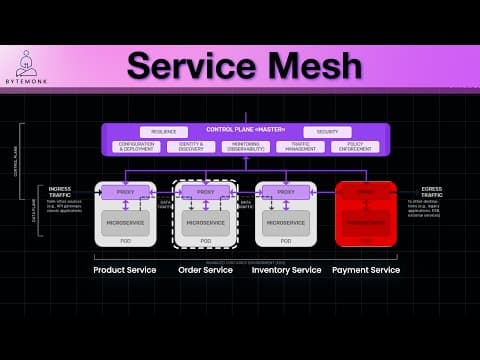
[0:00]A service mesh is an infrastructure layer that handles service-to-service communication. It's essentially a network of proxies called sidecars that manage traffic between microservices.
[0:11]But unlike traditional networking, a service mesh operates at the application layer. Think of it as an invisible layer that sits between services and manages how they talk to each other.
[0:20]It abstracts the complexity of communication, allowing you to focus on writing code, while the service mesh takes care of things like traffic management, load balancing, retry, security, and observability.
[0:35]As your microservices architecture grows, so does the complexity of managing it. Let's say you have dozens or even hundreds of services interacting with each other.
[0:45]You'll face challenges like handling network failures, such as what happens if one service is down or slow, or ensuring secure communication between services, monitoring and tracing what's happening across your distributed architecture, load balancing traffic to ensure your services remain performant.
[1:00]Or rolling out new versions of services with zero downtime. Handling these tasks manually through custom code would be inefficient and error prone. That's why service mesh is invaluable.
[1:12]It provides a consistent out-of-the-box solution to handle these challenges without having to change your service code. A service mesh operates through sidecar proxies that are deployed alongside each service.
[1:22]Now, I have made a detailed video on sidecar proxies with specific examples, do check it out. These proxies intercept all network traffic between services, allowing the service mesh to manage communication independently of the services themselves.
[1:36]So imagine you have an e-commerce application platform with several microservices: a product service that handles product details, an order service handling customer orders, inventory service keeping track of the stock, and a payment service which processes transactions.
[1:50]So in a typical microservices architecture, each of these services communicates with one another directly. But what happens if the payment service slows down or crashes?
[2:00]You need to update the order service, but also want to ensure zero downtime. You want to secure communication between services to protect sensitive customer data, and that is where service mesh steps in.
[2:10]The sidecar proxies deployed with each service will handle retries if the payment service is unresponsive so other services aren't affected. The traffic between services is encrypted, ensuring no sensitive data is exposed.
[2:24]And rolling out a new version of the order service can be done with Canary deployments, where the sidecar proxy routes a small percentage of traffic to the new version before it is fully rolled out.
[2:33]And this allows you to manage the complexity without hardcoding these behaviors into each service. Now, one of the most powerful aspects of service mesh is its ability to manage traffic routing between services.
[2:44]You can route traffic based on versions, load conditions, or even user specific rules. For instance, if you're rolling out a new version of your inventory service, you can set up Canary deployments to send only 10% of the traffic to the new version.
[3:00]And if everything works fine, you can gradually increase the number. Also, in a microservices environment, failures are inevitable. And a service mesh helps by automatically handling retries and fallbacks.
[3:10]So if the payment service becomes unresponsive, the service mesh will retry the request based on predefined rules. It can also reroute traffic to alternative services or degrade functionality gracefully.
[3:19]And by using mutual TLS or MTLS, service mesh ensures that communication between services is secure and encrypted. This adds an extra layer of security without requiring you to implement encryption in each service manually.
[3:32]So in our example, if the order service talks to the payment service, their communication will be encrypted. Finally, one of the most challenging aspects of microservices, understanding how services are interacting in real time.
[3:43]Service mesh comes with built-in observability tools like distributed tracing and metrics collection. This lets you trace the journey of a request through multiple services, helping you to detect bottlenecks, failures, or anomalies.
[3:55]A great real world example of service machine in action is Netflix. Netflix's microservices architecture includes hundreds of services that communicate constantly to deliver movies, show recommendation, user accounts, and streaming.
[4:07]They use Istio, a popular service mesh tool to route traffic to the appropriate microservices based on user location. It handles failure gracefully when a service becomes unavailable, ensuring users still get a good experience.
[4:20]It also secures communication between microservices using MTLS, since user data and viewing history are highly sensitive. In fact, with Istio, Netflix can deploy new versions of microservices without affecting its users even during high traffic periods like the launch of a new TV series.
[4:36]Now, there are several tools available to implement a service mesh in your microservices architecture. Obviously, Istio is one of the most widely used service mesh tools.
[4:44]It provides powerful traffic management, observability, and security features. It works with Kubernetes and integrates easily into existing systems.
[4:52]Linkerd is another lightweight, performance-focused service mesh solution often preferred for simpler use cases. Consul is another service mesh tool that provides service discovery, health checking, and network segmentation in addition to typical service mesh features.
[5:06]Now, service mesh isn't always necessary for every architecture, but you might need it when you have a large number of microservices that need reliable, secure communication, when you need fine-grained traffic control such as during Canary deployments or AB testing.
[5:20]When security and encryption of your internal traffic is a priority, or when you require deep observability into your microservices performance and behavior. If you only have few services, a service mesh might add unnecessary complexity.
[5:33]But as your architecture grows, it becomes a critical part of managing the entire ecosystem. So, if you're building or planning to scale your microservices architecture, a service mesh might just be the tool you need to keep everything running smoothly.


