[0:00]How much screen time is too much for young brains?
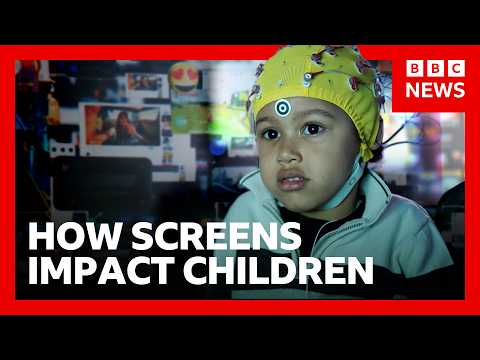
[0:06]Scientists in the UK have been looking at what happens when toddlers watch fast-paced content. And this research has informed new government guidelines for screen time for under fives. If stuff is happening, coming at us too fast, something called the fight or flight stress system kicks in. The advice says children under two should not have any screen time alone, and from the age two to five, viewing should be limited to one hour a day. We challenged one family to cut down, but it's not been easy. At the start of the week I was like, yeah, come on, we're going to do this. But it didn't happen. Really like that. On the 27th of March 2026, the government unveiled its guidance on screen time for under fives in England. It is advising parents to avoid screen time for under twos, unless it's a shared activity like calling relatives, for example. For children aged two to five, it should be limited to no more than one hour a day with no screen time at meal times or in the hour before bed, and you should use or watch screens together. Parents are also being asked to choose slow-paced, age-appropriate content. Fast-paced, social media style videos and AI toys and tools should be completely avoided. But why is this advice coming now? It's partly because what children are watching and how they're watching it has changed dramatically over the last 20 years. Smartphones and screens are much more common at home. Episodes are shorter and faster-paced. There are more characters and movement on screen, and plot changes can happen really quickly. Good job, Alex, you're doing really well. Scientists at the University of East London have been studying what impact all of that fast-paced screen time is having on toddler's brains. They looked at things like eye trace, where the eyes are looking on a screen. heart race, the more excited they are by a piece of content, the faster their heart is going to beat. And brain activity, how it reacts to things like light, sound and movement.
[2:18]Toddlers brains process things up to 10 times slower than adults, and the researchers find that under fives find it hard to process all that fast-paced activity on their screens. So we do have really good evidence that screens put children into this sympathetic nervous system, fight or flight mode. Your heart starts beating faster and you start to get a lot of energy released to your muscles, and that's your body readying itself to react to something at a moment's notice. This is happening when children are sat still on a chair watching screen content, and what's happening is the child is watching it on screen and their body is kind of getting tricked as it were, and it's responding to this imagine peril as if they're exactly they're actually experiencing the peril themselves. There is now loads of research going into the correlation between a child's early TV viewing and how they manage their behavior and emotions. On average, the more TV that a child watches when they're young, the more likely they are to be having, you know, tantrums and other form of behavioral disregulation when they're older. And we've also got good quality evidence that using TV and screens to calm a toddler tantrum can actually lead to the problem getting worse over time. And that's probably why, you know, almost every parent, myself included will say, you know, when you take the screens away, that's often the moment where you have tantrums. But how practical is the new advice for families and how easy is it to make changes? My name is Alexis. I'm in my early 40s. My husband is well. And we've got two boys, Romy who's nearly five. Are you zooming? Yeah, you're doing good. And Marlo is nearly two. You doing okay. That's us, two cats. Here we are. So it's a busy house? Yeah, yeah, it's mad. For the Montasti family in Manchester, life is a juggle.
[4:05]Make sure you sit down at the table. From school and nursery pick up to dinner time. He said, love at children like Romy and Marlo are growing up surrounded by technology. It has its advantages, helping them keep in touch with family living hundreds of miles away and offers endless entertainment. But the family are also worried about the effects it can have. It's a big thing in the house. It's it's a topic of conversation will everyday because we do it every day. Most of the time it is to avoid conflicts, meltdowns and to give yourself a bit of a break and a bit of a rest if you need it. The family spent one week trying to cut down on their screen time. Are you up for the challenge? Challenge accepted. Yeah. Okay. So they swapped morning viewing for dancing and other activities and limited the number of episodes allowed after school. How many number blocks episodes have you watched? Last night went quite well actually. We managed to turn it off after 26 minutes. At the start of the week I was like, yeah, come on, we're going to do this and by the end of the week, no screen or everything will just swap perfectly. We're on Thursday. Um, it's been quite challenging. I'm not going to lie. Should we just try and do five episodes of one program? But it didn't happen. Really like that. We've tried our best. Some of the swaps for Alexis were time consuming, especially before and after school, when she needed to get things done. So I need that time, so I'm not going to swap it to sit down and read a book because um, it's not realistic. This has definitely made me more aware and almost made me start doing things that I've always said, oh, we need to, we need to do that. Technology is such an integral part of everyday life, cutting down completely on screen time is hard for many parents. And some parents don't want to cut it out completely. Here is Parent Zone, a tech-friendly parenting organization. Technology is going to be the future for these young people and if we try too hard to keep them away from it, they're going to struggle. So what we've got to do is find a way of making technology a positive part of family life. For example, a a smart speaker is now AI enabled. A a small child under the age of five that's got one of those in the house will be interacting with a device that's got AI in it. So the idea that we can completely keep them away from it is is probably flawed. But it's good general guidance. With technology advancing all the time and limited research, the government will have to keep looking at this advice as things change and more is known about the effects on children. And the experts say parents should trust their own instincts as they make decisions about what is best for their child.


