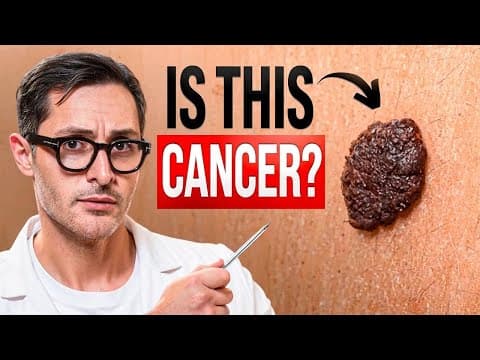
[0:00]We recently held an open house and people came to our center for free. This is the Federal State budget institution, Russian National Center for radiology and radiotherapy and we together with our colleagues who specialized specifically in oncology, work here. We examined moles and told people that this mole is pathological and it's better to remove it while this mole is fine. And through this diagnosis, we examined around 300 people and found moles needing removal in 27. In several of those Melanoma was detected after removal. These people lived peacefully with these moles and none of them knew how to tell when a mole had changed from a friend you've lived with your whole life into something malignant that could take your life. And that's why in this video, I'll tell you what you need to know about the moles you live with and how to make sure that a mole doesn't become the cause of an unbearable illness, a terrible illness. For example, melanoma may start as a small skin growth but can develop large metastasis elsewhere making it very difficult to treat. Ultraviolet light is a major factor and physical trauma also plays a role. Today we'll cover this in an organized way. You probably already know this without me. It's when a mole grows inside for instance it was 4 mm for years then suddenly increases to 5 6 or 7 mm and most of these growth stay with us. They can be on the face without causing concern and over the years they can change ship, structure and size. And sometimes we don't notice, but then we do. You know, when a friend at the gym says, hey, you have some mole or growth on your back that used to be smaller or has gotten bigger. I even once noticed in the gym that someone had a malignant growth and I told him, you know, I don't really like that mole of yours. I know it might not be appropriate for me to approach you, but you should pay attention. And that's why the ability to recognize these growth is important because there's probably no one who doesn't have them. And if you've noticed that a mole you've had for a long time has started to grow and it's not about millimeters, right? Over how many years, but about the fact that when a person starts to notice that it just became bigger than it was, yes, you started to notice that it became bigger than it was. And it's swelling too. Let's say irritation is also from the inside, which means some kind of tumor process might be starting. Why does it grow and the growth of a mole basically a tumor is actually one of the most important signs. because a mole should ideally always be stable and shouldn't change throughout life. And if this happens, it means there's something behind it. The second thing is a loss of symmetry, meaning the two halves of the mole no longer look alike. They don't have to be perfectly even, but if one half suddenly becomes asymmetric, it starts to look even more like a map. And if you notice that your mole is no longer symmetrical, well, if you imagine a line dividing it in half and one side becomes a different shape or density or maybe for example changes color. So it's not just about the size. This is a very characteristic process which can also indicate malignancy in Russian. Malignancy means turning something benign into something malignant. And the classic rule for specialists who deal with such growth is a symmetry. This is the first warning sign that should prompt you to see a specialist such as an oncologist, dermatologist for a dermatology. For example, if you like this kind of information that you can use in your daily life and benefit greatly from, then you will surely like my telegram channel. as well because it's free and contains a huge amount of useful information. Find my Telegram channel link below the video. Thank you, check it out, subscribe and benefit. If the edges are uneven, if they're jagged, if the border of the mole loses its clarity, that's the third sign and if the mole is safe, the edge is usually tight, fairly even and has a clearly defined outline. If you suddenly start noticing that something is changing, remember that with melanoma, the edge starts to spread it becomes ragged, reminiscent the outline of a continent, sometimes even marred. And that's why it feels like it's spreading and creeping onto the surrounding tissue. Sometimes a halo of inflammation appears, meaning the skin around the mouth turns pink or red, and this means your immune status around the tissue is changing and your body is starting to react to it. A change in color is also possible meaning the mole itself can change color. It can get darker, lighter, become more red, become darker and the color changes on This is also an important sign of negative development. It may develop frequent spots, become reddish brown, lose its color completely and in some cases there can even be de pigmentation. Pigment melanomas typically transparent can develop multiple colors or shades. Why does this occur? Because the cells that give color multiply and some of them become malignant. For example, deeper layers and vascular components become involved in this process leading to what In this case you don't yet know the mall is changing. The danger isn't the darkness itself it can stay with you for life but that it's lacking shifting meaning something has changed. Fifth it suddenly started to itch hurt itch or there was tingling. This means that something is happening because our benign growth usually stay with us our whole lives and even when they're quite large they don't cause any symptoms. But if you start to notice something happening like the appearance of some pain or itch. That means again that something is happening, the process is affecting nerve endings, it's reaching blood vessels and new tissues are getting involved. This results in you feeling a new sensation. Inside your mouth, even when you are born with, certain factors can trigger a new process causing new sensations. And that's why many patients remember it later in history. All right, this mole of mine started itch for some reason a few months ago, but I didn't really pay attention to it. I just wasn't focused on it. So let's not forget about this. The six sign is bleeding, meaning a crust suddenly appears. It starts to bleed, it starts to peel off. If a mole starts to bleed, it starts to peel off. If a mole starts to bleed, it starts to crack, it starts to get covered with crusts. And not because for example, you injured it with a bag or a belt because it's in an awkward spot. This is one of the most alarming signs and bleeding means that the blood vessels inside the tumor have become fragile and the tumors grow has become more aggressive. So if you notice that a growth you've had since birth suddenly starts to bleed, itch or hurt as if it has some kind ofdermitis, you should definitely see a specialist to have it checked out. 7th, there are structural changes, meaning it has changed on its own, you may notice when you rub your cheek or shave around this growth that for some reason it has become harder, it has risen above the skin, the texture has changed or the density has changed.
[7:07]Remember, any hardening, any change in height, any appearance of uneness orness is a reason to immediately see adermatologist and oncologist specializing in skin. Sometimes for example, in our center, oncologist also deal with this, so consult a specialist who is experienced in differential diagnosis, dangerous moles often rise above the surface and become more tense, giving the feeling that the skin can longer fully hold them. We've covered seven signs and I think if you remember all of them, then no mole will be a threat to you. Hello friends. Are there actually any reasons why moles can become malignant? Because today we discussed that we are usually born with moles, but for some reason they turn from good to bad, but as some of the reasons actually known to you, they're quite well known, we all know about them and let's try today to figure out in a structured way why this happens and what needs to be done to it because if you know the cause you can address it.
[8:03]Ultraviolet light, especially since tanning beds appeared which have nothing to do with vitamin D. People often wrongly believe tanning beds produce vitamin D, but that's not true and shouldn't be assumed. Ultraviolet radiation, its excess, specifically its excess because a lack of sunlight is about as harmful as smoking half a pack of cigarettes a day. Ultraviolet light damages DNA including both healthy skin and the DNA in neoplastic. and it can cause either reversible damage. When a mole can actually overcome this, reject it, just like the skin can reject alter tissues, a mole can't reject itself but it can deal with it. If this damage keeps accumulating, it builds up in the body and eventually it can't be controlled. And the cells inside this mole can mutate, meaning they can change. At first, this will create a tumor clone of cells, meaning a few cells will appear, not the whole mole at once, that will become completely different cells, terrorists. That's why sunburns are especially dangerous during adolescence. In childhood protect especially small children. As for tanning beds, just forget about them forever. And if you live in hot countries, especially if you are a white person living in hot countries, always protect your skin either with clothing or with sunscreen. Injuries can happen, as I mentioned, for example, on the face when you shave and constantly injure the area. Sometimes it's where a class is and you keep injuring it. There can also be regular constant trauma from a collar and belt or underwear. Especially if I have a friend who has a bad habit, he constantly pulls hairs out of his mouth, that's also trauma or attempts to cut off a mole or pick it a mole. They search online, assume it's a normal mole and may even try to remove it themselves. This raises the risk of transformation making chronic trauma particularly dangerous and thick related processes also contribute. If you have a mole in a place where you constantly injure it, go see a doctor and let them remove it. Third is genetic. Yes, genetics. There have been cases of familial melanoma, meaning when a parent had melanoma. This means that unfortunately you have a higher genetic risk of developing melanoma. So for you, even less sun and even more protective cream. Fourth, some people have a lot of moles while others have just one, some even look like a dalmation. So, if you have a huge number of Nivea, just think about it statistically. You have five on your back and each one could become malignant. If you've been out in the sun and gotten unborn several times. If you have a thousand, it's like drawing a thousand times from a lottery drum instead of just five, increasing the odds from 0.1%. Therefore, if you have more, more pigmented spots, the higher the chance that one of these areas could transform and lead to certain problems. This plastic ones are also moles, moles, moles, moles. So if it's round, irregular in shape or has an unusual color, you definitely need to keep an eye on it. You know what a typical mole looks like, but If there's an unusual growth. If it's large, changing, highly, big or in a spot you can check yourself, pay attention. There is also a fifth reason, immune disorders, immunosuppression. For example, after a kidney transplant patients take lifelong medications to prevent rejection, all of which have side effects. The side effect is that these patients have a higher chance of developing any type of cancer including this type of cancer. If you have a weak immune system or if you are being treated with certain biological drugs that can affect your body's ability to control the regeneration process. All of this can increase your risk of skin cancer. Naturally, any carcinogens will have an indirect effect on all of this. smokers have higher risks, so a smoker who sunbase or drinks and sunbase is at the highest risk, especially if you use toxic components in contact with your skin, since there are substances that are carcinogens by the If you work in a hazardous industry then you need to pay even more attention to this. We talked about why we talked about what types there are and now let's figure out what you should do if you suddenly notice something. Or like I saw on that young man's back in the audience and told him go get it checked out. The first thing you need to do is to document it take a good photo with proper lighting and compare it with all the pictures so you don't have to sit and zoom in later. When someone says something has appeared like when I told was losing hair on the back of his head and it turned out to be ringworm. He said he'd always looked that way. And even his wife who has lived with him for many years couldn't answer the question. Was that a bolt spot or not? Record it. There's a service called a skin passport where they'll photograph your whole body and document everything for future reference. Especially now, I think with artificial intelligence, you can do a really good diagnosis and check which molds are changing. So any change is a very important clue that can save time in the future before getting the right treatment. If there are no photos, take a photo now and photograph it. Not your whole body, passport or skin but just moles that are in spots you often injure or a large, strange or unusual. Identify and focus on those meeting our criteria. Next, consider the dermatologist or oncologist though they're known by both names and may take offense if misspelled. You need a procedure called. What does a scope look like? There are mechanical and more modern semi-automatic versions. The classic version is basically a magnifying glass with a light guide which can also be connected to a camera and you just look through it. And that's why the human factor is very important here. The specialist needs to have enough experience to know and be able to distinguish things meaning he must have expertise. The is the primary way to assess males, not ultrasound lab tests or a visual exam alone, people often come to me and I tell them to get a. It's the only thing that can help us make the right diagnosis. You need to assess the structure, size, lesion type, thickness, height, vascular pattern and pigment network. details not visible to the naked eye. In the morning at our RNR, we have a conference where different departments report on various surgeries and every day, two, three or four people are scheduled for surgery to remove a lesion on the face. When I look with the naked eye, I would never think that anything is wrong here. Sometimes they even point out an blind the leisons and I still can't see them. That's why suspicious moles need to be removed but it should be done surgically. A patient's mole was carefully removed without histology and three years later I had to remove growing metastasis. And when I started asking if he had any surgeries, he remembered that about three or two and a half years ago, he had some growth on his knee that were just cut out. We requested those slides, got them back and sent them for review. It turned out that one was a melanoma and the was also a melanoma with a positive surgical margin. It wasn't removed radically. That's why you shouldn't use laser coagulation, crior destruction or cellin if you don't know what you're removing because if the lesion imagine my nail falce is about the size of a melanoma, if it's something benign, that's generally the size they remove. If it's a melanoma, it needs to be removed over a large area. Even if it's removed and seems surgically clean, if the histology comes back as melanoma, they excise the post operative scar as well. and a large scar remains afterwards. That's why only a full surgical excision gives an accurate answer and if it's a malignant lesion, the excision is done not just within healthy tissue, but with a margin. The fourth point is to check the whole body, to examine all the skin because there may be a lesion you don't see since a dangerous mole is rarely the only one. It could mean that if malignancy developed here, you might have certain immune factors or ultraviolent damage that led to its appearance in this spot. Other moles might also develop changes. That's why someone might not notice changes on their back or scalp for years. There are also non-pigmented melanomas which we've encountered in our practice. When we saw large metastases, some as big as my fist, we took abdominal cavity biopsies and they told us it was melanoma. Later we found a non-pigmented melanoma in the intergluteal folds. I don't do this, but my colleagues at our center do. Fifth, after a mole is removed, wait for histogenesis and continue monitoring. There have been cases when people had a mal removed it was sent somewhere by mail or sent somewhere else or they were given the sample and they didn't look into it. Therefore if your doctor whom you visited is already performing the surgical removal and there is such an opportunity please send the sample for histology. histology will determine the further course of action. Even if everything is fine and annual checkup with a dermatologists or an oncologist is a must. If you have fair skin if you smoke especially if you are worried. In a country with a climate where you are constantly under the scorch sun and you have pathological moles or a mole has changed within a few weeks, go to the doctor. If there is a symmetry, uneven edges or variation, go to the doctor. If it bleeds becomes crusty or ulcerated or suddenly grows quickly, see a doctor. Also seek medical help for new pain or itch instead of self medicating. If a mole is in an area of constant friction, it's better to have it removed as well. Go to the doctor, let them examine it. and decide on the best way to remove it and have it removed. Today we went over simple rules and reasons. Believe me, one day they might save your life or someone else's, so share this video or leave a comment to support this episode. You need to know how to handle these growth properly and diagnose them in time. Have a good day.