[0:00]By every official measure, the economy appears to be fine. Unemployment is around 4%. Job growth appears to be strong on the surface and the GDP is still growing. But if this is true, why does it feel like everything is falling apart? And that's because the recession isn't coming. It's already here. The data just hasn't caught up yet. Because here's the thing about recessions, they're always declared retroactively. Meaning the National Bureau of Economic Research doesn't announce we're in a recession while it's happening. They wait 6 to 18 months, gather all the data and then tell you what you already lived through. Like the global financial crisis in 2008, because the recession actually started back in December 2007. But it wasn't officially declared until December 2008. A full year later, after Lehman Brothers had already collapsed and the world was already ending. Or the 2001 recession from the dot-com bubble. It began in March and didn't get declared until November, eight months after. And this isn't from stupidity, it's from the methodology. And that's because the NBER requires comprehensive data confirmation before they'll make it official. Which means you could be living through a recession right now and not know it officially for months. Which is exactly what's happening because the unemployment rate is sitting at 4.4%, which on the surface doesn't sound too bad. But here's what that number doesn't tell you. It only counts people who are actively looking for a job. Meaning you've applied for a job within the last four weeks and still haven't landed one. But since 2020, more than 1.6 million Americans have stopped looking for work. So these 1.6 million people are not counted as unemployed. They've simply disappeared from the statistics entirely. And at the same time, labor force participation has also dropped by nearly 1 and 1/2% compared to the pre-pandemic levels. So while on paper the unemployment rate appears to be relatively low, there's actually much more to the story. Because over the past few years, there's been a quiet shift happening. Full-time jobs are disappearing and part-time gigs are taking their place.
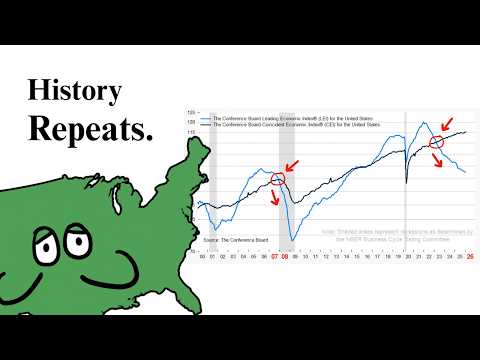
[2:11]And the way the government measures this in the labor market data is misleading. Because if one full-time worker gets laid off and ends up having to take two part-time jobs to stay afloat, the government counts that as two jobs added. Which means net job growth. And even with this accounting magic, 2025 only saw 181,000 net new jobs. Which is why we're seeing 4.4 million Americans working part-time because they can't find full-time work. So while these people are technically employed, they're also financially screwed. Because across the economy, full-time positions are being systematically replaced by multiple part-time roles that don't have the same benefits. Which means income drops, security disappears. But the employment statistics still seem healthy. It's like saying the housing market is fine because people still have roofs over their heads, while ignoring that everyone moved from houses to studio apartments. And when you consider that cumulative inflation has risen over 25% since 2020, things start to look even more scary for the average American. Because for a growing number of individuals, they can't keep up. They're now in a tough spot where they're holding their lifestyle together with a plastic poison. Because Americans aren't just swiping for convenience anymore, they're borrowing to cover the basics. It's a temporary solution that's creating a larger problem, and credit card debt just hit a record 1.28 trillion at the end of 2025. And the average interest rate on those credit cards is now around 22%. So while the media likes to brag about consumer spending remaining strong, it's not spending more because we're earning more. It's spending more because we're borrowing more. And the savings rate tells the same story. Because historically, Americans saved around 8% of their income. But now the personal savings rate has dropped to just 4 and 1/2%. And this is textbook pre-recession behavior. Households having to stretch themselves thin with debt to maintain their lifestyle, while real income stagnates. And it works until it doesn't. And we've seen this movie before, because in 2007, the media cheered about strong consumer spending. Right before it all came crashing down. And just like in 2007, the economy right now feels like it's running on borrowed time. But here's where it gets interesting, because the leading economic index, which is designed specifically to predict recessions, has declined for six consecutive months. Which is the same pattern that we saw before the 2001 and 2008 recessions were officially declared. And the cracks in the economy aren't just in consumer's wallets, they're also spreading straight into the corporate world. Because commercial bankruptcies have risen over 7% to over 24,000 filings, which is the highest level in over a decade. So the companies that survived on cheap financing from the pandemic era are now feeling the squeeze of economic conditions tightening. But maybe this is all just one big coincidence. Maybe each indicator is just crying wolf, but then again, maybe it isn't. Because labor force participation is falling, while the quality of jobs gets worse. Purchasing power is shrinking while credit use accelerates, and savings are vanishing while debt piles up. So this isn't just one metric having a bad month. This is the entire constellation of pre-recession indicators lighting up simultaneously. It's like your car's check engine light, oil pressure warning and brake light all coming on at once. Sure, any one could be a false alarm, but all of them together, something deeper is probably happening. Which brings us to the million-dollar question. Why do the official numbers still look healthy when the economy feels anything but? And it's because the system we use to measure the economy wasn't just created in the 1940s, it's been systematically revised to hide the cracks. Like the unemployment rate data, because the unemployment rate assumes if you work one hour a week, you've got a job. So if you drive on Doordash for an hour, you are tossed in the exact same employed bucket as a salaried software engineer. And then there's the GDP, which counts credit-driven spending the same as income-driven spending. These methodologies don't create an accurate picture of the economy. They create blind spots where bad data can hide. And underneath all of this is something called Goodhart's Law. The idea is simple. The moment a metric becomes a target, it stops being a good metric. So once policy makers, institutions, and markets start optimizing for a specific target number, they stop optimizing for reality. And that's how your lived experience can say one thing while the official number says another. Because we're no longer measuring the economy itself. We're just managing the metrics we use to measure the economy. And over time, this is why the numbers drift further and further away from what people are actually experiencing. Which is why the unemployment rate has become more about lowering the headline number and not improving job quality itself. Or GDP becoming more about maximizing output rather than increasing well-being. Or even inflation focusing on managing the index that measures it rather than reducing your actual cost of living. And none of this is random. It's the downstream effects of Goodhart's Law. So when the metric becomes the target, the system optimizes for the number and not the thing the number was supposed to represent. Because the gap between measurement and reality isn't by accident. It's where recessions hide until they're too obvious to ignore. And that's exactly what we're feeling in today's economy. And so when the NBER eventually makes the recession official, it won't be news. It'll just be confirmation of what anyone paying attention already knew. And once you see this illusion with how we measure the economy, it's hard to unsee. Because when the media celebrates job growth, ask about job quality. When they brag about wage growth, check it against inflation. When consumer spending looks strong, check the credit data, because there's always more to the story than what you're being told. And the deeper you look, the clearer the picture becomes, because the economy people live in and the economy being reported aren't always the same thing. Because the real economy leaves clues, and the constellation of these signals forms a pattern. One where labor markets are deteriorating, credit is expanding, and savings are disappearing. And this same pattern has historically preceded major recessions. So the question now becomes, how long will it take the official data to catch up this time? And if you find these type of videos helpful, subscribe, because it's about time we shed some light on the economy. And if you're spotting these trends in your own life, drop a comment, because sometimes the best economic data comes from the people living in the economy, not from the people measuring it. Because when the dust finally settles and the numbers align with reality, the bigger question is, who's going to be prepared and who's going to be blindsided?


