[0:14]So in this next module, we're going to talk about the discussion section of your manuscript. In the discussion section, in terms of the writing, it really gives you the most freedom of any of the other written sections. So it gives you the most chance to put your good writing on display, all the things that we've been talking about in this course. Of course, since there's so much flexibility, it actually is the most challenging to write. But challenging in a good way because it's really going to get you to really practice your writing skills. So follow all the good rules, the rules for good writing that we've been talking about in this class. And in the discussion section, you're kind of remember we had that cone in the introduction section, you're kind of inverting that cone. So where you left off in the introduction section was with the specific question that you were trying to answer, the specific hypothesis that you were trying to test in your study. So you start the discussion section by saying what happened by answering the that question, by answering that hypothesis. So you ask a question in the introduction section, you answer it right at the beginning of the discussion section. We found that is the most common way to start that discussion section. Then you're going to, you've given what you think your the answer to that question is based on your data, then you're going to support that conclusion with your data and other people's data from the literature. So give all the lines of evidence, say say how your results fit in in the context of the literature. Then you're going to defend your conclusions. So this is the limitations section, the obligatory limitation section of your discussion section. You want to anticipate the criticisms that people might have, the reasons that they might disagree with your conclusions and defend your conclusions. And then at the end, you're going to go broad. So now you're going to do something, you you started with something specific, now you're going into something very general. You want to give the big picture take home message. What are the big implications of your research? This is where you want to give implications, recommendations, give the big picture take home message, give your clear take home message. So in other words, the discussion to tell you what are my results mean and why should anyone care. And that's a very important point. A lot of times people will, you know, spend a lot of time saying what the results mean, but they spend too little time saying why those results are important. That means if somebody that's outside your immediate little niche area in science goes to read your paper, they're not going to know why they should care. You got to make them care. So here's one kind of way of organizing the discussion. Here's kind of the elements that most discussion sections will contain and of course, again, it's a little bit disciplined specific, exactly what goes in that discussion, but these I I'm giving a fairly general kind of picture. So again, you want to start the discussion section with something like, we found that, and then you answer the question that you ended with in the introduction section. What were you your aim was or what your hypothesis was. What did you find relative to that hypothesis? You're going to explain what the data mean at that very high level, give the big picture, uh, what are my results mean? You want to clearly and explicitly state if the findings are novel. You want to point that out for your readers. You may also have some key secondary findings. Oftentimes we, you know, we do a study to to find one thing and we find some other interesting findings in the process, so then you might state those other key secondary findings. So you're going to give your findings and then you're going to put all of that in context. So this means, here's where you can get to some detail that I didn't want you to put into your, into your introduction section. So you can give possible mechanisms or pathways that might explain something that you're seeing in your data. Go down, you know, one level in the biology, for example, if you're looking at people, you might talk about the genes and cells that might be involved. Maybe you didn't measure any of that in your study, but maybe here here are the potential mechanisms that explain what I'm seeing. Compare your results with other people's results. So this is where you're getting to dive into the literature and say what's out there already on this topic. How do you, how do your results fit in? Are are they confirming other results that are in the literature? If they're not confirming, if they're in contrast with other results in the literature, why do you think you're you got different results? Um, so that's right there, you've got the bulk of your discussion. Somewhere as you're getting towards the end of your discussion, you need to have at least one paragraph on strengths and limitations. And inevitably, we actually end up often times spending a lot more time on limitations than we do on strengths, but do try to remember to highlight the strengths of your paper. Uh, you know, you're going to make a sale to your reader that, hey, here's all the good things about my paper. Put that in, too. And uh, and then you're going to give your limitations. In in no matter what discipline you're in, you're going to have to have at least one paragraph on limitations. You want to explain why you think your results are robust despite some potential limitations of your study. All studies have limitations. Um, my main recommendation on the limitations paragraph is the mark of a good paper for me is when I'm looking through the rest of the paper before I get to the discussion section, I'm reading the results, looking at the tables and figures and my a question comes up in my head. I'm like, well, yeah, but see this is the problem with your analysis and I and I think of these things as I'm going along, something I'm going to criticize the author's on. Mark of a good paper for me is when I get down to that limitations paragraph in their discussion section. If they've anticipated my concern, and they directly, at least directly acknowledge it, sometimes just having it acknowledged that they were aware of that is really important to me as a reader and a reviewer. Uh, and even better if they tell me how they addressed that potential problem, that's great too. So that's really the mark of a good paper. A lot of times people write limitations section in a very generic way. Like, oh, well, my study was small and it had, you know, in other words, in a way that could apply to almost any study in that discipline. Don't write a generic limitation section. Really point out what matters, what limitations matter for your specific paper. Try to anticipate the reader's criticisms. You also want to spend a little bit of time saying what's next. Usually, again, that goes going to towards the end of the discussion section. Well, some of these results need to be confirmed in future studies. Um, here are the unanswered questions. Here's the studies I can think of that come out of this study. That's really helpful to readers and other people in your field to figure out what studies need to happen next. So put that in.
[7:30]And then, it's often nice in the discussion section to have one paragraph at the end where you have a very strong conclusion. Some some journals will actually have a separate section for conclusion, but if they don't, just wrap up your discussion section by restating your main findings. The same finding that you opened your discussion section with and give some kind of final take home message for your readers. So some tips on the discussion section. Again, showcase your good writing. Use the active voice. Tell it as much as you can like a story. Start and end with the main finding. So the first sentence of your discussion section should be something like it doesn't have to be exactly this, but it should be something like, we found that and you answer the question that you asked you answer your the hypothesis. What what did you find uh, relative to that hypothesis you were testing. And then you want to wrap up your discussion section again with some kind of conclusion where you restate that main finding. It's okay to repeat it because your reader will want to really, you know, we really have it sink in with the main finding was. Be very, very careful in your in your discussion section that you don't travel too far from your data. Now again, it's okay near the end to give some kind of speculation, big picture implication, how might this help humans. It's okay to step away from your data a little bit at the very end where you're very clear that this is the potential implications. But when I'm talking about is in your main findings, when you're talking about the main findings, your key finding and your possibly your secondary findings, what you see happening a lot. Is uh, people will find one thing in their data and yet when they go to the discussion, they'll tell you what they wanted to find, not what they actually found in their data. This is one of the reasons that I like to go and look at tables and figures first before I read anybody's discussion section so that I can make a judgment about what I think they really found and what their data really support, as opposed to what they're hoping it supports. And there's always a temptation. There's something that we really want to prove and um, there's a temptation to even if your data don't show it, to just act like they showed it. So be very careful about that. One of the major problems that happens in discussion sections is that people will really reach way past their data. Sometimes this means also people will start discussing things that they don't have any data on, and so again, don't travel too far from your data. Stick to what you actually measured in your study.
[10:36]As I mentioned earlier, I talked about this already. You want to focus focus on the limitations that matter, not generic limitations. If you can anticipate what the reader will uh, criticize in your paper, if you can anticipate that and beat them to the punch, you will impress a lot of readers and reviewers. Uh, again, that's the mark of a good paper for me. Finally on the discussion section, make sure your clear and consistent about your take home message.
[11:15]I again, I think this gets to that often times the data, we want the data to show one thing and they don't quite show what we want them to and we still want to tell our readers that the data showed that. We still just believe in that hypothesis. So make sure that what that ends up happening is a little bit of waffling. So make sure that you're clear about your take home message and that you're consistent and you don't kind of say, well, you know, maybe it's this, maybe it's that. You you've got to, you've got to make it clear what you think your data actually say and be consistent about that and don't start wandering again into what you wanted your data to say.
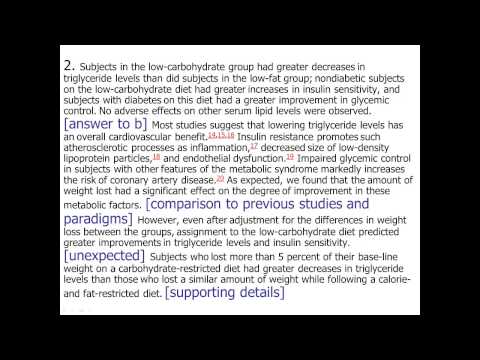
[12:16]So a few things of what not to do in your discussion section. So this was the beginning of a discussion section. It started with, this meta-analysis is subject to a number of limitations. So do not start your discussion section with the limitations, start with the, we found that, the main finding that you found. The limitations bury deeper into the discussion section, that should be several paragraphs down. In terms of verb tense on the discussion section, well, first of all, your verb should be in the active voice for for sure. And then, similar to the methods and results and introduction sections, you're going to use the past tense when you're referring to things that have already been completed. Those are study details, results, analysis because you've already completed the analysis and and other people's work. So we found that, subjects may have experienced, Miller et al. found. But you're going to use the present tense when talking about what the data suggest, because the data are still suggesting that. The greater weight loss suggests, the explanation for this difference is not clear. Potential explanations include.