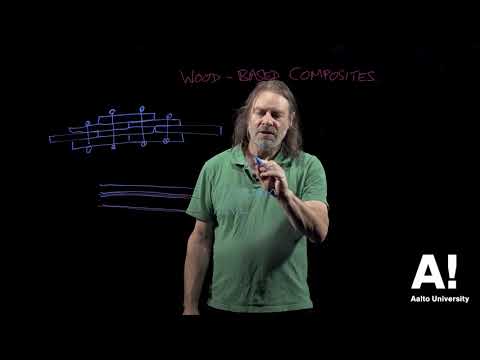
[0:10]composites have a number of advantages over the use of solid wood. If we make a product from wood particles or wood strips or wood pieces which are then glued together in some way. we can end up with very big sheets of material which you clearly can't obtain from trees. You can end up with very long pieces of material, so maybe we want to make long beams. It would be extremely difficult to get solid wood in such lengths, especially these days when most of the the large specimen trees were removed probably more than 100 years ago. Um, but um in order to do that, we have to break the wood down in certain specific ways and then reform it in certain specific ways. In order to do that, we need adhesives in most cases. Um, wood-based composites, or the use of composite materials goes back to historical times, really. Probably further than that. Um, one of the principles is to get pieces of wood and join them together in some sort of a structure like this, maybe. Um so that we can end up with a much longer beam using pieces of wood than would be possible if we just use one single piece. So in this case, we would be bolting these pieces together. So that is a a wood beam that's made out of wood lamellae. Um, it's a very, very old technique, a very good way of spanning large distances using small pieces of wood. And actually if you choose the wood carefully, uh, you'd be able to span that more effectively than you would with a single piece of wood. These days, although we can do these sorts of stress laminated beams where we bolt these sections together, and stress laminated structures exist all over the world. You're more commonly going to encounter structures where we've glued the wood together. And, uh, I'll just show the glue in red and the wood in blue. So we end up forming structures like this. Um, typically bonded structures where we would have long pieces of wood together would be called glulam for glue laminated structure, or laminated veneer lumber, LVL. In which case we use wood veneers and glue those together. Glulam is where we get pieces of wood and glue those together to make, uh, long structures like this. Usually get several wooden beams, join them together. So the grain runs in opposite ways in those. So that would be a three-element glulam beam. And of course, we're going to have various things like knots and weird grain angles and all sorts of stuff. And if we glue things together, we find out that those defects, uh, are in different places. So that a defect in one place is compensated for the fact that in another place, one of the other beams doesn't have a defect. So we end up with a property of having three of these glued together that would actually give improved properties compared with three pieces of wood that weren't glued together. And that's where the word composite comes from, because we actually have joined these pieces of wood together, and they actually have a property that's enhanced over that of those three pieces of wood in isolation. Uh, because of the effect of the glue transferring loads between those different elements. And a much more, um, recent introduction to this family is cross-laminated timber.
[4:21]And that makes very large sheets of material from fairly small pieces of wood. So these cross-laminated, uh, structures are becoming extremely popular now for making tall buildings out of wood. It's been quite a revolution in timber engineering the introduction of cross-laminated timber. So these are composites that are based on using large pieces of wood, but there are also composites that are produced using small pieces of wood.


