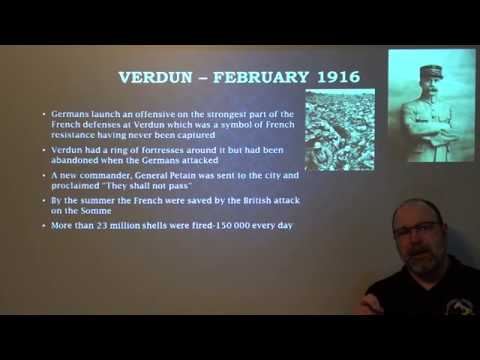
[0:12]Greetings everybody and welcome to part two of a two-part series dealing with World War I in Europe predominantly, although we do touch on other components of the war, certainly the Eastern Front and the Mediterranean. I just wanted to mention quickly also that, um, you know, putting the history of the Great War in two lectures is pretty, uh, cumbersome. And I just want to be clear that the purpose of these lectures is to kind of give you a very broad sweeping narrative of of the linear sequential, um, story of how the war rolled out. You know, something like the Battle of Verdun, uh, you could spend a whole series of lectures looking at Verdun alone, or the Somme, or Passchendaele, or then you could get into the details of the United States and World War I, or Canada and World War I. So, just to be clear that, uh, certainly there's going to be components that are left out. The goal is to introduce you to things that maybe you haven't, uh, studied or looked into before, that might trigger some interest for further study. And, uh, certainly for myself as a high school teacher, um, I'm not getting quite as in depth as others who may be teaching either at the college or university level. Um, so for our purposes, I think, uh, getting that story, getting in touch with, uh, how soldiers lived, how decisions were made, the impact of decisions, uh, all those pieces are what really make this war very, very interesting. Now, by the end of 1915, early 1916, it's fair to say that the realization was pretty clear on all sides. Nobody really knew how this war was going to end, and frankly, nobody really knew how to win it. The trench system had been firmly entrenched in Europe, uh, northern France and all through Belgium had become a labyrinth of of trenches, actually, that extended from the French coast all the way to the Swiss border. And, you know, after the holiday season, if you will, of 1915, I should note, by the way, there were no Christmas truces in 1915, that would have been, uh, you know, soldiers would have been court-martialed and potentially executed. We do know, though, there were unstated truces on Christmas Eve where there'd be no contact with soldiers, but maybe, just maybe, both sides would not be shooting off any artillery. So maybe just for one night, um, soldiers could get a good night's sleep. So, uh, so the Christmas trues of 1914 was really a one shot deal, uh, in in that regard. Now, by early 1916, it's fair to say that also, while both sides had come to terms with the reality of this war, everybody was hoping for a breakthrough. That was the language of of all the leadership of the Great War, we have to find a breakthrough, we have to keep pushing, keep pushing, keep pushing. And by by, uh, February 1916, um, that decision, uh, happens at Verdun, and of course, Verdun is the first major, major high scale battle that sees, uh, grotesque amounts of casualties in this battle. Now, Verdun, of course, is, uh, fortified heavily, and, uh, that is where the Germans had never broken through to Verdun up to this point. So there was a real dogged determination to hold on to Verdun. Up here we have, of course, Marshall Petain, who would be a great hero, uh, during the First World War. And tragically, he would become enemy number one in his association with Vichy during the Second World War. So, uh, really interesting, uh, character for certain. So, the Germans launch an offensive on the strongest part of the French defenses at Verdun, which was a symbol of French resistance, having never been captured. If you get the chance to go to France, I took my family to Verdun two years ago, we also went to Vimy. Uh, it is a remarkable site. The museum is, is excellent, and, uh, what really amazed me about, um, Verdun, just outside of the museum, was looking at the landscape, you can still see the rolling, uh, you know, the location of where all the potholes were and, and, and you can just see evidence of No Man's Land right in front of you. And the cemetery is quite remarkable too. So, uh, pretty tragic. Verdun had a ring of fortresses around it, but had been abandoned when the Germans attacked. So they had to abandon those fortresses to confront the, um, Germans on their flank, if you will. A new commander, here he is here, General Petain was sent to the city and proclaimed, "They shall not pass." And when you make that kind of proclamation, the last thing you want is for them to pass. So, that is a big part of what really made Verdun such a tragedy is that the French were absolutely determined that they were not going to pass. And the Germans were absolutely determined to break through. So, that dynamic creates, uh, and the same thing happens at the Somme as well, uh, where you see really just horrific amounts of casualties as a result. By the summer, the French were saved by the British attack on the Somme. So, what alleviates pressure from this horrific battle at Verdun, is the Battle of the Somme begins, and then many of those German troops have to be sent over to the Somme as well. So, uh, it just saves Verdun. More than 23 million shells were fired, 150,000 every day. 150,000 shells every day for the duration of this war. Uh, you can imagine the impact that has on the mental health of these soldiers. Like I say, coming back to what I said in part one, that sleep deprivation was such a big part of, um, the mental health challenges that soldiers faced. Um, and certainly this is going to contribute to that. Over 300,000 soldiers were killed between February and December 1916, making it the first really horrifying battle of the First World War. So this battle went on for, you know, what is it? Eight, eight or nine months, you know, and a battle of attrition, just constant bombardment, sending boys over the top. So the tragedy of Verdun really can't be overstated. And the remarkable thing is that these kinds of epic battles, uh, continued after Verdun, once the lessons of Verdun were pretty clear that this kind of thing wasn't going to work. Well, and just when you thought Verdun was as bad as it could get, along comes the Somme, which you can see began on July 1st, 1916 and was a combined British and French offensive. Lord Kitchener, the Minister of War, had recruited over 1 million volunteers by 1916 and they were fit and keen to get into battle. Joffre, the French commander and Douglas Haig, the British commander oversaw the Allied effort, and both believed in a war of attrition, this battle was intended to relieve pressure off Verdun.
[8:00]Okay, there you go. You can see the link between the two. attrition. What is a war of attrition? What is a war of attrition? A war of attrition, and I believe I mentioned this in the first part, but it's certainly relevant to to mention again, in in the second part of this series, is the idea that you just have to keep throwing artillery and infantry at the enemy. And eventually, by sheer force of numbers, you will overcome the enemy. Now, one of the things I mentioned last time is the idea that on one level that has a certain degree of logic. The problem with a war of attrition is that when your enemy is fighting under the same principle, uh, you just have two worlds colliding and clashing, and, and, and, uh, nobody's moving, but everybody's dying and a huge amount of resources is being destroyed. You know, Douglas Haig, uh, who's the British commander, he oversaw all British Expeditionary Forces, I believe, on the Western Front. Um, his real problem, and I think many of the generals of the Great War, the real problem was is that they lacked creativity and ingenuity. Uh, because they were generals who were overseeing a war, um, that had never been fought like this before. I mean, you know, nobody really knows what to do. There's no textbook on how to fight trench warfare. There's no, um, there's no historical marker to refer to. You can't go back to Alexander the Great, you can't go back to Napoleon and go, ah-ha, I see what they were doing. I'm going to incorporate Napoleonic tactics, they're irrelevant in a war of attrition. So, for people like Douglas Haig, who really gets, uh, a scathing, um, review in in the in the narrative of the Great War, I would just say that, um, he really, uh, uh, just lacked creativity. And later in the war, when he's introduced to people like, uh, General Sir Arthur Currie, Canada's brilliant commander, um, that's when we begin to see the introduction of things like the creeping barrage, which we'll look at another time. Um, but, uh, uh, so it's, it's very, very difficult to judge these generals, based on a 21st century vantage point because they were fighting a war of survival. They were improvising. Um, I suppose the one criticism we could make of Haig and others is that they kept fighting this war of attrition when there was pretty clear evidence that it was not working. So in that regard, I think it's not unreasonable to be very critical of of this war of attrition. And, and the decision, that is, of these commanders, the Somme was the strongest part of the French defenses and the Germans were well aware the attack was coming. So, they had fortified themselves, they had brought in extra troops, they were ready to go. Um, the first wave went over the top on a bright sunny day in July, but British bombardment before had not destroyed German trenches. On the first day, 20,000 British soldiers were killed and 40,000 wounded. Just pause and think about that for one minute. On one day, 20,000 British soldiers are killed. Now, I've heard upwards of 25,000, um, but I've tried to balance, it's a problem with statistics, is, you know, you, and this is obviously, um, why it is important to always review as many sources as you can, particularly where something like statistics are concerned. Because there can sometimes be a fairly, uh, big difference between between sources, so generally what I do as a, as a philosophy, is I read as many as I can and I find the average. So, we can never know for certain, but we do know that upwards of 20 to 25,000 British troops were killed on the first day. Uh, so, you know, those kinds of casualties are just, uh, uh, have never really been seen before. This was something unique. These horrific casualties continued for the next 20 weeks. And bad weather in November ended it and only minimal gains had been made. The tragedy is, is that you might be able to say, we gained 500 meters. It's a victory. You had to use that in your propaganda campaign to to get continued support from civilians back home. People at home wanted to hear that the war was going well, you know, and if you advance a foot, then you've advanced. You may not publish in the paper that it was only a foot, but you did advance. Um, and what's interesting is that by the time you get into 1916 as well, you know, people aren't volunteering in Great Britain or in Canada or other places. People are like, uh, all these guys are coming home without legs and arms and their faces mutilated and telling horror stories of life in the trenches and we see a dramatic drop, which is why many countries would implement conscription. Uh, as a, which means mandatory service. Uh, it's no longer about who volunteer, it's here's your letter in the mail, you have to register ASAP. So, All right. Well, the French Mutiny of 1917 was probably one of the best kept secrets of the war. And I, what I mean by that is that Germany, I never caught on to the fact that the French troops had mutinied for this period of time. And had the Germans been aware that there was a mutiny, they could have just plowed their way through the French lines and, and, and steamrolled right into Paris, but they didn't, and they didn't find out. So, the French Mutiny of 1917 was the culmination of three years of attrition. The tragedy, the frustration, the anger, the mental pain, the, uh, the, the wounded, you name it. Uh, it was, it was a culmination of all those things where French soldiers had simply had enough. So, in April, French General Nivelle replaced Joffre as overall commander and attacked the Hindenburg line but lost 200,000 men with no breakthrough. Here we go again. Is this a justifiable cause for French troops to be angry? I'll let you decide, but my instincts say, well, I can understand why they would be upset. From April to June, that's what, two months, three months, many French troops refused to obey orders and troops on leave refused to return. Nivelle was sacked and replaced by Marshall Petain, the hero, if you will, of Verdun. Uh, and, um, the hope would be that that would shift things. 55 ring leaders of the mutiny were executed. So from a French perspective, certainly the French commanders understood why French troops were upset. But they still had their orders. They still had to win the war, and they still needed to find people accountable. So 55 were, um, thought or deemed as ring leaders and executed. Petain promised there would be no more attacks in 1917. So, that was his way of appeasing the troops that look, okay, we're just going to hold the line. We're not going to attack, okay, we're just going to hold the line. So, pay would increase, conditions were, were, were bettered, and leave were all improved. So, a lot of the demands that the French troops had were actually met, because I think, as I said, even the leadership realized that this is not unreasonable. Fortunately, the Germans never learned of the mutiny until it was over, but this would mean the British had to lead the way for the rest of the year. What this means is because the French leadership out of a way of appeasing the French soldiers for their frustration by saying, we will not attack, we will just hold our ground. That put all this pressure now on the British and, of course, the Canadians, as well as, and the Americans when they arrive in April of 1917.
[16:55]So, now, you have to consider, too, that outside of Verdun and the Somme, there were, there were battles all over the front. And, um, you know, there was territorial lost here and territory gained here. Um, so I want to sort of just give a brief look at some of the successes. And, uh, because there were military successes, 1917 was a, a, a spotlight year for for, uh, Canada, uh, certainly at the Battle of Vimy Ridge. Now, if you're interested in Canadian history, or military history, please have a look at my two-part series on Canada in the First World War, because I'm going to get into a considerable amount more details about the impact of, uh, Canadian forces on the Western Front, and particularly at the Battle of Vimy Ridge, and which is the first thing I mention. Canadian troops were very successful at Vimy from April 9th to the 12th due to improved tactics perfected by Arthur Currie. Basically, Curry, uh, real estate agent and school teacher from Victoria, British Columbia, who had a history, uh, working in the local militia. Basically, his his idea was simple that war of attrition wasn't working. We needed tactics. We needed every soldier to be in formation. Every soldier should get a map. There needs to be a coordination between your artillery and your infantry, and everything else in between. And just to give you a kind of a basic idea of what, what happened at Vimy. It was an extension of this idea called the creeping barrage. So for example, if you've got two trenches and in the middle you've got No Man's Land, what you would do is you would send your habitual artillery over to the enemy trench. And you recognize that when those, when that artillery hits the trench, there is a puff of smoke and confusion, where for X amount of time, just for the sake of reference, let's call it 30 seconds. You've got 30 seconds where the enemy is completely immobilized because they're coughing, they're waving away smoke, they're still on the ground covering. At that point, a line of young Canadians gets up out of the trench, moves 25 feet forward, another, you know, arbitrary number, and they go down on the, they lie on their bellies. When the smoke clears and the Germans look over the wall through their binoculars, um, they don't see anything. And then a second round comes to the German trench from the Canadians. Poof, puff of smoke. Those troops that are on the ground get up and move forward another 25 feet, and a new line comes out. So there's a coordination between your artillery and your infantry. Ideally what you want by the fourth volley, when the smoke clears on the German trench, there the Canadians are standing on top of the German trench, looking down on the, on the Germans. So, that's kind of a crude basic idea, but, but you have so many other variables, but that's basically what Arthur Currie did was he said, we need to implement tactics. And Vimy Ridge, by the way, I believe was one of the most rehearsed battles in military history. So it's a pretty remarkable, uh, set piece battle. In June at the German held Messines Ridge, 1 million pounds of high explosives blew up under the feet of the Germans. For a year, miners had dug 22 tunnels under the ridge. 10,000 Germans were killed instantly, buried alive, or thrown like rag dolls. One year of digging. I mean, this is desperate, right? I mean, whatever it takes, if you've got to dig a, dig a tunnel underneath the enemy trench, and it takes a full year, well then you've just knocked 10,000 men out of the war. And probably beyond the 10,000 killed, there'll be, you know, 100,000 wounded. So, British, Australian, and NZ troops charged and took the ridge by midday. And at Cambrai, part of the Hindenburg line, on November 30th, 378 tanks supported by 289 aircraft smashed through German lines.
[21:16]While initially successful, many tanks broke down or ran out of fuel, and there was too few British infantry to take on the Germans. There were shortfalls after Passchendaele, and Passchendaele, we'll talk about next, another tragedy, another war of attrition in many ways. So, there we are, uh, the Battle of Mud. Uh, and British Forces and Canadian Forces again, like Vimy, uh, were a big part of, um, of the Battle of Passchendaele. Interestingly enough, when Douglas Haig, the Supreme Allied Commander, of British Expeditionary Forces, apologies, I'm not clear on his exact title anymore, but, um, when he told Arthur Currie, uh, Canada's General that, um, he wanted to take Passchendaele, uh, right away, uh, Currie said, that's not good.
[22:15]It's a mud pit, there's nothing to gain. You're going to have grotesque casualties, but Haig moved ahead, and as it was, it became another war of attrition. And, uh, and what's interesting, and this is after we had seen the success of, of battles like Vimy. Maybe every battle should be fought that way until the enemy figures out what we're doing. So, Douglas Haig launched this offensive to take pressure off the French, but also to break through at Ypres and March north to capture the Belgian ports of Zeebrugge and Ostende, which were important bases for German U-boats that were sinking a great number of British ships in 1917. You have to destabilize the, um, the U-boats from being able to, uh, implement policies that are preventing shipping from getting to the troops. And that's what was happening. So that's why this was so important. And apologies for the pronunciation. Um, I'm always learning, and, uh, pronunciation, uh, in either French or or German or other languages is always a bit of a challenge. So here you can see some pretty, uh, grotesque, uh, sites. You know, in fact, um, I should note that basically what made Passchendaele such a horrible place, was that summer of 1917, the British had pounded it with shells. What happens is that you have created conditions where all these bombs that have exploded, you've got all these big holes in the earth, potholes, if you will, and and millions of tons of loose soil. So when it rains, that loose soil becomes a thick, sticky, almost quicksand kind of a mud. This is more than just, you know, mud up to your ankles. This is mud that is 20, 30 feet deep, and troops when they're walking around in these conditions, have to be very careful because if you take a wrong step, you could sink into this mud. And there were many, many stories of soldiers who were misstepped and sank, and they're sinking down and a comrade would pass him the end of his rifle to pull him out and and then that soldier would fall forward and his feet would be coming out of the mud, and they're both sinking. And I mean, it's just horrific. You know, horse and carts were going missing. And, you know, all of a sudden you'd realize, oh my gosh, where the horse go? Um, well it sank in the mud. So they would have to build these, you can't really see it very well in this picture, but the sort of side, these, these, um, walkways made out of wood. And you wanted to be darn sure that you stayed on the path, because if you take one wrong step into here for example, looks like an innocent little puddle, but that could be 20, 30 feet deep of just loose sticky mud. So, it was a pretty horrible place to fight a war. First attack was July 31st and British and Empire troops lost 30,000 in the first week and 67,000 by the end of August. By October, the fighting had reached the ruined village of Passchendaele, about 11 kilometers from where the battle started. And on November 6th, the Canadians captured Passchendaele, but the battle failed to make the desired breakthrough. So it was a military victory, uh, if you will, for the Canadians, uh, but nothing was gained. As I said, they didn't reach the end goal of taking these ports, uh, the Belgian ports on the coast, um, but because they moved forward, it was deemed a victory. But, uh, what what to, to what gain? You know, not very much. So, pretty tragic. Um, failure was largely due to the weather where flat and soggy land was reduced to a sea of mud and craters, making it impossible to move horses, tanks, guns, or supplies. That's what it says here, moves horses, tanks, guns and supplies. Pictures getting in the way here. All right, Battle of Cambrai. Cambrai was part of the Hindenburg line, and the Germans never expected an attack on such a fortified line. I guess the Germans thought, well, we got this pretty well defended, you know, there's no way they're going to attack us here. I mean, Vimy was the same thing, the Canadians had to go uphill in order to confront the Germans. On the 20th of November, 378 tanks and 289 airplanes smashed through the trench punching a hole 10 km wide and 6 km deep. The initial attack was successful because the ground was firm and the Germans did not see it coming. So this was no Passion Dale, that's for sure. However, the tanks soon ran out of gas or broke down, and the German infantry simply walked around them. A lack of British infantry was a problem as there were shortfalls after Passchendaele. The last thing you want to do is make a significant push forward and assume that, well, we've got all the tanks, they're going to scare the heck out of the enemy. But what happens when the tanks run out, you don't have enough infantry. That's what happens at Cambrai. Despite this, tanks, when properly used, could be a war winning weapon. And you can see, you know, some of them could even roll right over a trench, but if the trench was too wide, then the top what would happen is a tank would go up and then boom. This one overshot itself. So, you know, the tanks looked fearsome and they clunked away through No Man's Land, they they spat out and shoot out everything in its way, including the barbed wire. But they were slow, they were not very mechanically sound. They broke down, they ran out of gas, and they sure as heck were easy targets for artillery as well. So, All right. So by the end of 1917, there was a stalemate on the Western Front, but two main changes would occur, which would impact the outcome of the war. Number one, the Bolshevik Revolution of October 1917 saw Lenin come to power, and he would announce peace with Germany, resulting in the March 1918 Treaty of Brest-Litovsk. We're going to come back and look at the Russian Revolution a couple lectures down the line, um, because of course, that topic needs certainly its own lecture, if not a a couple. Uh, but when the Russians pull out of that war, um, that put a tremendous amount of pressure on the Western Front. Because basically what that meant was all those German troops that were fighting the Russians on the Eastern Front, which is turn around and go back to the and double up on the Western Front. So there was a lot of anger and resentment from the Allies that their allies, their ally in Russia, um, pulled out of the war. But the Bolsheviks, they had their own vision, right? They had their communist dream of building this new state, so, um, Lennon realized that he couldn't fight a war and win a revolution at the same time. So, on April 6th, 1917, the USA would join the war for several reasons, number one, the declaration of unrestricted submarine warfare by Germany, and the final straw was the revelations of the Zimmerman Telegram. Woodrow Wilson was the American president at the time, and he had to contend with a very, very strong tendency towards isolationism, which means a desire of American people not to get tangled up in foreign affairs, foreign wars, for that matter. Um, so I think just that the Germans have the audacity to make this kind of, uh, proposal to Mexico was enough to get Americans behind a declaration of war.
[31:04]So, the USA's vast resources and manpower would be a major lift for the exhausted Allies on the front.
[31:16]Okay. Well, as we get into 1918, so many lives had been lost. So many battles had been won and lost. Countries were economically collapsing. Germany was starving, by the way, because the Allies had a very effective blockade on Germany during the war, and it really began to have, see its impact where you see people actually starving to death in Germany, living off roots and turnips. I think in the winter of 17, 18 was referred to as the Turnip Winter, where that was the only thing people had to eat. So, uh, but the Ludendorff Gamble of 1918 intended to make a quick victory before the Americans arrived in strength. The U-boat campaign by the Germans to starve Britain did not work because of the convoy system, and it would be a deciding factor in the entry of the USA in the war. The British naval blockade off the German coast was working, and Sweden, Denmark, and the USA would follow, leading to massive shortages of food and supplies by 1918.
[32:32]Germany's allies, Turkey and Austria were talking surrender by 1918. They were also starving and struggling. The Russian withdrawal from the war allowed Germany to move all troops to the Western Front, and for a time they outnumbered the Allies. And since Germany was attacking, they had appalling casualties, 400,000 by July 1916. You know, I mean nothing was working, right? With no breakthrough and exhausted troops, the effective blockade and the arrival of the Americans, German victory appeared impossible. The German military command, Paul von Hindenburg here, Eric Ludendorff here, who, of course, would figure quite centrally, um, throughout the twenties and also during the rise of the Nazis period, as well. Um, they recognized that while the war might not be lost, the war cannot be won. Now these are very powerful, vain, confident, patriotic, nationalistic, generals who are built around the old school Prussian military notions of honor.
[33:55]So for these two guys, the thought of of actually losing this war or, or seeking an armistice was a pretty unfathomable idea. But that was something that they were both going to have to confront. Uh, certainly we'll we get to the drive to November 11th. In August, the allies hit back and at Amiens in thick fog, 456 tanks caught 30,000 Germans and 400 field guns. By the end of summer, 400,000 Germans were captured and the remaining troops were in retreat. By October, the Belgian coast had been liberated, and in a single day, the Allies advanced 13 kilometers from Ypres. That was highly unusual. So, the Allies were on the march, the Germans were in retreat. However, the Germans still held a significant portion of of Belgium, and also Northern France, despite these significant losses. Germany at home, though, was in a state of chaos and revolution by late October, early November, which led to the collapse of the war effort and the abdication of the Kaiser himself. Um, the Kaiser, you know, I mean he really had been shuffled to the side. He was not a military man. Ludendorff and Hindenburg were running this war. Um, basically what ends up happening, I'll try to boil this down because it's quite a, quite a remarkable story.
[35:59]Germany had political parties for decades, and, uh, you know, you had the Social Democratic Party, you had the Catholic Center Party, the Liberal Party, the Nationalist Party. Varying parties on the left and right, and they all could elect people who would represent them in the Germany, Germany's parliament, in the Reichstag. Uh, German parties didn't have any power, though.
[36:25]They could, they could get together and debate and discuss things in in Germany's parliament, but at the end of the day, the Kaiser could veto anything, much like the Tsar in Russia before the revolution, where he had a Duma, a governing body, where parties existed, but the political parties really couldn't, uh, sway, um, leadership. Unless they implemented, uh, proposals that the King, in this case, the Kaiser agreed with. But basically what happens is the Kaiser says, I will not sign any armistice. I would rather quit, which he does on the 9th of November. And Ludendorff and Hindenburg go to Germany's Parliament. Now there had been kind of a transition beginning where the civilian government, if you will, these political parties began to have a little bit more tug and sway by the summer of 1918. You really get the sense like the leadership in Germany knew that there was going to be an inevitable transition towards, uh, you know, maybe a constitutional monarch or even a republic. I mean, who knows, but, but that, that shift was coming.
[37:39]So what happens is on November 9th, um, they go to Germany's Parliament, and the largest political party in Germany at the time was the Social Democratic Party. They were akin to, uh, sort of a, I guess, Canada's New Democratic Party, or sort of more liberal Democrats in the United States. I guess, um, Social Democrats, is what they were. But basically, they, they're told, okay, guys, you guys have been whining about democracy for years. You're the largest party in Germany's Parliament, so here you go. It's all yours. And they're like, what? You need us? Yeah, you guys, there you go. It's all yours. Oh, and by the way, uh, the Kaiser's abdicated, and you're signing an armistice on the 11th.
[38:32]So, the new civilian government, which was now led by the Social Democratic Party in Germany, was basically set up in many ways to take the fall because Hindenburg wasn't going to sign an armistice, and nor was Wilhelm or Ludendorff. So, on November 9th, the new German government requested an armistice, which, as I said, had already been kind of put into place by those people that were leading, right? So they're not going to take responsibility for it, and on the 11th, the Germans agreed to Allied terms, and at 11:00 AM, the war was over. The last shot is fired at 11:00 AM on the 11th month on the 11th day, 11-11-11. Um, at this time, Germany thought they had signed an armistice. An armistice is an agreement to stop fighting. And I don't think that the Germans, certainly the new governing party, the Social Democratic government, who for the most part were decent people who were inclined towards democracy, who were well-meaning and everything in between. They didn't have an idea of what was coming their way, uh, the following June in 1919, when they would sign the fateful Treaty of Versailles. So, but for November 11th, I think both sides were happy that the war was over. Um, but out of the ashes of November 11th, we see the rise of the Nazis, and I think it's really important I just set you up for this before we, we finish here. When the German troops were told on the 11th, or the 10th for that matter, hey, guys, pack up your things, the war's over tomorrow at 11:00. German soldiers are like, what do you mean the war's over? We haven't won it yet. Oh, no, we're signing an armistice, it's done, you can go home. And they say, what? How on Earth could the Kaiser do this to us? Oh, no, it's not the Kaiser, we've got a new government. Remember those social Democrats, what's given the Kaiser grief before the war? Yeah, they're now in charge. They're the ones signing the armistice. So, when those German troops begin to walk home, and when they begin to go to their towns and villages, and see their wives and children starving, and the hardships that they faced, which really had to do with the war, of course, not to do with the new government. There begins this sort of notion that Germany was betrayed by Democrats at home. They were stabbed in the back. So, the myth of the stab in the back is born out of this anger and frustration at the hands of many Germans who felt that they didn't lose the war, and that they could have won it, and that the armistice was signed at the most inopportune time. But now they had someone to blame. So, when we come back and look at the Weimar Republic, that is Germany between 1919 and 1933, that young republic has to deal with all the tensions that begin to crop up, that stem from how the war ended. And I would argue that the Kaiser, Ludendorff, Hindenburg, they knew darn well that, um, they were leaving a mess behind them, but they had now passed the buck on to the Social Democrats, who were left to kind of clean up the mess. So, so the war is over, but Germany's troubles are just beginning. All right, ladies and gentlemen, well thank you again for coming to my lecture series. This ends our two-part, uh, narrative on, um, historical narrative on the Great War. Uh, please do come back where, uh, next time we should be, my plan is to do a lecture on the Paris Peace conferences. And of course, within that is the Treaty of Versailles, uh, which, of course, really gives the emergent Nazis the perfect scapegoat for everything that's wrong, uh, with Germany and, and the Peace Treaty itself. So, anyway, thank you very much, as always, for enjoying my YouTube lectures and once again, don't hesitate to contact me through my YouTube site, or leave a comment. Thank you very much.