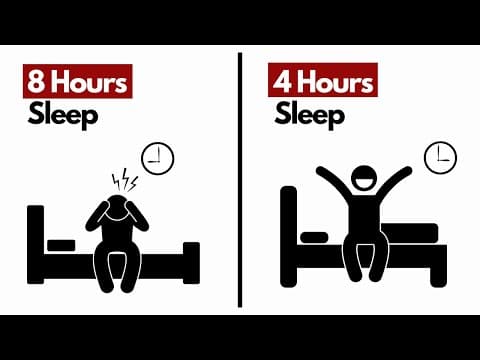
[0:00]You ever see someone say, I only sleep five hours and feel great, while you sleep eight and still wake up tired? Let's talk about why, backed by psychology and real sleep science. One, your brain cares about sleep quality, not just quantity. According to sleep psychology, your brain doesn't count hours, it tracks sleep cycles. Each cycle lasts about 90 minutes and has several stages, but the two that matter most are: Deep sleep, where your body repairs muscles, strengthens the immune system, and releases growth hormones. REM sleep, or rapid eye movement sleep, where your brain processes emotions, stores memories, and boosts creativity. When these stages are balanced, your body feels fully restored, even in 5 to 6 hours. But if your sleep is broken by blue light, caffeine, or stress, your brain never reaches deep or REM sleep properly, and that's why you wake up feeling heavy and unfocused. Psychologists call this fragmented sleep, your body rests, but your mind doesn't recover. Two, sleep and wake at the same time every day. In psychology, this is tied to your circadian rhythm, your internal body clock. When you sleep and wake at random times, your brain gets confused about when to release melatonin, the hormone that controls sleepiness. But when you keep a consistent routine, say, sleep at 11 p.m., wake at 6 a.m. Your brain learns the pattern. It starts releasing melatonin naturally, helping you fall asleep faster and wake up fresher. It's like training your mind to trust your schedule. Three, follow the 90-minute rule. Sleep research shows that waking up in the middle of a cycle increases sleep inertia, that groggy, slow feeling in the morning. But waking up at the end of a 90-minute cycle helps your brain shift smoothly from sleep to alertness. So plan your rest in blocks of 4.5, 6, or 7.5 hours instead of random hours. You'll notice the difference immediately. It's biology working with you, not against you. Four, the 3-2-1 power down rule. Your brain needs a signal to slow down before sleep. Psychologists call it cognitive offloading, telling your nervous system, it's safe to rest. Try this: 3 hours before bed: no heavy food, digestion keeps your body active. 2 hours before: stop working or solving problems. 1 hour before: no screens. Blue light blocks melatonin and keeps your brain in alert mode. Instead, stretch, journal, or listen to calm music. These habits shift your brain waves from beta (active) to alpha (relaxed), the state where sleep starts naturally. Five, use morning sunlight to reset your brain. The first 10 minutes after waking decide your alertness for the rest of the day. Psychologists link morning sunlight to serotonin activation, the chemical that boosts your mood and focus. Step outside right after waking, no phone. That light exposure resets your circadian rhythm and helps you feel awake without caffeine. Bonus: movement and cold water. Quick movement or cold water activates your sympathetic nervous system, releasing dopamine and norepinephrine, natural energy boosters. Within minutes, your brain clears up, and that morning fog disappears. The mindset shift. Psychologically, people who view sleep as a lazy habit often struggle with burnout and emotional instability. Sleep isn't a weakness, it's your brain's recovery mode. It restores focus, regulates mood, and sharpens decision-making. So don't just sleep more, sleep smarter. When your brain is rested, your mind becomes unstoppable. If this helped, hit like and subscribe.
How to Sleep LESS hours and wake up FRESH (psychology explains)
KnowSense
4m 6s573 words~3 min read
Auto-Generated
Watch on YouTube
Share
MORE TRANSCRIPTS