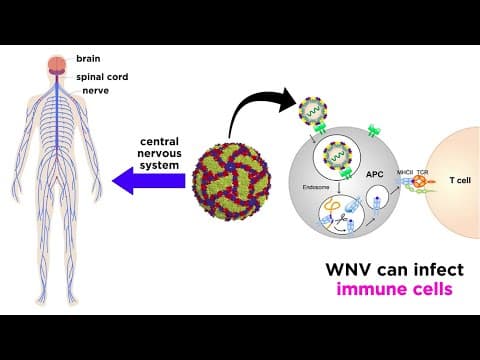
[0:00]He knows a lot about the science, Professor Dave explains. Compared to some of the other pathogens we've covered, West Nile is a relatively newer disease. It was first discovered in the West Nile District of Uganda in 1937, and then a few outbreaks popped up in other areas of Africa and the Middle East. We've seen relatively minor outbreaks here and there since, with one major outbreak in Israel in the 1950s and another in Romania in the mid-1990s. It wasn't until 1999 that West Nile Virus or WNV was introduced to North America. So let's take a step back and put things in context virus-wise. There are over 500 arthropod born viruses, which are called arboviruses. That's just a general term for viruses that are spread to humans by the bite of an infected mosquito or tick. Arboviruses can be divided into six families, including Togaviridae, Bunyaviridae, Rhabdoviridae, Reoviridae, Orthomyxoviridae, and Flaviviridae. In particular, West Nile Virus is part of the Flaviviridae family. A few of the viruses in this family, like dengue virus, have spread all over the world, but many of the arboviruses have surprisingly distinct geographic ranges. The simplest explanation for that is that there are several overlapping factors that determine when, where, and how an arbovirus spreads. It often comes down to the life cycle of the specific reservoirs, hosts or vectors and their unique ecological habitats. Altogether, these factors put limitations on how far and wide a virus is able to spread. That's why the discovery of West Nile Virus in the United States was very surprising. When the virus appeared in Romania in the mid-1990s, experts could explain the jump by examining bird migration between Africa and Europe. Birds are the natural reservoir for West Nile after all, and the virus is maintained by a mosquito-bird-mosquito transmission cycle. It was completely unexpected for the virus to jump across the Atlantic Ocean and show up in New York City of all places. A cluster of cases popped up in Queens in the summer of 1999, causing severe meningoencephalitis, or inflammation of the brain. From there, the virus spread to 10 other states, infecting humans, birds, and a surprisingly large number of horses. The largest outbreak of West Nile ever recorded happened in 2002, when the virus spread all the way across the United States and into Canada. Even though scientists have done significant investigations and analyses to figure out exactly how the virus spread to the US, we still don't know for sure how it happened. Now back to the virus itself. As we mentioned, West Nile Virus is part of the Flaviviridae family. Flaviviruses in general have a positive strand RNA genome and an envelope, but no visible capsid structure. They attach to specific receptors on lots of different types of cells in lots of different species, though each individual virus tends to have a specific tissue tropism. That just means they only attack cells in a specific type of tissue, which can cause a little bit of variation in the way the disease presents. Similarly to Rhabdoviruses, Flaviviruses enter the cell by endocytosis. Then the viral envelope fuses with the endosome membrane, and the capsid and genome are set free into the cytoplasm of the cell. After replicating, Flaviviruses aren't pushed out at the cell surface via budding, the way that Rhabdoviruses are. Instead, they acquire their envelope by budding into intracellular vesicles. From there, the virus is released by exocytosis or cell lysis. When a person acquires the virus from a mosquito bite, the virus first replicates at that site of inoculation and then it spreads to the lymph nodes and bloodstream. The thing about Flaviviruses is that they have the ability to attack crucial immune cells like macrophages and monocytes. Because of this, when West Nile Virus makes it to the central nervous system, it can trigger a domino effect of immune responses that ultimately makes the blood-brain barrier more permeable. It can then directly infect neurons in the brain which can lead to paralysis or tissue damage. It turns out that about 80% of human infections of West Nile Virus are completely asymptomatic. For those that show symptoms, a good portion of them get West Nile fever, which is characterized by acute onset of headache, fever, fatigue, muscle pain, weakness, and malaise, along with gastrointestinal symptoms and sometimes a rash. Less than 1% of people infected with West Nile Virus develop neuroinvasive disease, which can show up as serious meningitis, encephalitis, or paralysis. The risk for encephalitis is higher for those who are older or have received an organ transplant. When it comes to arboviruses, disease is more likely to occur during the summer months and rainy seasons, which is when mosquitoes breed and cycle among bird populations. Humans are considered dead-end hosts because we can't spread the virus to another vector, mainly because these viruses don't maintain a persistent viremia. A general rule of thumb is that if the virus is not in the blood, a mosquito cannot acquire it. There are a variety of serologic methods that can be used to diagnose West Nile virus infections, though no treatments exist other than supportive care. Even though we have vaccines available to prevent West Nile virus infection in horses, we don't yet have a West Nile virus vaccine licensed for use in humans. At the moment, the best defense we have against arboviruses is eliminating their vectors and breeding grounds. Thanks for watching, guys. Subscribe to my channel for more tutorials. Support me on Patreon so I can keep making content. And as always, feel free to email me, ProfessorDaveExplains@gmail.com.
West Nile Virus (Genus Flavivirus)
Professor Dave Explains
6m 29s943 words~5 min read
YouTube auto captions
Transcript source
YouTube auto captions
This transcript was extracted from YouTube's auto-generated caption track. The transcript below is server-rendered so it can be read, searched, cited, and shared without opening the original YouTube player.
Pull quotes
[0:00]Compared to some of the other pathogens we've covered, West Nile is a relatively newer disease.
[0:00]It was first discovered in the West Nile District of Uganda in 1937, and then a few outbreaks popped up in other areas of Africa and the Middle East.
[0:00]We've seen relatively minor outbreaks here and there since, with one major outbreak in Israel in the 1950s and another in Romania in the mid-1990s.
[0:00]It wasn't until 1999 that West Nile Virus or WNV was introduced to North America.
Use this transcript
Related transcript hubs
Watch on YouTube
Share
MORE TRANSCRIPTS


