[0:11]Before we begin, let us all stand for a short prayer. Are you ready to pray? Let us pray in the name of the Father, of the Son and of the Holy Spirit. Amen. Dear Lord, we offer this day all we do, think and say. Give light to our mind to learn lessons of all kind. Help us to be obedient, true, full and loving to all. Amen. In the name of the Father, of the Son and of the Holy Spirit. Amen. Good morning, children. Okay, before we continue, let us sing first. Oh, it's English time after all. Are you ready? Okay, ready, sing. Oh, it's English time after all. Oh, it's English time after all. Oh, it's English time after all. Oh, it's English time after all. Oh, it's English time after all. Very good. You can now sit down. Is there any absent today? Okay, none. Since nobody is absent today, let us give ourselves five clubs. 1, 2, 3, 4, 5. Now, before we continue, let us recall our guidelines when we have our lessons in our classroom. Number one is be prepared and do our activities. Number two is be positive, be happy. Number three is be productive. Number four is be respectful of your classmates and teacher. And number five is be participative. Do you understand? Okay, very good. Now, let us recall our lesson last time. I have here several sentences and let us read all of them. I want you to identify whether the following sentences state a command or a request. Are you ready? Okay, kindly read the first sentence. Go. Does it state a command or a request? Very good. It is a request. Second sentence, please read. Is it a command or a request? Very good. Command. Third sentence. Excellent. It is a command. Fourth sentence. Very good. It is a request. Fifth sentence.
[3:04]It is a command. Excellent. Last meeting, we learned when to use the simple past tense and the past perfect tense for our verbs. Now, who can tell me the difference between the two tenses? Kresha Pay. The simple past tense.
[3:26]Great. What about the past perfect tense?
[3:31]Excellent. Now, I have here another set of sentences. I want you to read all of them. And I want you to identify whether each verb uses the simple past tense or the past perfect tense. Are you ready? Okay. First sentence. I can't believe she ate my sandwich. Does the verb use the simple past or the past perfect tense? Yes, the verb uses the simple past tense. Second sentence. He had done his homework, so he was allowed to eat with us. Simple past tense or past perfect tense? Yes, the verb uses the past perfect tense. Third sentence. She watched television throughout the afternoon.
[4:26]The verb uses the simple past tense. Fourth sentence. I hadn't thought of going to Italy before she suggested it.
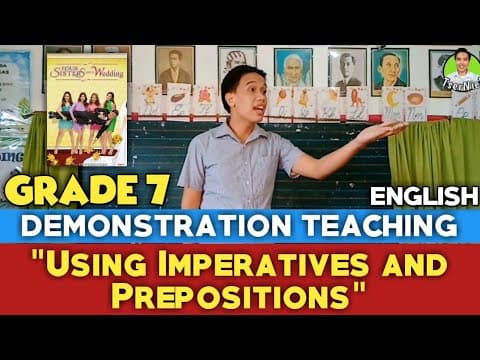
[4:38]Past perfect tense. Fifth sentence. My dog ripped my dress. I was so upset. I had bought it this morning. Simple past tense or past perfect tense? Very good. The verb uses the past perfect tense. Now, let us take a look at this movie poster. Has anyone watched this movie? Great. What is the title of this movie? It is four sisters and a wedding. Exactly. Now, this movie tells us a story about five siblings and how do they deal with family matters. But before we proceed, please face your sitmate and do a high five. Ready? Go! High five. Very good. Now, this is an anticipated guide. Let us check if you know something about the movie Four Sisters and a Wedding.
[5:39]Now, I will give each pair one copy of this anticipated guide and I want you to answer the left portion of it. You have one minute to do that.
[5:50]Are you done with the anticipated guide? Okay, please pass it forward. Students, what happened when Theodora told the truth to her family? Krisani.
[6:06]Very good. Are there other answers? Cheska.
[6:13]Excellent. Now, is the mother mad at Theodora? No. Why is that so? Why is the mother not mad at Theodora, Daniel?
[6:28]Precisely. The mother is not mad at Theodora because she loves Theodora. She loves her. Now, this movie gives us a perfect example of how a family solves a problem. Theodora told everything about her as an OFW. She's afraid to reveal it to her family because she might thought that everyone will see her as a failure. But did the family see her that way? Did the family see her as a failure? No. Now, telling the truth about being an OFW in Spain made Theodora freed from what she's afraid of. Now, let us remember that it is important to seek your family's help in solving your problems and improving yourselves. Do you understand? Very good. Now, let us read a few sentences from the video clip. Read the first sentence. Second sentence.
[7:27]Third sentence.
[7:31]Okay. What type of sentences are these? They are imperative sentences. Very good. Now, what does an imperative sentence express? They express either a command or a request. Now, let us take a look at the first sentence. Teddy, say the truth. It's about time. Now, this sentence is an imperative sentence and as you have mentioned earlier, it expresses either a command or a request. Now, let us take a look at the sentence. What part of this sentence or what word in this sentence express the command or request? Jasper. Very good. It is the word say. Now, what part of speech does the word say belong to? Is it a noun? Is it an adjective? Is it a conjunction? What what part of speech does the word say belong to? Jen Carlo. Indeed, the word say is a verb. Now, let us take a look at the second sentence. Please tell me, Roberta. What word in this sentence was used to express the command or a request? Jene. The word tell. Now, what part of speech does the word tell belong to? J M.
[9:16]Very good. The word tell is a verb. Now, for the third sentence, what word in the sentence express the command or request? Blair May. It is the word let. Now, what part of speech does the word let belong to? Alyssa.
[9:42]Very good. The word let is a verb. Now, after we examine the following sentences, what part of speech expressed the command or request? Yes, Johan.
[9:59]Very good. The verbs express the command or request. In every imperative sentences, there is a verb that speaks either a command or a request. They are called imperatives. We use imperatives to tell someone what to do. Now, let us take a look at this picture. Using this picture, who can make an imperative sentence out of it? Yes, Natalie.
[10:31]Very good. Pick the trash. What is the imperative in this sentence?
[10:39]The word pick. Now, why did we choose pick instead of other words? Yes, Donaline. We choose pick because we have to pick up the trash in the picture, correct? Although this sentence is correct, it lacks something. Let us remove the picture.
[11:04]Using this sentence, do we still know where to pick up the trash? No. Why is that? Al Ray.
[11:17]Correct. We don't know where to pick up the trash since we don't know its location. Now, remember, in writing imperative sentences, we have to be very specific. We have to use the correct preposition in order to tell the location where to perform the command or the request. Now, how can we improve this sentence? Remember, we have to use the preposition to tell its location. Yes, Danielle. Pick the trash where? Very good. Pick the trash beside the tree. What is the imperative? Pick. Now, what is the preposition used? The word beside. Exactly. Now, let us examine another picture. Using this picture, who can make an imperative sentence out of it if you want somebody to buy milk? Yes, Natalie.
[12:23]Correct. Please buy milk beside our house. Now, what is the imperative used in the sentence? The word beside. Was it used correctly?
[12:45]Correct. Very good. Now, instead of the word beside, what prepositions can we also use for this sentence? We can also use by, next to, or near, since their functions are also the same with the preposition beside. Excellent. Let us have a group activity. I will group you into two. This will be group one, and this will be group two. Now, two members from each group will have to perform a short skit that is using an imperative sentence that includes the imperative and the preposition. You have to perform a short skit about an experience from your family that made you learn a lesson. I will give you a scenario to help you make your own skins. Now, the remaining members from each group will have to identify the imperative sentence used, the imperative and the preposition. Do you understand? Now, everybody will receive two kinds of face cards. This is the happy card and this is the sad card. As soon as the group explains their answers, please raise the happy card if they gave me the correct answer. Raise the sad card if not. Is that clear? Okay, before we proceed, let us recall our guidelines in conducting a group activity. What are those reminders? Yes.
[14:18]Respect your groupmates. What else? Read the direction. What is the last one? Hydishine. Work silently. Now, I will give you three minutes to finish this activity. Are all groups finished? Very good. You can now take your seats. Let us begin with group one. For group one, their situation is telling a personal problem. You found out that your son failed a test in math. What will you say to know the reason behind it? Now, they can choose from the following imperative word imperatives and prepositions. Now, group one, perform the skit.
[15:02]Very good. Now, let us clap for group one. Group one. What is the imperative sentence used? Say something from this test. Very good. Now, what is the imperative used in the sentence? Say. What is the preposition used? From. Okay, group two. What card will we raise? The happy card or the sad card? The happy card. Group one gave the correct answer. Let us give five class to group one. 1, 2, 3, 4, 5. Very good. Let us proceed with group two. Now, for group two, their situation is getting help in decision making. Your daughter needs an advice about choosing what course to pick in college. They have to choose a word as an imperative and for their preposition. Group two, please perform the skit.
[16:07]Well done, group two. Now, what is the imperative sentence used? Follow the course you want inside your heart. Exactly. What is the imperative used? Follow. And what is the preposition? Inside. Now, group one, what kind of card will we give to group two? Happy card or sad card? The happy card because group two also gave the correct answer. Let us give group two five class. 1, 2, 3, 4, 5. Now, let us recall our lesson today. What should we remember in writing our imperative sentences? Kresha Pay.
[16:56]We have to use a verb that states either a command or a request. What what is the term for that?
[17:08]They are called imperatives. What is the other reminder? Yes, Natalie.
[17:17]We have to use the correct preposition in order to tell the location where to perform the command or the request. Well done. Now, I will give you an activity sheet.
[17:33]You have to write your name at the top of the paper, and you have to write an imperative sentence for each picture, but the imperative sentence will include an imperative and a preposition. Do you understand? Okay, you have 10 minutes to finish this activity.
[17:56]You may now start the activity.
[18:02]Is everybody finished? Okay, please collect the papers and give it to me. Now, let us make an imperative sentence for the following pictures. Number one. What imperative sentence can we use for this picture? Please put the burger on the plate. Very good. Now, what is the imperative used? Put. What is the preposition? On. Exactly. The second picture. What imperative sentence can we use? Wash the dishes in the sink. Very good. What is the imperative? Wash. What is the preposition? In. Third picture. What imperative sentence can we use? Kick the ball in the field. What is the imperative used? What is the preposition? Very good. Fourth picture. What imperative sentence can we use? Read a book on the sofa. What is the imperative? Read. What is the preposition? On. Fifth picture. This is the last picture. What imperative sentence can we use? Walk me to school. What is the imperative? Walk. What is the preposition? Two. Let us give ourselves three clubs. 1, 2, 3. Now, for your assignment, I will give you another activity sheet. I want you to write an imperative sentence for the following pictures that is using an imperative and a preposition. Do you understand? Okay, please use the proper capitalization and punctuation marks and please write legibly.
[20:19]Now, pack your things and let us all stand for our closing prayer. Are you ready to pray?
[20:28]Okay, let us pray. In the name of the Father, of the Son and of the Holy Spirit. Amen. Thank you, Lord, for guiding us for all the things we've done today. Watch us, Lord, on our way and take us home safely. Amen. In the name of the Father, of the Son and of the Holy Spirit. Amen. Goodbye, children. Hey guys, this is Sir Neil and you just watched another episode from the short demonstration teaching series by Sir Neil. lesson plan at instructional materials lesson. Illagay ko ang lahat ng link description box. videos ranking, lesson tutorials teacher-related stuff. Ilagay ko ang lahat ng link description box. Once again, this is Sir Neil. Thank you so much for watching and I'll see you next time. Bye guys.